Turkish Defence Industry Signs $15 Billion in New Contracts in 2026, Expects $20 Billion
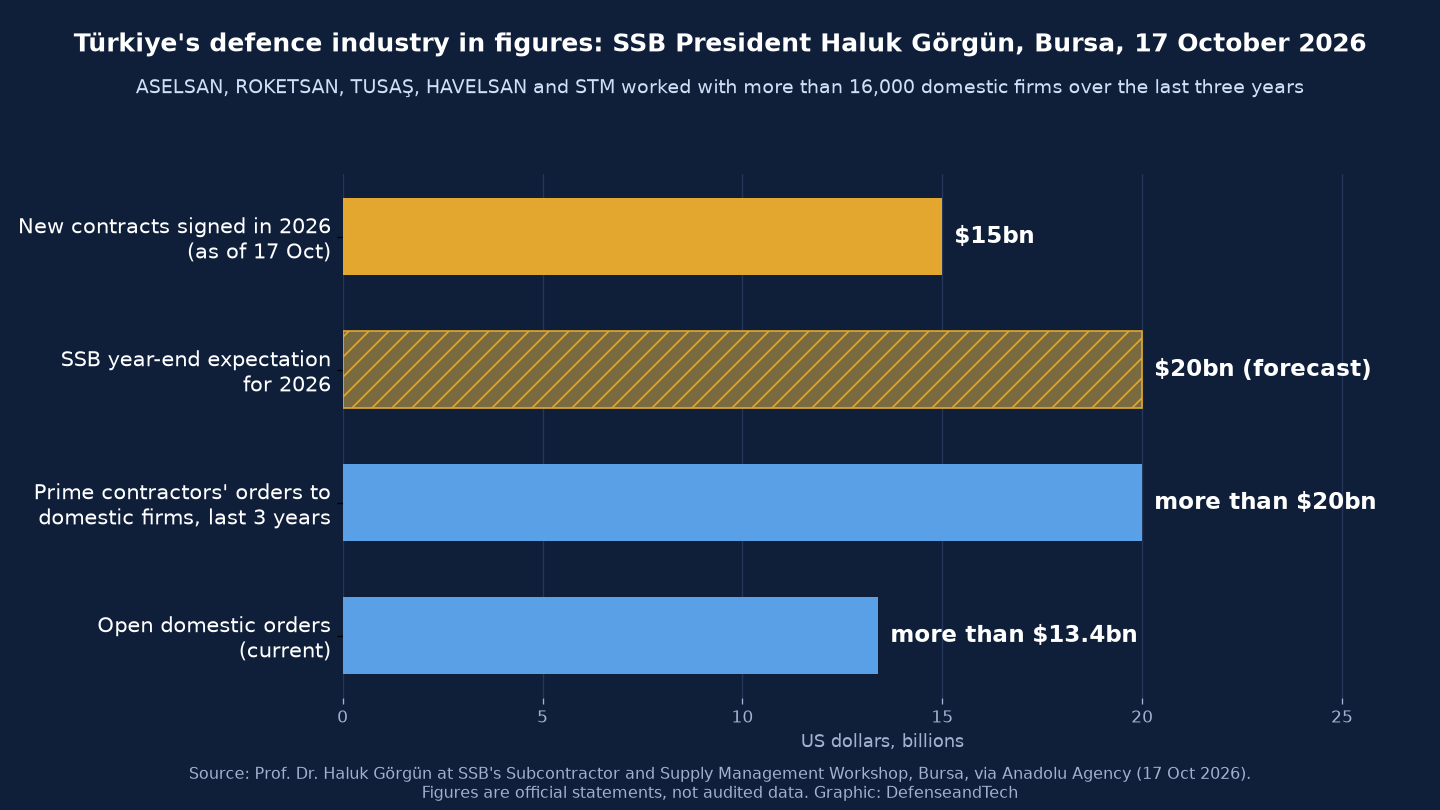
Turkish defence companies have signed new contracts worth $15 billion so far in 2026, and the Presidency of Defence Industries (SSB) expects the figure to reach $20 billion by the end of the year, SSB President Prof. Dr. Haluk Görgün said in Bursa on 17 October. He gave the numbers at an SSB workshop on subcontracting and supply management, Anadolu Agency reported, adding that open orders held by domestic suppliers now exceed $13.4 billion.
Last updated: 18 October 2026
- New contracts signed in 2026 (as of 17 October): $15 billion
- SSB expectation for the full year: $20 billion
- Orders placed by ASELSAN, ROKETSAN, TUSAŞ, HAVELSAN and STM with domestic firms over the last three years: more than $20 billion, spread across more than 16,000 companies
- Open domestic orders today: more than $13.4 billion
- Not disclosed: how the $15 billion splits between domestic procurement and export contracts
What did Haluk Görgün say in Bursa?
Görgün used the workshop to give an update on the orders moving through Türkiye’s defence supply chain. According to Anadolu Agency, he said $15 billion of new contracts had been signed with companies in the sector during 2026. “We expect this figure to reach $20 billion by the end of the year,” he said, as quoted by the local daily Bursa Hakimiyet.
He also put numbers on the role of the five largest prime contractors. ASELSAN, ROKETSAN, TUSAŞ (Turkish Aerospace), HAVELSAN and STM have worked with more than 16,000 domestic companies over the past three years and placed orders worth more than $20 billion with them. “Today, open orders in the domestic market exceed $13.4 billion,” Görgün said.
On exports, he said the sector’s growth was clearly ahead of the growth in Türkiye’s exports overall, and that the value per kilogram of defence exports was 40 times the national average.
These are official statements made at a public event, and SSB has not published a breakdown. The reported remarks do not say how much of the $15 billion is procurement for the Turkish Armed Forces and how much comes from export deals, so the figure should not be added to, or compared directly with, annual export totals.
What is the Bursa supply-chain workshop?
The meeting is the second edition of an SSB event that brings prime contractors together with their subcontractors and small and medium-sized suppliers. It began on 16 October and runs until 18 October. According to the Hibya news agency, 209 companies are taking part and around 1,000 one-to-one business meetings are planned. Görgün said proposals from the first meeting had been turned into a roadmap under SSB coordination, covering skills, financing, exports, contracts and payment processes, and that the closing declaration of this edition would feed into a new strategic roadmap.
SSB’s own account of the first full day lists sessions on production capacity, the supply chain and the development of domestic capabilities. In the evening, Görgün presented awards to companies in 17 categories, from exports and R&D to product development and SSB’s supplier competence programme, EYDEP, he wrote on X. In an earlier post he thanked the Bursa Chamber of Commerce and Industry (BTSO), BASDEC and the prime contractors for hosting the event.
Why open orders matter
An open order is work that has been contracted but not yet delivered. A domestic backlog of more than $13.4 billion shows how much of Türkiye’s current defence output depends on second- and third-tier suppliers: machined parts, electronics, cabling and subassemblies that end up in radars, missiles, aircraft and ships. It is also why capacity, financing and payment times were on the agenda in Bursa rather than new products.
Recent contracts behind the numbers
SSB does not itemise the $15 billion, but its weekly bulletin for the week to 12 October gives a sense of the pace. It listed:
- contracts between SSB and ASELSAN worth €2.46 billion for hybrid air defence systems;
- a $195 million SSB contract with ASELSAN for radar systems;
- an ASELSAN export contract worth $125 million for weapon and electronic warfare systems, with an unnamed foreign end user;
- the HÜRSAT-2 project contract between TUSAŞ and ROKETSAN, signed at the 77th International Astronautical Congress with SSB as witness.
The bulletin gave no delivery dates. For the systems involved, see our guides to Türkiye’s air defence systems and Turkish electronic warfare systems.
Industry context
The figures follow the 2027 budget proposal, in which Vice President Cevdet Yılmaz said allocations for weapons, ammunition and other defence equipment in the National Defence Ministry’s budget would rise by 229%, as we reported in our 2027 defence budget story. Yılmaz also put Türkiye’s defence and aerospace exports at $10.05 billion in 2025, according to Anadolu Agency. Contracts signed, deliveries made and exports recorded are different measures, and a contract signed this year can take several years to deliver.
For Turkish industry, the more telling figure may be the 16,000 domestic firms. Some flagship programmes still depend on imported subsystems, such as the General Electric F110 engines that power early KAAN fighters until a domestic engine is ready. SSB’s stated aim in Bursa was to build a subcontractor base that develops critical subsystems and competes abroad under its own brands. Our overview of Türkiye’s drone fleet shows how much of that output now goes into unmanned systems.
Frequently asked questions
How much did Turkish defence companies sign in new contracts in 2026?
$15 billion as of 17 October 2026, according to SSB President Haluk Görgün. SSB expects the total to reach $20 billion by the end of the year.
Does the $15 billion include exports?
The reported remarks do not say. SSB has not published a breakdown between domestic procurement and export contracts.
What are open domestic orders?
Work contracted to Turkish suppliers but not yet delivered. Görgün put the current total at more than $13.4 billion.
Which companies are Türkiye’s main defence prime contractors?
Görgün named ASELSAN, ROKETSAN, TUSAŞ, HAVELSAN and STM, which together worked with more than 16,000 domestic firms over the last three years.
Sources
- Anadolu Agency: Savunma ve havacılık sanayisi 2026’da 15 milyar dolarlık yeni iş aldı (17 Oct 2026, in Turkish)
- Bursa Hakimiyet: Görgün: Firmalarımız 2026’da 15 milyar dolarlık yeni sözleşme imzaladı (in Turkish)
- Hibya News Agency: SSB holds second supply-chain meeting (17 Oct 2026, in Turkish)
- SSB on X: Bursa workshop, 17 Oct 2026
- Haluk Görgün on X: workshop opening and award ceremony, 17 Oct 2026
- SSB: Türk Savunma Sanayiinde Bu Hafta Neler Oldu? (week to 12 Oct 2026)
- Anadolu Agency: Türkiye raises defense equipment procurement by 229% in 2027 (16 Oct 2026)