Pakistan Tests Extended-Range Fatah-2 Missile After Reported Combat Setback
Lead
Pakistan’s Army Rocket Force Command (ARFC) test-fired an extended-range variant of the Fatah-2 guided missile on October 13, 2026, the service’s second missile test in a single week and its fourth publicly disclosed missile launch of the year. The military’s media wing, Inter-Services Public Relations (ISPR), described the new “Fatah-2 ER” as a hypersonic ballistic missile with upgraded navigation and avionics intended to defeat missile-defense systems, but it disclosed no range, speed, or payload figures. The test follows the reported failure of a Fatah-series missile fired toward Delhi during the brief but intense India-Pakistan clash of May 2025, a context that gives the quiet technical announcement outsized strategic weight even though ISPR itself made no reference to that episode.
What Happened
ISPR announced on October 13, 2026, that the ARFC had successfully test-launched the Fatah-2 ER. The statement said the missile carries “advanced navigation” and “state-of-the-art avionics” that let it strike targets with precision while maneuvering to defeat enemy missile-defense systems, and that it extends the Army’s reach against deep targets. ISPR did not disclose the missile’s maximum range, flight profile, payload, or propulsion details, nor did it name who attended the launch or where it took place, according to Janes.
The launch came exactly a week after an October 6 test of an extended-range Fatah-4 ground-launched cruise missile and followed an April 28, 2026 training launch of the baseline Fatah-2, according to Quwa, a defense-industry analysis site that tracks Pakistani missile testing. Quwa counts the October 13 launch as the ARFC’s fourth publicly announced missile test of 2026, on top of at least seven overland airspace-warning notices (NOTAMs) Pakistan has issued this year that likely cover additional, undisclosed tests.
The Product/System
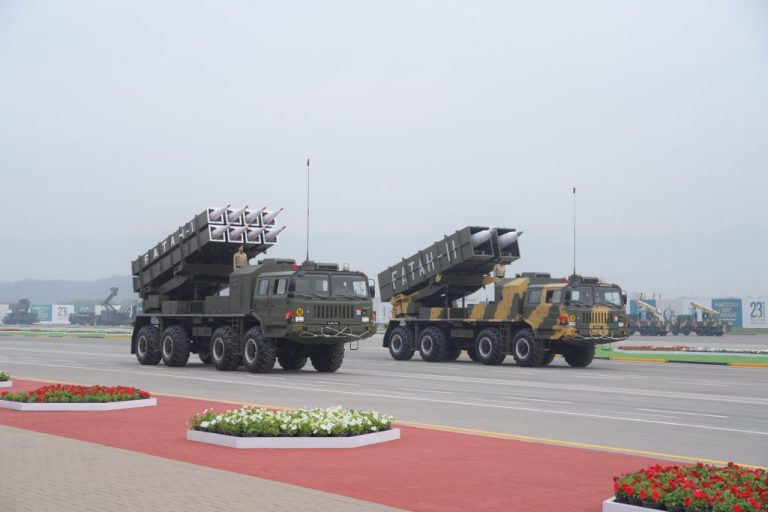
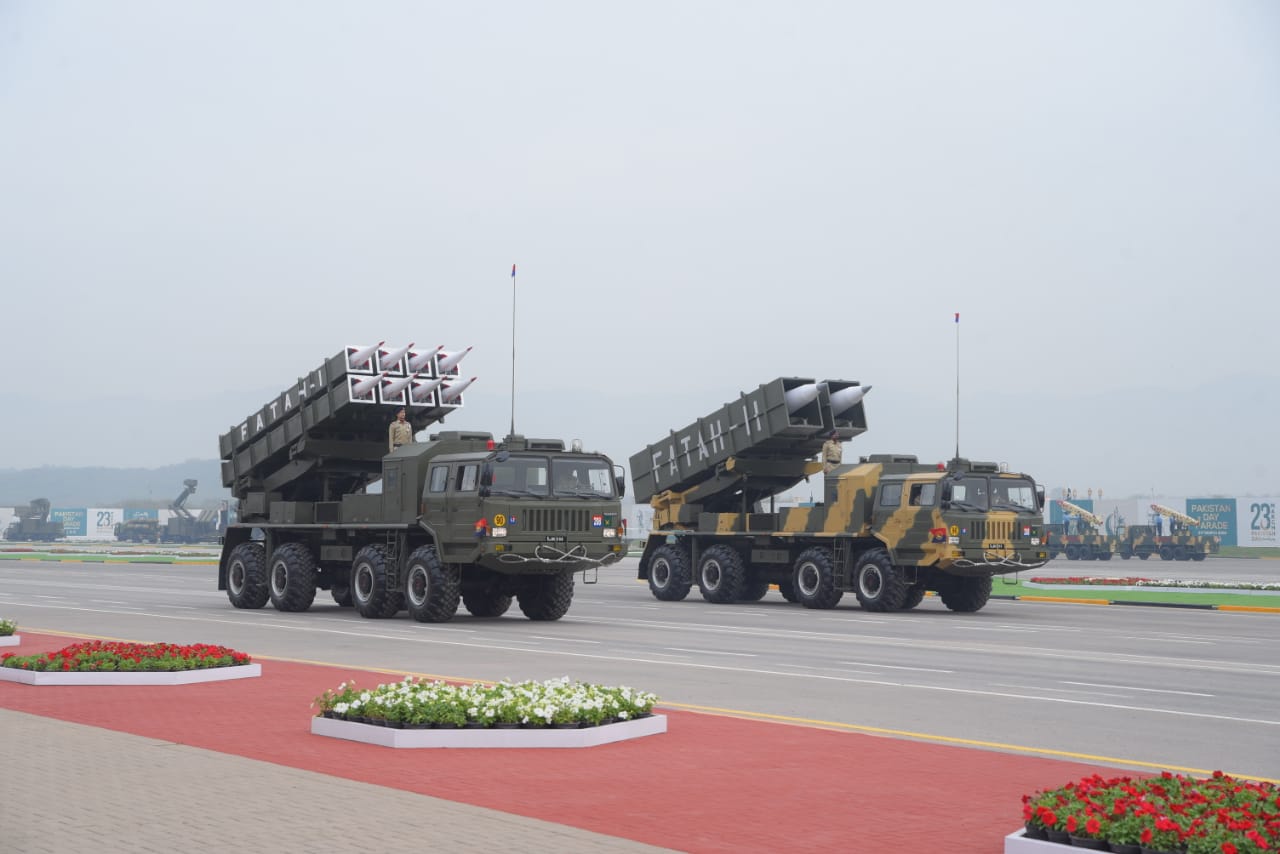
The Fatah-2 is a short-range, precision-guided ballistic missile developed by Pakistan’s state-owned National Engineering and Scientific Commission (NESCOM), with Khan Research Laboratories also credited in some reporting, and marketed for export by Global Industrial Defence Solutions (GIDS). ISPR’s previously disclosed figures for the baseline missile put its range at 400 km (280 km in the export configuration), with a 7.5-meter length, 600 mm diameter, a 365 kg warhead, a dual-thrust single-stage rocket motor, and a claimed circular error probable (accuracy) of 50 meters or less, per Janes and Quwa. It uses inertial navigation combined with satellite guidance.
Quwa’s analysis of footage from the October 13 test suggests the ER variant is longer than the baseline while retaining the same 600 mm diameter, consistent with added fuel volume to extend range — a change that would need a more efficient motor or improved propellant to avoid simply making the missile heavier without a proportional range gain. Pakistan has not confirmed the extended range figure.
The Fatah-2 is fielded by the Army Rocket Force Command, a unit Pakistan announced in August 2025 to consolidate conventional, non-nuclear missile forces separately from the Army’s nuclear-capable Strategic Forces Command, which remains under the National Command Authority. Analysts have described the ARFC’s creation as part of a push to build up conventional deterrence and precision-strike depth following the May 2025 conflict with India.
Who Uses It
The Fatah-2, in both its baseline and ER forms, is operated exclusively by Pakistan’s Army Rocket Force Command. No foreign operator has been confirmed. GIDS has promoted an export-configured Fatah-2 with a reduced 280 km range, but no sale has been publicly reported.
Export/Procurement History
Pakistan has not announced any export contract for the Fatah-2 or Fatah-2 ER. The missile remains, for now, a domestic Army Rocket Force Command asset, tested through a mix of announced training launches and unannounced trials inferred from airspace-warning notices. The ER designation itself has appeared only since mid-2026, first for the Fatah-4 cruise missile on October 6 and now for the Fatah-2 ballistic missile on October 13, suggesting a program of incremental range and survivability upgrades across the family rather than a single new weapon.
Global Competitors
In the short-range precision-strike category, the Fatah-2 competes conceptually with systems such as India’s Pralay quasi-ballistic missile and the Indian Army’s Prithvi and BrahMos-derived land-attack options, as well as China’s export-oriented short-range ballistic missiles. None of these comparisons are official; Pakistan has not positioned the Fatah-2 against any specific foreign system, and independent range and accuracy data for the ER variant does not yet exist for a rigorous side-by-side assessment.
Why It Matters
The announcement’s significance lies less in any single test than in its pairing with unresolved questions from the May 2025 India-Pakistan conflict. Indian officials and media reported at the time that a Pakistani missile aimed toward the Delhi region was intercepted over Sirsa, Haryana, roughly 220-250 km from the capital; Indian outlets have since split on whether the missile involved was a Fatah-1 or a Fatah-2, and a widely circulated video claimed to show the interception was later debunked by fact-checkers as unrelated footage from the Israel-Yemen conflict, according to BOOM Live. Pakistan has not confirmed any missile was intercepted. Treated cautiously, the episode nonetheless forms the backdrop against which ISPR’s emphasis on the Fatah-2 ER’s ability to “defeat missile defence systems” reads as a direct response to a reported operational shortfall rather than a routine capability upgrade.
The timing also reflects a broader pattern: the ARFC has tested a missile roughly once a month through the second half of 2026, a cadence consistent with a force still validating subsystems and building institutional experience rather than one approaching full operational fielding. For India, the development reinforces the case for layered terminal air defense — systems such as the S-400, Akash-NG, and Barak-8 MR-SAM that Indian sources credited with the 2025 interception — remaining central to countering Pakistan’s growing inventory of short-range precision-strike missiles.
What Happens Next
Neither ISPR nor NESCOM has indicated when the Fatah-2 ER might be declared operational or how many further tests are planned. Given the pace of 2026 testing and Pakistan’s pattern of unannounced trials flagged only through NOTAMs, additional Fatah-family launches are likely before year’s end. Confirmation of the ER variant’s actual range and whether it enters serial production with the Army Rocket Force Command will depend on future ISPR disclosures, which have so far been deliberately vague on performance figures for this system.
FAQ
What is the Fatah-2 ER missile?
It is an extended-range version of Pakistan’s Fatah-2 short-range guided ballistic missile, tested on October 13, 2026, with ISPR describing upgraded avionics and navigation intended to defeat missile defenses. Pakistan has not disclosed its range.
What is the range of the baseline Fatah-2?
ISPR has previously stated the baseline Fatah-2 has a range of 400 km, with a 280 km export variant marketed by Global Industrial Defence Solutions (GIDS).
Is the Fatah-2 really a hypersonic missile?
ISPR has described it as hypersonic, but Pakistan has not released speed, altitude, or trajectory data to independently verify that classification. Most short-range ballistic missiles reach hypersonic speeds (above Mach 5) during their terminal descent regardless of specialized design, so the label alone does not establish an unusual capability.
Did a Fatah missile reach New Delhi in 2025?
Indian officials said a missile aimed toward the Delhi region was intercepted over Sirsa, Haryana during the May 2025 conflict; Indian sources differ on whether it was a Fatah-1 or Fatah-2, and Pakistan has not confirmed the incident. A viral video purporting to show the interception has been debunked as unrelated footage.
What is the Army Rocket Force Command?
It is a Pakistan Army unit established in August 2025 to operate conventional, non-nuclear missile systems like the Fatah series, distinct from Pakistan’s nuclear-capable Strategic Forces Command.
Sources
- Janes, “Pakistan test launches extended-range hypersonic Fatah-II missile,” October 15, 2026 — primary technical details and ISPR statement. Link
- Quwa, “Pakistan Tests Fatah-2 Extended-Range Ballistic Missile,” October 2026 — testing history, footage analysis, ARFC context. Link
- Arab News Pakistan, “Pakistan successfully test-fires Fatah-2 extended-range hypersonic missile,” October 13, 2026 — ISPR statement coverage. Link
- Radio Pakistan, “Pakistan successfully test-launches Fatah-4 cruise missile,” October 6, 2026 — prior test in the same sequence. Link
- BOOM Live, “Old video from Israel falsely linked to Fateh-2 missile destruction in Sirsa” — fact-check on the May 2025 interception video. Link
Internal reading: What Missiles Does India Have? Agni, BrahMos, Pralay and More | How Strong Is India’s Military in 2026? | Russia’s Air Defense Systems: S-300, S-400, S-500 and More