
Hanwha Systems, the Electronics Brain of Korea’s Arms Boom
Hanwha Systems is the electronics brain of South Korea’s defense boom, the developer of the KF-21 fighter’s AESA radar, with reported annual revenue around 2.8 trillion won and a product line running from naval combat systems to satellite communications. Less famous than its artillery-making sibling, it supplies the sensors and networks that make Korean platforms exportable.
Hanwha Systems at a glance
| Item | Detail |
|---|---|
| Full name | Hanwha Systems Co., Ltd. |
| Headquarters | Seoul, South Korea |
| Origins | Samsung defense electronics; Samsung Thales JV from 2001 |
| Ownership | Hanwha Aerospace is the leading shareholder; listed on KOSPI since 2019 |
| Employees | Roughly 5,000 |
| Revenue | Around 2.8 trillion won reported recently |
| Main fields | Radar and EO sensors, naval combat systems, tactical networks, avionics, space and ICT |
From Samsung Thales to Hanwha Systems
The company descends from Samsung’s defense electronics arm, which became a joint venture with France’s Thales in 2001. When Samsung sold its defense businesses to Hanwha in 2015, the JV followed, becoming Hanwha Thales and then, after Thales exited, Hanwha Systems. A 2018 merger with the group’s ICT affiliate added a commercial IT business, and a 2019 stock market listing gave it independent capital. The heritage matters, three decades of license production and joint development with Western suppliers built the radar and combat-system competence it now sells under its own name.
Within the group’s division of labor, Hanwha Aerospace builds the platforms and engines while Hanwha Systems supplies their eyes and nervous system, a pairing that turns up in nearly every Korean export deal.
What Hanwha Systems builds
| Line | Flagship work |
|---|---|
| Airborne radar | KF-21 AESA fire-control radar, developed with the ADD |
| Naval systems | Combat management systems for Korean destroyers, frigates and submarines |
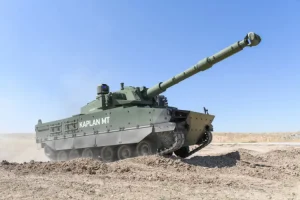
| Land systems electronics | Fire control and sensors for K21, Redback and artillery programs |
| Tactical networks | TICN, the Korean army’s battlefield communications backbone |
| Electro-optics | Targeting and surveillance sensors, IRST work |
| Space and ICT | Satellite communications, SAR satellite development, enterprise IT |
The KF-21 radar and sensors
The company’s signature achievement is the KF-21 Boramae’s AESA radar, developed with the Agency for Defense Development after the US refused to transfer the technology. Flying since the prototype’s 2022 first flight and now in serial production for the initial fighter batch, it moved South Korea into the small club of nations building fighter-class AESA radars, the technology explained in our AESA radar guide. Hanwha Systems also supplies the jet’s IRST and targeting electronics, and the radar’s maturation is central to the export case examined in our KF-21 vs KAAN comparison.
Naval electronics are the quieter strength. Korean combat management systems, fielded across dozens of hulls, keep domestic content high on the destroyers and submarines Korea now offers abroad, in friendly rivalry with fellow Korean electronics house LIG Nex1.
Satellites and new businesses
Hanwha Systems has spent aggressively to escape the domestic defense ceiling. It put about $300 million into the OneWeb low-Earth-orbit constellation, invested in antenna maker Kymeta, and develops small SAR satellites for Korean reconnaissance programs. An urban air mobility bet through US-based Overair was wound down as that market cooled, a reminder that not every diversification lands. The through-line is connectivity, the company wants to own the links between Korean sensors, shooters and satellites, the layer where future margins live.
The export outlook tracks the group’s platform wins. Every K9 battery, Redback vehicle, Korean frigate or KF-21 sold abroad carries Hanwha Systems content, from fire control to combat management, so the company’s order book compounds quietly on the back of deals announced under other names. Management has also pushed maintenance, training and software upgrades as recurring revenue, the part of defense electronics that keeps paying decades after the platform contract closes.
Hanwha Systems frequently asked questions
What does Hanwha Systems make?
Military radars including the KF-21’s AESA, naval combat management systems, tactical networks, electro-optics, avionics and satellite communications, plus commercial IT.
Is Hanwha Systems the same as Hanwha Aerospace?
No. Hanwha Aerospace builds platforms and engines and is the leading shareholder of Hanwha Systems, the group’s defense electronics and ICT company.
Who developed the KF-21 radar?
Hanwha Systems together with South Korea’s Agency for Defense Development, after a US technology transfer refusal forced a domestic path.
How big is Hanwha Systems?
Roughly 5,000 employees and reported revenue around 2.8 trillion won, above $2 billion.
Why did Hanwha Systems invest in OneWeb?
To secure a position in low-Earth-orbit connectivity for both defense networking and commercial satellite communications.
- Public company data and KOSPI disclosures (accessed October 2026)
- Wikipedia – Hanwha Systems (accessed October 2026)
- Program reporting on the KF-21 AESA radar and ADD partnership
- Defence & Tech reporting on the Korean defense industry