

F-47 vs J-20: America’s Next Fighter Against China’s Stealth Jet
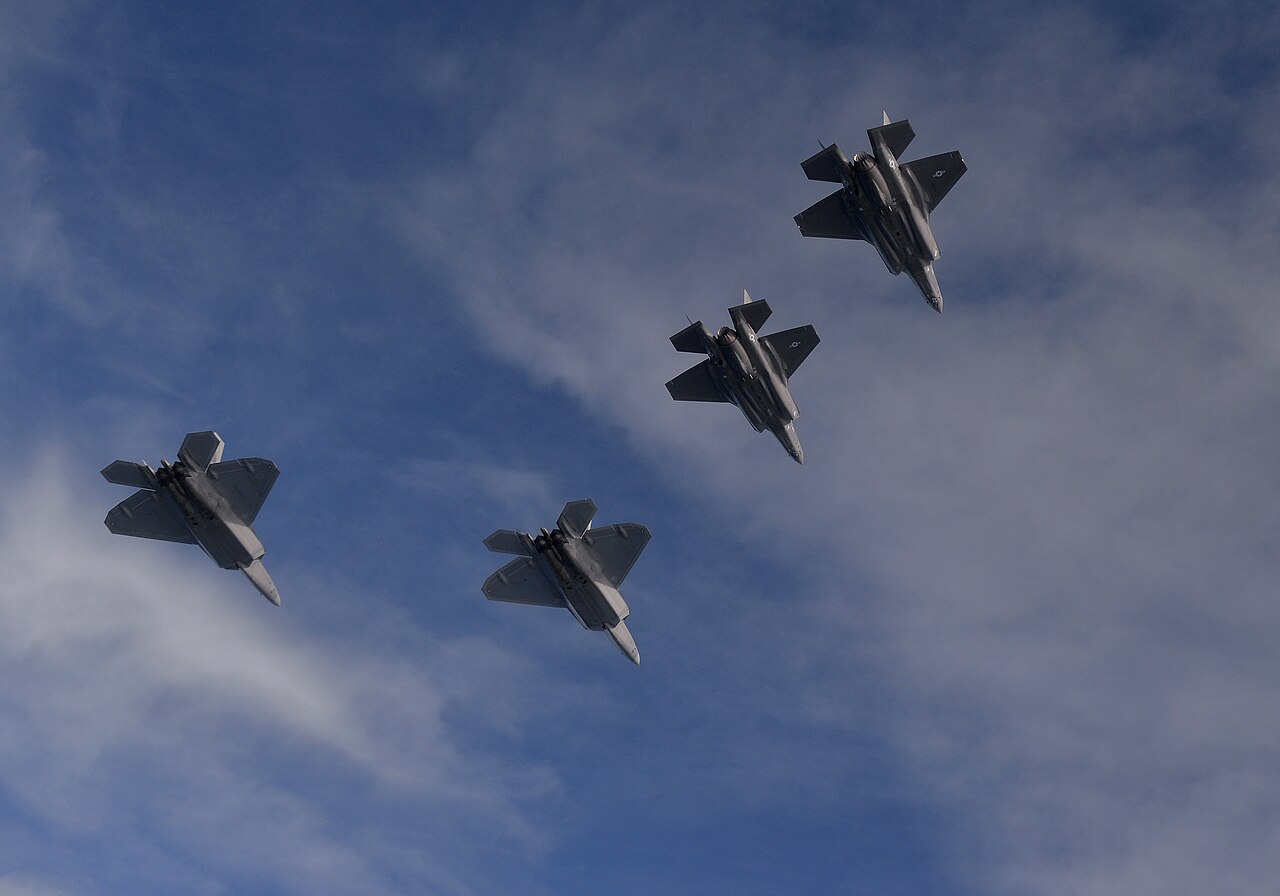
The J-20 is the fighter the F-47 is most likely to meet in combat, because by the time the American jet reaches squadrons China may have close to a thousand of them. On paper the F-47 is a generation ahead: longer-ranged, harder to detect and designed to command drones. In practice it does not yet exist as a flying aircraft, while the J-20 has been in service since 2017.
This comparison uses the published American figures and open-source estimates for the Chinese aircraft, and it treats the question of numbers as seriously as the question of technology.
The short answer
If the F-47 meets its stated goals, it should hold a clear technical advantage over the J-20 in stealth, range and the ability to fight as part of a team with uncrewed aircraft. The J-20 holds the advantages of existing, of being built at an estimated 100 to 120 a year, and of fighting close to home.
A fair summary is that the F-47 is designed to beat the J-20 one against one, and that the United States does not plan to buy enough of them to make that the deciding factor.
F-47 and J-20 side by side
| F-47 | J-20 | |
|---|---|---|
| Generation | Sixth | Fifth |
| Maker | Boeing | Chengdu Aircraft Corporation |
| First flight | 2028 (planned) | 2011 |
| In service | About 2030 (goal) | Since 2017 |
| Built | None yet | 300 to 500 (est.) |
| Combat radius | 1,000+ nm stated | 650 to 1,100 nm (est.) |
| Top speed | Mach 2+ | About Mach 2 (est.) |
| Layout | No vertical tails shown | Canards and twin tails |
| Engines | Adaptive NGAP | Two WS-10C; WS-15 on the J-20A |
| Internal air-to-air load | Not disclosed | Four PL-15 and two PL-10 |
| Drone teaming | Designed in | Two-seat J-20S variant |
See what the F-47 is for the American figures and our profile of the J-20 Mighty Dragon for the Chinese aircraft.
Where the F-47 should be ahead
Stealth is the clearest gap. The J-20 is well shaped from the front but has canards, twin tail fins and, on most aircraft, round engine nozzles, all of which make it easier to detect from the side and rear and by low-frequency radar. The F-47 is described as low-observable from every direction and across more frequencies, as we explain in F-47 stealth explained.
Range is the second. Estimates for the J-20’s combat radius vary widely, but the upper end is close to the F-47’s stated 1,000 nautical miles. The J-20 achieves that by being very large. The F-47 is expected to do it with adaptive engines that also provide cooling for more powerful sensors.
The third is teaming. The F-47 is built to direct Collaborative Combat Aircraft. China is working on the same idea: the two-seat J-20S, shown publicly in 2025, is widely thought to be intended for controlling drones.
The numbers problem
China does not publish J-20 totals. The researcher Andreas Rupprecht identified about 300 by autumn 2025 and suggested the fleet could approach 500 by mid-2026. The British think-tank RUSI put production at about 120 a year, and some analysts project around 1,000 by 2030.
The Air Force plans at least 185 F-47s, as set out in how many F-47s will be built, and production will not begin in earnest until after 2028. Even with the F-22 and F-35 added, an American general has warned that China could have a five-to-three advantage in fifth-generation fighters in the western Pacific by 2027.
Quality offsets quantity only up to a point. An aircraft can be in one place at a time, carries a limited number of missiles and has to return to a base that may itself be under attack.
Missiles may matter more than airframes
The J-20’s main weapon, the PL-15, is estimated to reach about 200 kilometres, and the larger PL-17 is believed to reach much further against big targets such as tankers. The American answer is the AIM-260, which is entering service now and is the likely main weapon of the F-47, as we discuss in what weapons the F-47 will carry.
In a long-range fight the side that detects first and has the longer-ranged missile usually wins. That is why stealth, sensors and missile range are treated as one problem, and why neither air force has published the figures that would settle it.
So which is better?
By design, the F-47, by a generation. By availability, the J-20, by more than a decade. The F-47’s real competitors are China’s newer prototypes, which we compare in F-47 vs J-36. Against the J-20 the question is less whether the American aircraft is better than whether there will be enough of them, with enough drones, in the right place.
Frequently asked questions
Is the F-47 better than the J-20?
It is designed to be, with greater stealth and range and the ability to control drones. It has not flown yet, while the J-20 has been in service since 2017.
How many J-20s does China have?
China does not say. Open-source estimates range from about 300 to roughly 500, with production put at around 100 to 120 a year.
Is the J-20 a sixth-generation fighter?
No. It is a fifth-generation fighter, comparable in generation to the F-22 and F-35.
Which has the longer range, the F-47 or the J-20?
The F-47’s stated combat radius is more than 1,000 nautical miles. Estimates for the J-20 range from about 650 to 1,100 nautical miles.
Can the J-20 control drones?
China has shown a two-seat version, the J-20S, which analysts believe is intended to direct uncrewed aircraft. This has not been officially confirmed.
Will the F-47 outnumber the J-20?
No. The Air Force plans at least 185 F-47s, while China already has several hundred J-20s and is building more each year.
- The War Zone – How Many J-20 Stealth Fighters Does China Actually Have?: twz.com
- CSIS ChinaPower – Does China’s J-20 Rival Other Stealth Fighters?: chinapower.csis.org
- MiGFlug – China’s J-20 and J-35 production numbers to 2030: migflug.com
- The War Zone – First F-47 6th Generation Fighter Now Being Built: twz.com