
F-35 Helmet: What the $400,000 Display Does
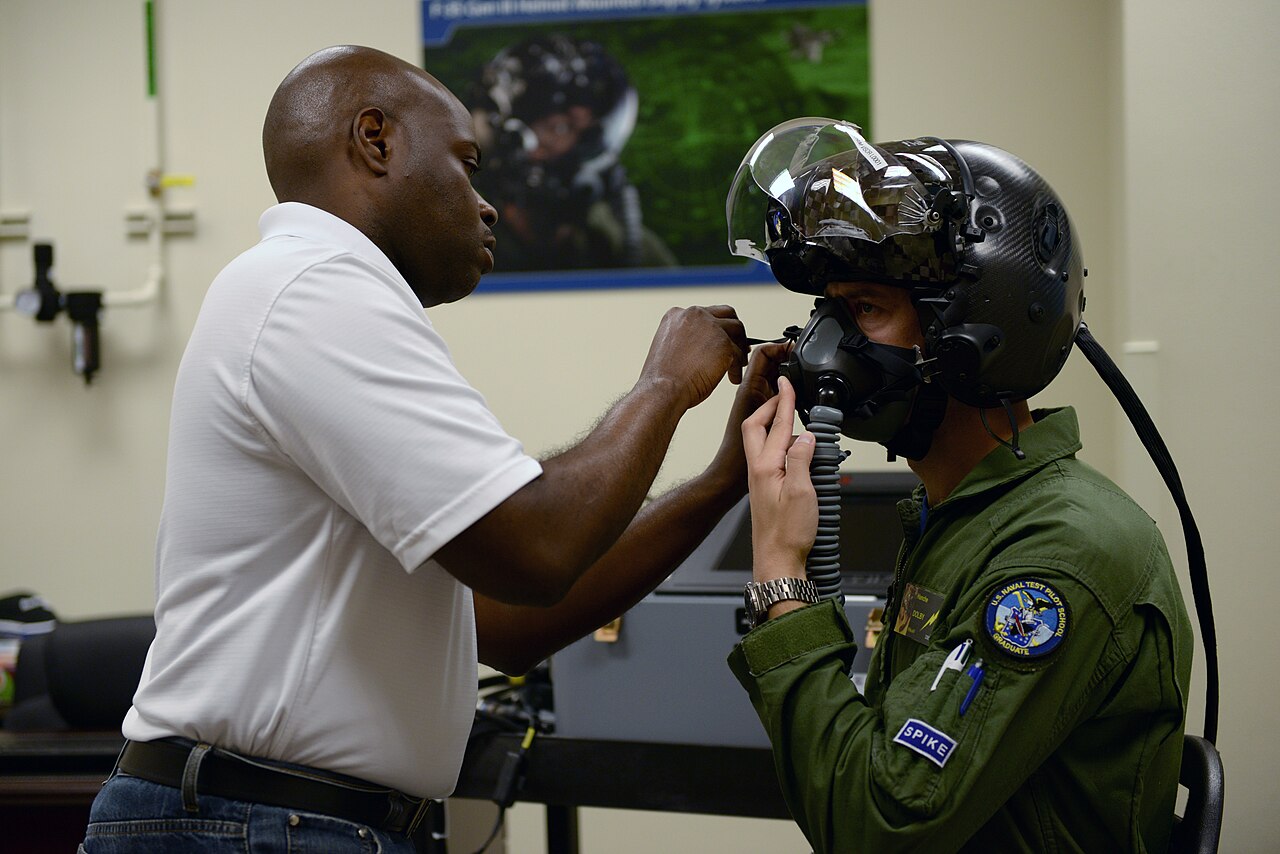
The F-35 helmet costs about $400,000 and is the pilot’s main flight display, projecting speed, altitude, targets and night-vision imagery onto the visor. The F-35 has no head-up display on the cockpit coaming, so the jet cannot be flown in combat without it.
It is made by a joint venture of Collins Aerospace and Elbit Systems of America and is built to fit one pilot’s head. The third-generation version in service today fixed most of the faults that dogged earlier models. This guide explains what the F-35 helmet does, how it is fitted and where it has had trouble.
What does the F-35 helmet do?
Its formal name is the Generation III Helmet Mounted Display System. Two small projectors throw an image onto the inside of the visor, one for each eye. The pilot sees flight data, navigation cues, radar and infrared tracks and weapon symbols laid over the outside world, wherever the head is turned.
That replaces the fixed head-up display found in every earlier fighter. In those jets the pilot had to point the nose roughly at a target to see aiming symbols. In the F-35 the pilot can look over a shoulder, see a target marked on the visor and cue a missile to it.
| Item | Detail |
|---|---|
| Name | Generation III Helmet Mounted Display System |
| Maker | Collins Elbit Vision Systems, a Collins Aerospace and Elbit Systems of America venture |
| Cost | About $400,000 |
| Weight | About 5 lb (2.3 kg) |
| Display | Binocular, 30 by 40 degree field of view, projected on the visor |
| Night vision | Built in, shown on the visor |
| Shell | Carbon fibre with a custom-milled liner |
How does the helmet let pilots see through the aircraft?
Six infrared cameras are mounted around the airframe. Together they cover the full sphere around the jet. A tracker in the cockpit measures where the helmet is pointing, and the computer sends the matching part of the camera picture to the visor.
The effect is that when pilots look down they see the ground below instead of the cockpit floor. It is most useful at night and for the F-35B’s vertical landings, when the pilot needs to see the deck beneath the aircraft. The same cameras warn of missile launches and track other aircraft. The radar side of the picture is covered in F-35 radar.
How is the F-35 helmet fitted?
Each helmet is made for one person. Technicians scan the pilot’s head in three dimensions and cut a foam liner to match. They measure the distance between the pupils and from each eye to the visor, because the two projected images must line up to within about two millimetres for the pilot to see a single picture.
The first fitting takes two sessions. Pilots return for a fit check every 120 days, and a significant change in weight or even a new haircut can mean adjustment. The fit data is stored so that a replacement can be made without starting again.
What problems has the helmet had?
Enough that the Pentagon paid BAE Systems to develop a fallback helmet in 2011. It dropped that effort in 2013 once the main design improved. The faults and fixes are below.
| Problem | Effect | Fix |
|---|---|---|
| Image lag | Picture trailed behind head movement | Faster processing and a hybrid optical, magnetic and inertial tracker |
| Jitter | Symbols shook in turbulence and high-g turns | Inertial sensors added to steady the image |
| Green glow | Display backlight washed out the view on dark nights, worst in carrier landings | LCD replaced with OLED displays |
| Weight | Raised the risk of neck injury in an ejection for light pilots | Lighter helmet and ejection seat changes; weight restriction lifted in 2017 |
The weight problem was the most serious. In 2015 the US services barred pilots weighing less than 136 lb from flying the F-35 after tests showed the helmet could snap the neck of a light pilot during ejection. A lighter helmet, a head support panel and a switch that delays the parachute for lighter pilots allowed the ban to be removed.
Why does the helmet cost $400,000?
Because it is a display system, a night-vision device and a targeting sight in one, built in small numbers and fitted individually. It also removes equipment from the aircraft: there is no head-up display and no need for separate night-vision goggles.
Set against the price of the jet it is a small item. The helmet is about 0.4% of the cost of an F-35A, as set out in how much an F-35 costs. An overview of the aircraft is in what the F-35 is.
Frequently asked questions
How much does an F-35 helmet cost?
About $400,000 each.
Who makes the F-35 helmet?
Collins Elbit Vision Systems, a joint venture of Collins Aerospace and Elbit Systems of America.
Can F-35 pilots really see through the plane?
In effect, yes. Six cameras around the airframe feed the visor, so the pilot sees the camera view of whatever lies in the direction the head is turned.
Does the F-35 have a head-up display?
No. The helmet’s visor display replaces it.
How much does the F-35 helmet weigh?
About 5 lb, or 2.3 kg, for the Generation III version.
Can an F-35 pilot use someone else’s helmet?
Not properly. Each helmet is fitted to one pilot’s head and eye spacing.
- Aviation Today – The F-35 helmet (August 2018): aviationtoday.com
- New Atlas – F-35 Lightning Gen 3 HMDS helmet (June 2024): newatlas.com
- Defence Industry Europe – US plans major F-35 weapons expansion (F-35 Modernized Selected Acquisition Report): defence-industry.eu
- Wikipedia – Lockheed Martin F-35 Lightning II: en.wikipedia.org