China’s Air Defense Systems: HQ-9, HQ-19, HQ-29 and S-400

China operates one of the largest and densest air and missile defence networks in the world. Its backbone is the long-range HQ-9 surface-to-air missile, supported by Russian S-400s, medium-range HQ-16 and HQ-22 systems, and a growing layer of ballistic missile defence led by the HQ-19. At the September 2025 Beijing parade China showed six ground-based air defence systems, including three never seen before: the HQ-20, the HQ-22A and the HQ-29, which Chinese media described as an “exoatmospheric” interceptor.
This guide sets out what each system does, how the layers fit together and how they compare with American defences.
What air defence systems does China have?
China’s ground-based air defences are run mainly by the PLA Air Force, which defends cities, bases and command centres, while the army has its own short-range systems to protect troops in the field. The Pentagon describes the result as one of the world’s largest forces of advanced long-range surface-to-air systems. The layers range from guns and short-range missiles against drones to interceptors meant to hit ballistic missiles in space.
| System | Type | Approx. range | Role |
|---|---|---|---|
| HQ-29 | Exoatmospheric interceptor | Space | Ballistic missile and possibly anti-satellite defence; shown 2025 |
| HQ-19 | Ballistic missile defence | Upper atmosphere and above | Intercepting medium- and intermediate-range missiles |
| HQ-9 / HQ-9B / HQ-9C | Long-range surface-to-air missile | 200 km+ | Aircraft, cruise missiles, some ballistic missiles |
| S-400 | Russian long-range system | Up to 400 km | Two regiments bought from Russia |
| HQ-22 / HQ-22A | Medium- to long-range missile | About 150-170 km | Cheaper complement to HQ-9 |
| HQ-16 | Medium-range missile | About 40-70 km | Army and navy air defence |
| HQ-17 / HQ-11 / HQ-20 | Short-range systems | Up to about 20-30 km | Protection against aircraft, missiles and drones |
| LY-1 and other lasers | Directed-energy weapons | Short | Counter-drone; shown at 2025 parade |
HQ-9: the backbone
The HQ-9 is China’s equivalent of the American Patriot and the Russian S-300, from which it borrowed some features. It entered service in the late 1990s and has been steadily upgraded: the HQ-9B extends the range beyond 200 kilometres, and the HQ-9C appeared in 2025. A naval version, the HHQ-9, arms the Type 052D and Type 055 destroyers described in our guide to Chinese warships. The HQ-9 has also been exported, as the FD-2000 or HQ-9/P, most notably to Pakistan. It is usually compared with the Patriot, though unlike Patriot it has never been tested in a war against modern ballistic missiles.
Ballistic missile defence: HQ-19 and HQ-29
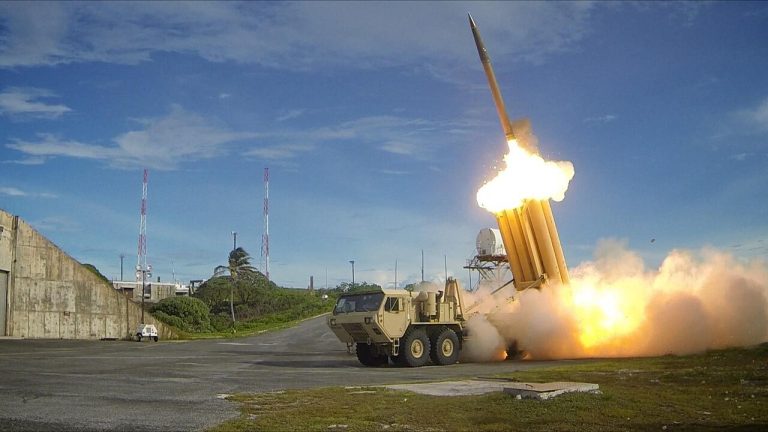
China has tested missile interceptors for more than 15 years, often announcing only that a “land-based mid-course interception test” had taken place. The HQ-19 is designed to hit medium- and intermediate-range ballistic missiles high in their flight, much like the American THAAD. The HQ-29, unveiled in 2025, is larger, and Western analysts believe it is meant to intercept missiles outside the atmosphere and could also be used against satellites in low orbit. China also has large phased-array radars and early-warning satellites that can detect a missile launch, which support both its defences and its nuclear forces. How these layers work is explained in our guide to missile defence layers.
The S-400 and Russian systems
China was the first foreign buyer of Russia’s S-400, receiving two regiments from 2018. Before that it bought large numbers of S-300 variants in the 1990s and 2000s. As its own systems have matured, China has stopped buying Russian air defences, and the S-400 is now one part of a network built mainly from Chinese equipment.
How does it compare with the United States?
China has more long-range air defence batteries than the United States, which has relied on its air force to keep enemy aircraft away and has far fewer Patriot batteries than it needs. In ballistic missile defence the United States is more experienced, with THAAD, Aegis and the national interceptors in Alaska and California. Britain’s much smaller network is covered in our guide to UK air defence, and the missiles China’s defences are meant to counter in our guide to Chinese missiles.
Frequently asked questions
What is China’s main air defence system?
The HQ-9 long-range surface-to-air missile, whose latest versions have a range of more than 200 kilometres.
Does China have missile defence?
Yes. The HQ-19 is designed to intercept medium- and intermediate-range ballistic missiles, and the new HQ-29 is believed to intercept missiles outside the atmosphere.
Does China have the S-400?
Yes. China bought two S-400 regiments from Russia and received them from 2018.
What is the HQ-29?
A large interceptor unveiled at the September 2025 parade and described by Chinese media as an exoatmospheric interception system, possibly also usable against satellites.
Is the HQ-9 better than Patriot?
They are broadly comparable on paper. Patriot has far more combat experience, including against ballistic missiles in Ukraine and the Middle East.
Which countries use Chinese air defence systems?
Pakistan is the main user of the HQ-9 and HQ-16 family, and several other countries have bought Chinese short- and medium-range systems.
- China Daily – Ground-based air-defense and anti-ballistic missile systems shine at V-Day parade (September 2025): chinadailyhk.com
- Defense One – China’s new missiles: parade showpieces or showstoppers? (September 2025): defenseone.com
- Breaking Defense – China’s parade shows off nuclear triad (September 2025): breakingdefense.com
- US Department of Defense – Military and Security Developments Involving the People’s Republic of China 2025: media.defense.gov