Archer vs CAESAR vs PzH 2000, Three Ways to Build a Howitzer
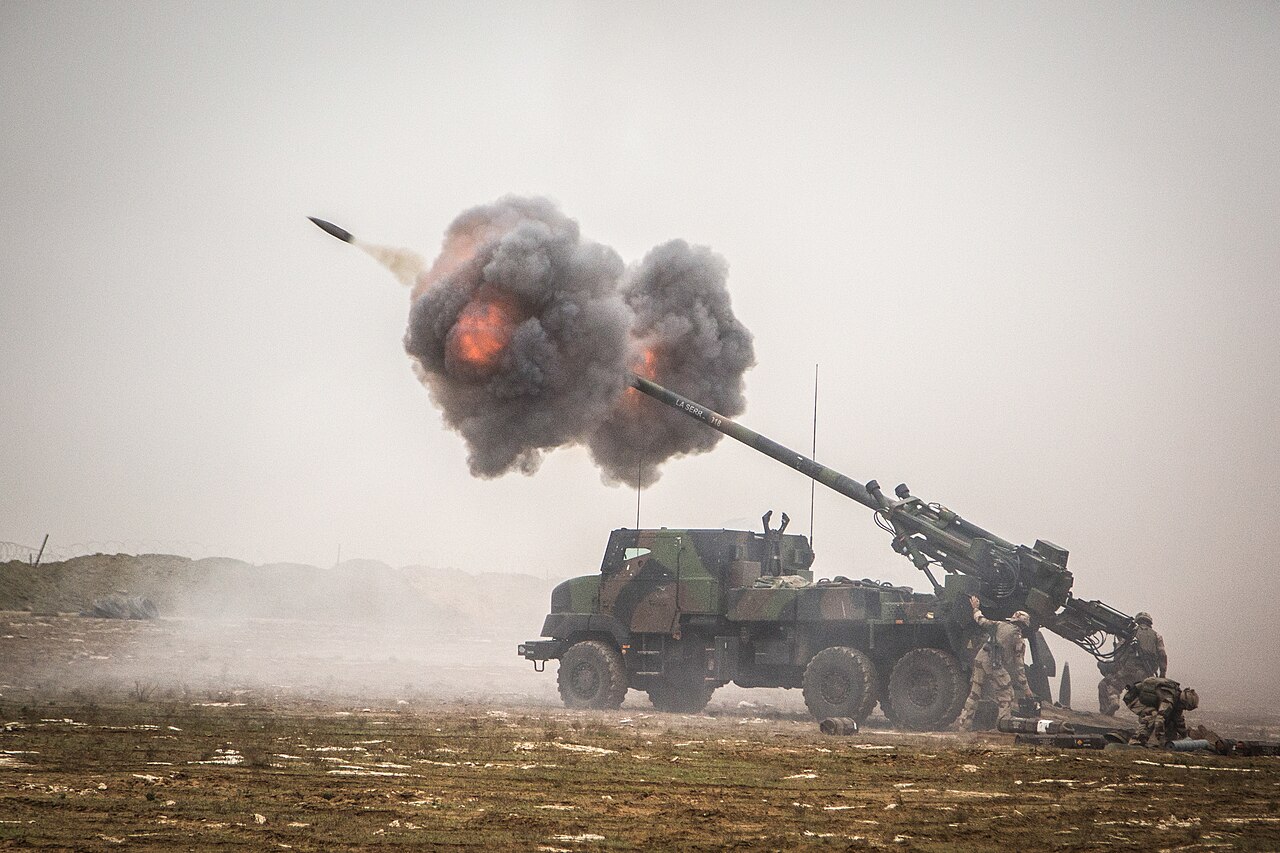
Archer, CAESAR and PzH 2000 are the three main Western answers to the same question, how to put a 155mm, 52-caliber gun where it survives, and all three have now been graded by Ukrainian crews in combat. One is a truck with an autoloader, one is a truck built light enough to fly, and one is a tracked fortress, and the right choice depends entirely on the war you expect.
Archer vs CAESAR vs PzH 2000 spec table
| Item | Archer | CAESAR | PzH 2000 |
|---|---|---|---|
| Country / maker | Sweden, BAE Systems Bofors | France, KNDS France (Nexter) | Germany, KNDS Deutschland and Rheinmetall |
| Chassis | Volvo A30 6×6 articulated hauler | Arquus 6×6 or Tatra 8×8 truck | Tracked armored hull |
| Weight | About 30-33 t | About 17.7 t (6×6), about 30 t (8×8) | About 55.8 t |
| Crew | 3-4, under armor in cab | 3-5, dismount to fire | 5, fully under armor |
| Onboard rounds | 21, fully autoloaded | 18, semi-automatic loading | 60, automated magazine |
| Burst / rate | 3 rounds in well under a minute, magazine dump possible | About 6 rounds per minute | 3 rounds in about 9 seconds, up to 10 per minute |
| Range | Roughly 40 km base bleed, 50+ km with precision rounds | Roughly 40 km base bleed, more with assisted rounds | Roughly 36 km base bleed, 40+ km reported with special rounds |
| Into / out of action | Under 30 seconds each | About a minute each | A few minutes, mitigated by armor |
| Key operators | Sweden, UK, Ukraine | France, Czech Republic, Denmark, Belgium, Lithuania, Ukraine and others | Germany, Italy, Netherlands, Greece, Qatar, Hungary, Croatia, Lithuania, Ukraine |
Three design philosophies
The PzH 2000, fielded in 1998, is the maximalist, a tracked, armored 55-tonne vehicle whose 60-round automated magazine can hold five rounds in the air at once through MRSI fire. CAESAR, France’s expeditionary answer, bolts the same class of gun to a truck light enough that a C-130 can lift the 6×6 version, trading armor and magazine depth for strategic mobility and low cost. Archer splits the difference, an automated 21-round turret on an articulated hauler whose crew never leaves the armored cab, built for Sweden’s duel with Russian counterbattery radar.
All three fire the NATO 52-caliber ballistic standard, so their reach is similar. Everything else, weight, cost, crew workload and survivability doctrine, diverges.
What Ukraine crews report
Ukraine operates all three types, which makes it the first honest comparison lab. Operator-reported feedback praises CAESAR’s accuracy and its ability to fire and displace inside Russian sensor-to-shooter loops, with France and Denmark having supplied dozens of 6×6 and 8×8 vehicles. Archer crews, working a small fleet donated by Sweden, report similar shoot-and-scoot survivability with the added comfort of never dismounting. PzH 2000 crews praise precision and burst weight but have reported wear and maintenance burdens under firing tempos far beyond German peacetime assumptions.
None of this is laboratory data, and loss figures on all sides are contested. But the convergent operator lesson is that time-to-displace now matters more than armor, a shift also visible in Latvia’s purchase of Czech Morana wheeled howitzers.
Firepower and survivability compared
For pure weight of fire, PzH 2000 still wins, 60 rounds aboard, the fastest burst and a protected crew who can fight through shrapnel that would shred a truck cab. For survivability against precision counterbattery fire, Archer’s sub-30-second displacement is the benchmark, and its full autoloader means three soldiers can do the work of a PzH crew. CAESAR wins the logistics war, at roughly a third of the PzH 2000’s weight it burns less fuel, crosses weaker bridges, and costs markedly less to buy and run, which is why its operator list keeps growing while tracked howitzer buyers, like those choosing the K9 Thunder, increasingly sit in high-intensity corner cases.
Which howitzer fits which army
Choose PzH 2000 if you expect sustained, high-intensity fires alongside heavy armor and can afford the support tail. Choose Archer if your doctrine is dispersed defense against a peer with good counterbattery capability and your crews are scarce. Choose CAESAR if you deploy far from home, buy in numbers, or need artillery that a medium transport aircraft and a modest budget can carry. Ukraine’s verdict, notably, has been to keep asking for all three while building wheeled systems of its own.
Archer, CAESAR and PzH 2000 frequently asked questions
Which is better, Archer or CAESAR?
Archer displaces faster and keeps its crew under armor with a full autoloader; CAESAR is far lighter, cheaper and easier to deploy. For dispersed peer warfare Archer, for expeditionary use and fleet size CAESAR.
What is the range of the PzH 2000?
Roughly 36 km with base bleed ammunition and more than 40 km reported with special long-range rounds.
How fast can the Archer fire and move?
It can come into action, fire and leave in under 30 seconds each way, with a 3-round burst from its 21-round magazine in well under a minute.
Which howitzers does Ukraine use?
All three, donated CAESARs from France and Denmark, PzH 2000s from Germany and partners, and Archers from Sweden, alongside many other types.
Why do armies still buy tracked howitzers?
Tracked systems like PzH 2000 carry more ammunition, protect crews better and keep pace with tanks cross-country, which matters in sustained high-intensity combat.
- Manufacturer literature from BAE Systems, KNDS France and KNDS Deutschland
- Wikipedia – Archer, CAESAR and PzH 2000 articles (accessed October 2026)
- Operator-reported assessments from Ukraine compiled from public interviews
- Defence & Tech reporting on European artillery procurement