
South Korea, India Revive $2.5B Biho Air Defense Deal
South Korea and India have restarted negotiations over the K30 Biho Hybrid short-range air defense system, five years after a roughly $2.5 billion acquisition collapsed under the weight of New Delhi’s push for domestic weapons production. The talks, held on September 29 in New Delhi between South Korea’s Defense Acquisition Program Administration (DAPA) and India’s Ministry of Defence, mark the most concrete sign yet that the stalled deal could be revived as India races to close gaps in low-altitude air defense exposed by recent drone and missile exchanges with Pakistan.
What Happened
DAPA officials met Indian defense ministry counterparts in New Delhi on September 29 under the Joint Commission on Defence and Logistics, a bilateral forum the two countries use to review ongoing cooperation and identify new programs. According to DAPA and Korean press reporting, the Biho Hybrid system was raised specifically as a candidate to meet India’s growing requirement for mobile, gun-missile short-range air defense against drones and low-flying aircraft.
The two sides also discussed sustainment of the K9 Thunder self-propelled howitzer, which India already operates as the locally built K9 Vajra-T, and broader defense-industrial cooperation, including efforts to revive a 2020 bilateral defense partnership roadmap and expand industry and academic exchanges. DAPA described the meeting only in general terms, saying the sides “assessed the current status of their defense industry cooperation and exchanged views on potential future partnership,” without committing to a timeline or contract structure. No agreement has been signed, and both governments have characterized the discussion as exploratory.
The Product/System
The K30 Biho is a tracked, self-propelled anti-aircraft gun developed by South Korea’s Agency for Defense Development between 1983 and 1991 and fielded by the Republic of Korea Army from 1999. It mounts twin 30mm KCB cannons on a modified K200 armored personnel carrier chassis, firing at a combined cyclic rate of around 600 rounds per minute out to roughly 3,000 meters against aerial targets, cued by a TPS-830K surveillance radar and an electro-optical/infrared fire-control suite.
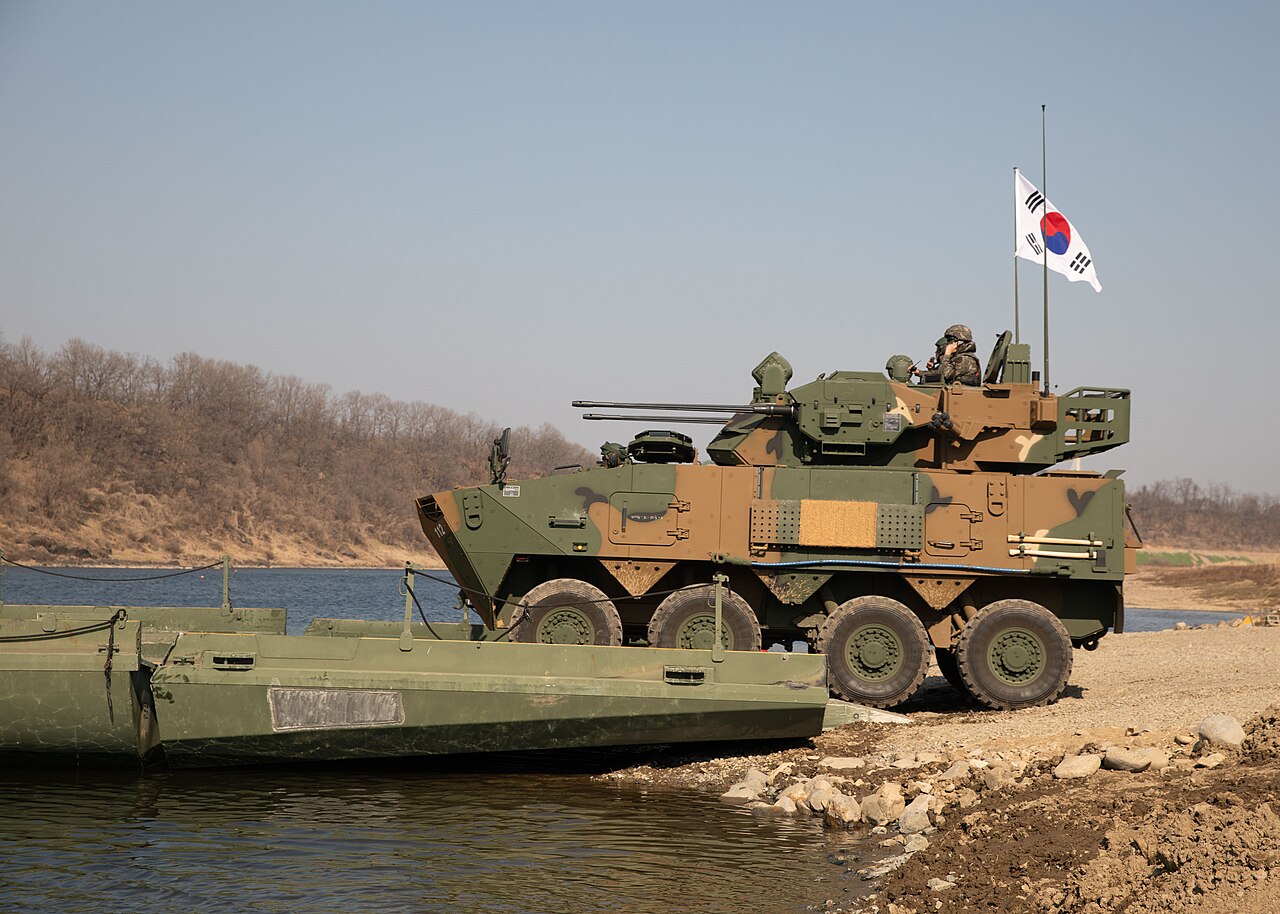
The “Hybrid” variant at the center of the India talks adds the Shingung short-range surface-to-air missile, carried in two triple- or quad-round pods on the turret, extending engagement range to roughly 7 kilometers and giving the vehicle a layered gun-plus-missile capability against helicopters, fixed-wing aircraft, cruise missiles and drones in a single platform. The system is manufactured by Hanwha Aerospace, which absorbed its Hanwha Defense subsidiary in a November 2022 corporate consolidation. A wheeled derivative, the K30W Cheonho (“Sky Tiger”), mounted on an 8×8 K808 chassis, entered Korean service in 2021 and has been photographed operating alongside U.S. and Korean forces in exercises such as Freedom Shield.
Who Uses It
South Korea is the only confirmed operator of the K30 Biho family, fielding roughly 176 tracked units along with the newer K30W wheeled variant in army air defense units. India does not currently operate the system. New Delhi selected the Biho in October 2018 after a competitive evaluation but never took delivery, meaning any current Indian inventory would start from zero rather than building on an existing fleet, as is the case with the K9 howitzer program.
Export/Procurement History
India’s interest in the Biho dates to 2013, when the Indian Army opened a tender for a self-propelled short-range air defense gun-missile system to replace Soviet-era ZSU-23-4 Shilka and towed L-70 guns along the Pakistan border. After evaluation rounds in 2015 and field trials in 2017, where the Biho reportedly outperformed Russia’s Tunguska-M1 in comparative testing, the Indian Army selected it in October 2018. The planned package covered 104 K30 Biho systems, 97 ammunition carriers, 39 command vehicles, and 4,928 Chiron (Shingung-derived) missiles, valued at roughly $2.5–2.7 billion, with deployment originally targeted for 2020 along the Pakistan frontier.
The deal unraveled before a contract was signed. A rival bidder challenged the selection process, alleging the Biho had not been adequately tested, and lobbied for the tender to be reopened; South Korean officials pushed back and sought expedited negotiations in 2019. By around 2020, the procurement was shelved as India’s Ministry of Defence pivoted sharply toward its Atmanirbhar Bharat (“self-reliant India”) policy, prioritizing indigenous programs over direct imports even where domestic alternatives were not yet mature. The September 2026 talks are the first substantive, officially acknowledged re-engagement on the program since that collapse, and Indian and Korean reporting both indicate that any revived deal would now have to include local production, technology transfer and high indigenous-content commitments rather than a straight import.
Global Competitors
The Biho Hybrid would compete for India’s attention against both foreign and domestic alternatives. Russia’s Pantsir-S1 and the Tunguska-M1 it was benchmarked against in 2017 remain the most direct foreign rivals and are already familiar to Indian crews through decades of Russian-origin equipment, though New Delhi has grown wary of over-reliance on Moscow given sanctions-driven supply disruptions. Domestically, India’s Army Air Defence has pursued its own short-range answers: an upgrade program for the Cold War-era 40mm L-70 gun, integrated with the AVGARDE DIWAR drone jammer, and trials toward a 220-unit successor to the L-70 and ZU-23 guns, alongside expanded deployment of the indigenous Akash missile system for medium-range cover. Any Biho revival would need to be positioned as filling a mobile, armored gun-missile niche that neither the upgraded L-70 nor Akash directly covers.
Why It Matters
The renewed talks land against a backdrop of urgency in India’s short-range air defense planning. The Indian Army has publicly cited lessons from Operation Sindoor, its most recent exchange of drone and missile strikes with Pakistan, in accelerating counter-drone and gun-based air defense upgrades. A protected, mobile platform that pairs rapid-fire cannons with short-range missiles addresses a gap that slower-reacting missile batteries and towed guns struggle to cover, particularly against swarming drones and low-flying threats near forward areas. For South Korea, reviving the deal would be a marquee win for Hanwha Aerospace’s export push and for Seoul’s broader strategy of positioning Korean defense firms as alternatives to Russian and Chinese suppliers across South and Southeast Asia.
What Happens Next
Neither government has set a timeline, and officials on both sides have described the September 29 meeting as a review of cooperation rather than the start of formal contract negotiations. Indian defense-industry reporting suggests any path forward will hinge on how much local manufacturing and technology transfer Hanwha Aerospace is willing to commit to, following the template set by the K9 Vajra-T howitzer program, which is license-built in India by Larsen & Toubro. A further Biho-specific announcement, such as a formal request for proposal or a localization framework, would be the next concrete milestone to watch.
FAQ
What is the K30 Biho Hybrid?
It is a South Korean self-propelled short-range air defense vehicle combining twin 30mm cannons with Shingung short-range missiles on an armored chassis, built by Hanwha Aerospace, designed to counter low-flying aircraft, helicopters and drones.
Has India signed a contract for the Biho?
No. India selected the Biho in a 2018 tender worth roughly $2.5 billion, but the deal was never signed and was shelved around 2020. The September 2026 talks reopened discussion without producing a contract.
Why did India’s original Biho deal fall apart?
A combination of a rival bidder’s procedural challenge and India’s broader policy shift toward prioritizing indigenous defense production under its Atmanirbhar Bharat initiative led the Ministry of Defence to shelve the procurement.
Who currently operates the K30 Biho?
Only South Korea’s army operates the K30 Biho and its K30W Cheonho wheeled variant; India has no units in service.
What would India need for a revived deal to succeed?
Indian and Korean reporting indicates any renewed agreement would likely require substantial local production and technology transfer, similar to the K9 Vajra-T howitzer program built domestically by Larsen & Toubro.
Sources
- The Korea Times, “Korea, India discuss stalled Biho air defense deal at defense talks,” September 29, 2026 — primary report on the DAPA-India meeting and official DAPA statement. link
- Raksha Anirveda, “India, South Korea Reopen Discussions on K30 Biho Air Defence Deal,” September 2026 — Indian defense-industry context on the deal’s revival. link
- idrw.org, “Biho Hybrid Returns to India’s Air Defence Discussions Says Korean Media,” September 2026 — additional detail on counter-drone context and localization expectations. link
- Defensehere, “South Korea and India discuss stalled Biho air defense deal,” September 2026 — corroborating report on the talks. link
- Army Recognition, “South Korean sale of K-30 Biho anti-aircraft systems to India threatened,” 2019 — original procurement timeline, package contents and the 2019 procedural challenge. link
- Wikipedia, “K30 Biho” — technical specifications, development history, operators and the 2019 order/2020 cancellation record. link
- Deccan Herald / Bharat Shakti, reporting on Indian Army L-70 gun upgrades and Akash regiment expansion, 2026 — domestic competitor context. link