KC-46 Pegasus Specs, Problems, Cost and Operators
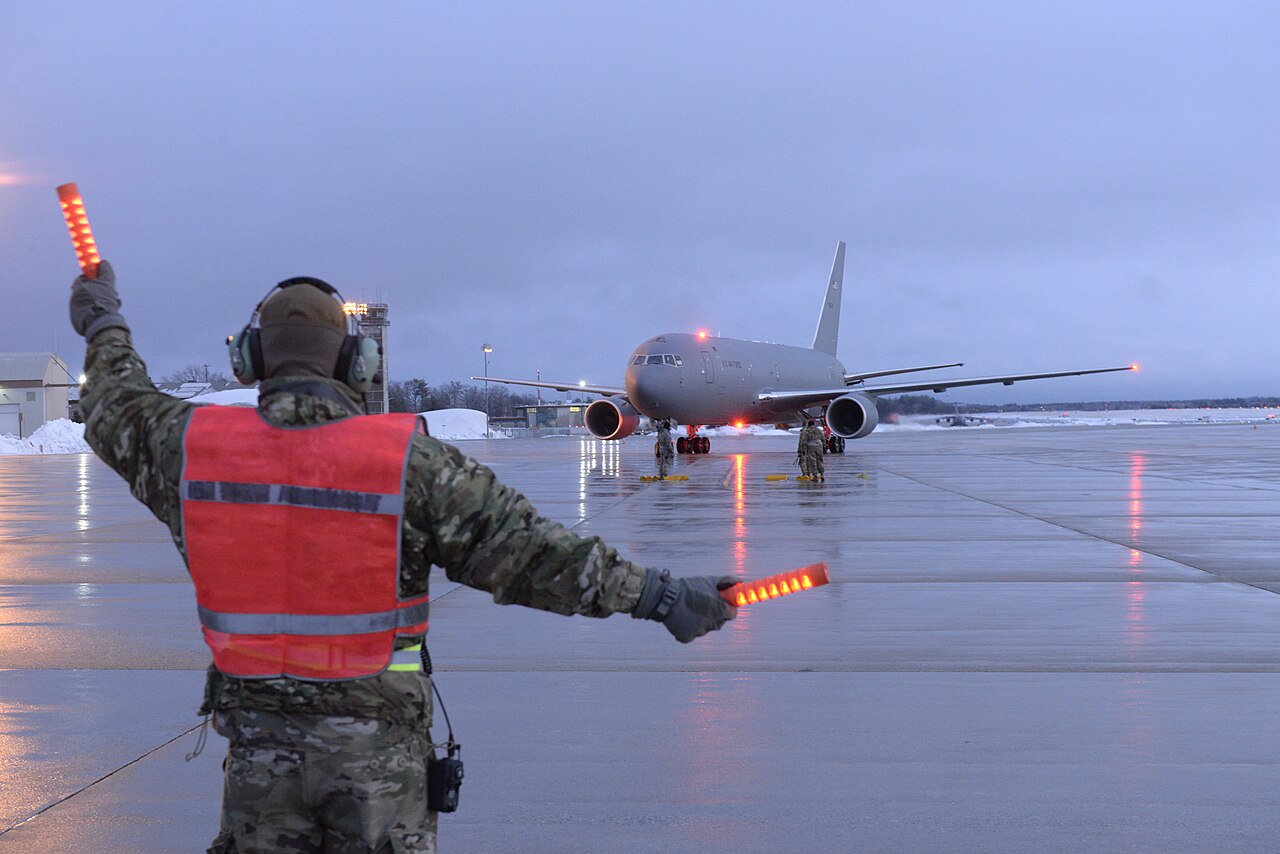
The Boeing KC-46 Pegasus is the US Air Force’s newest aerial refueling tanker, a 767-based aircraft that carries about 96 tonnes of fuel, and one of the most troubled programs in recent Pentagon history. The aircraft works and is in service, but years of design defects, delays and Boeing losses have left some of its key capabilities still incomplete.
What is the KC-46 Pegasus
The KC-46A is a military tanker and transport developed from the Boeing 767-200ER airliner. It was picked in 2011 to replace part of the Air Force’s Eisenhower-era KC-135 Stratotanker fleet, under a fixed-price development contract. Boeing beat a competing Airbus design, the ancestor of the A330 MRTT, in a long and contested competition.
The aircraft refuels others in two ways: a rigid boom that the operator flies into the receiver, and probe-and-drogue hoses fitted to wing pods and a centerline hose for Navy, Marine Corps and allied aircraft. It can also carry cargo and passengers, and it is designed to receive fuel itself. The flight crew includes a boom operator seated at the front of the aircraft, who sees the receiver through cameras rather than a rear window.
KC-46 Pegasus specifications
| Specification | Value |
|---|---|
| Base aircraft | Boeing 767-2C, derived from the 767-200ER |
| Engines | Two Pratt & Whitney PW4062 turbofans, about 62,000 lbf each |
| Length and wingspan | About 50.5 m long, 48 m wingspan |
| Maximum takeoff weight | About 188,000 kg (415,000 lb) |
| Fuel capacity | About 96,000 kg (212,000 lb) |
| Cargo capacity | Up to about 29,000 kg (65,000 lb), per Boeing and USAF |
| Passengers | Up to about 114 in the aeromedical and passenger configuration |
| Range | Roughly 7,000 nautical miles ferry range, manufacturer figure |
| Service ceiling | About 12,000 m (40,000 ft) |
| Crew | Two pilots plus a boom operator |
It is one of the largest programs in the Boeing defense portfolio, and its tanking capacity matters to receivers such as the F-35, whose range depends on high-volume, high-availability tanking in any Pacific scenario.
KC-46 problems and delays
The KC-46 is best known for what went wrong. The program was awarded as a fixed-price deal, so Boeing absorbed cost growth from changes and rework. Reported cumulative charges exceed $7 billion, and first delivery came in January 2019, well behind the original schedule.
Remote Vision System
The central defect was the Remote Vision System, the camera-based display that lets the boom operator see the receiver. Early versions had distortion and depth perception problems, and in bright sun or certain lighting the operator’s view could be degraded. That contributed to contact between boom and receiver, and the Air Force classified the problem as a Category 1 deficiency, its highest severity. A redesigned system, RVS 2.0, has been under development with delivery schedules that slipped repeatedly; it remained a key outstanding fix in recent reporting.
Other issues
Other problems included foreign object debris left inside delivered aircraft, which triggered delivery pauses in 2019 and 2020, a boom that was too stiff to refuel some lighter aircraft such as the A-10 at certain settings, and fuel-system and hose-related defects. Some of these have been fixed. The Air Force has limited some missions and withheld full capability approval while work continued, and its inspector and watchdog organizations have monitored progress.
Who operates the KC-46
The US Air Force is the principal operator, with aircraft flying from McConnell AFB in Kansas, Pease in New Hampshire, Altus in Oklahoma, Seymour Johnson in North Carolina and other bases. More than 100 aircraft have been delivered, reported. Japan has also ordered the type for its Air Self-Defense Force, and other export interest is limited compared with the Airbus competitor.
| Year | Event |
|---|---|
| 2011 | Boeing selected for the KC-X tanker competition |
| 2015 | First flight of a KC-46 test aircraft |
| 2019 | First delivery to the US Air Force; foreign object debris pauses deliveries |
| 2020s | Continued RVS redesign and capability restrictions while deliveries proceed |
| Planned | USAF plans 179 aircraft in total, reported |
KC-46 cost and outlook
Per-aircraft cost depends on how it is counted. Press estimates put the flyaway price near $150 to $200 million, with program costs higher because development overruns fell largely on Boeing. The Air Force still needs a bigger, more modern tanker fleet: the KC-135 is decades old, and a next generation tanker, the so-called NGAS, is expected to arrive later in the 2030s. It is also a transport aircraft, so it can move cargo and passengers when tanker demand is light. For broader comparisons, see our top 10 military transport aircraft.
KC-46 Pegasus frequently asked questions
What is the KC-46 Pegasus?
A Boeing 767-based aerial refueling tanker and cargo aircraft built for the US Air Force.
Why is the KC-46 troubled?
Mainly because of the Remote Vision System, which suffered depth perception and lighting issues, plus delays and other defects.
How much fuel does the KC-46 carry?
About 96,000 kg, roughly 212,000 pounds.
How many KC-46s has the Air Force ordered?
The program of record is 179 aircraft, reported.
Who else flies the KC-46?
Japan has ordered the aircraft for its Air Self-Defense Force.
- US Air Force KC-46A Pegasus fact sheet
- Boeing KC-46A product literature
- US Government Accountability Office reports on KC-46 tanker acquisition
- Wikipedia – Boeing KC-46 Pegasus (accessed October 2026)