
AIP Submarines, How Diesel Boats Learned to Disappear
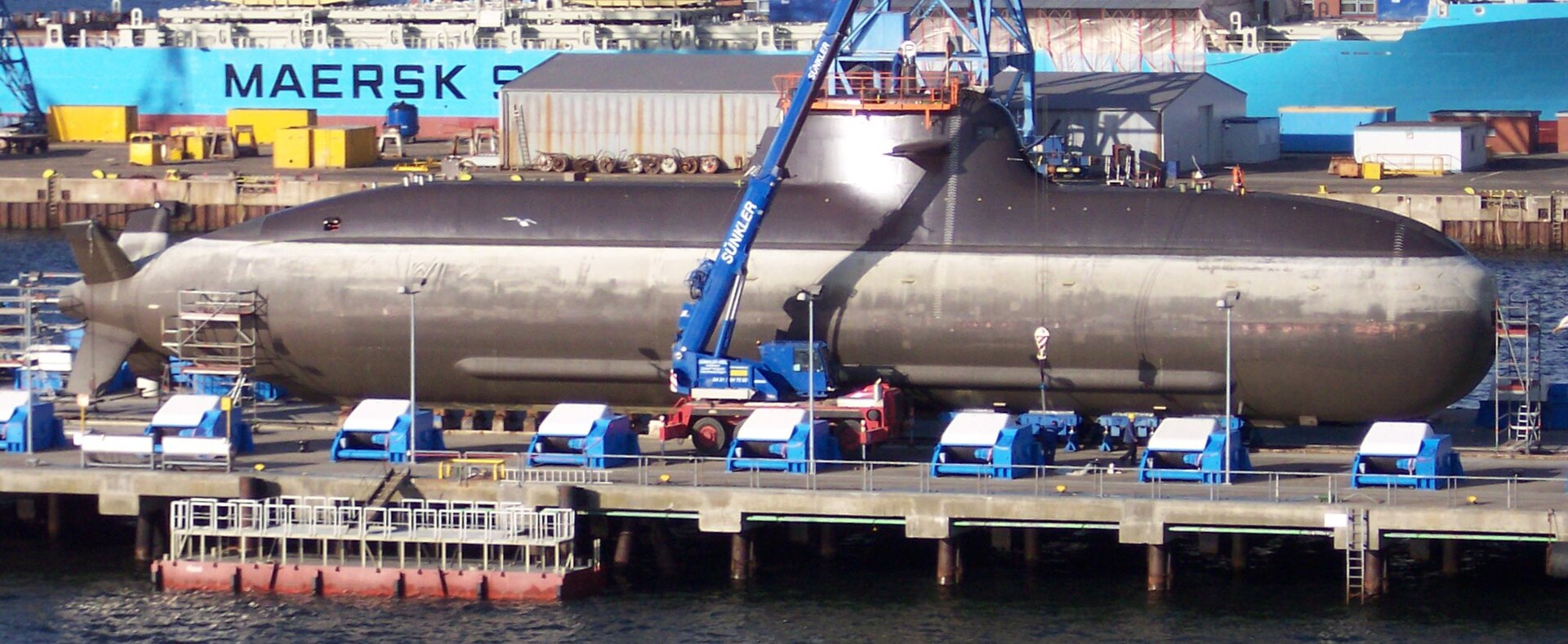
Air-independent propulsion is what lets a $500 million diesel submarine do a nuclear boat’s most important trick, staying under for weeks, without the reactor or the price tag. Fuel cells, Stirling engines and now lithium batteries have rewritten the underwater balance for every navy that cannot, or will not, go nuclear. Here is how each works and who bets on which.
The snorkel problem AIP solves
A conventional submarine is electric underwater and diesel on top; every few days it must snorkel near the surface to recharge, radiating noise, showing a mast and dying, statistically, in wartime, at exactly that moment. AIP breaks the cycle with onboard oxygen: stored liquid-oxygen feeding engines or cells that trickle-charge the batteries at depth, stretching the silent interval from days to weeks. It does not make a diesel boat nuclear; it makes the diesel boat’s ambush, the quiet, waiting kind, sustainable.
The three families, fuel cell, Stirling, MESMA
| Type | How it works | Signature users |
|---|---|---|
| PEM fuel cell | Hydrogen and oxygen combine across membranes, electricity with no combustion, no moving parts | German Type 212A (nine Siemens modules) and 214 exports; TKMS’s franchise technology |
| Stirling engine | External combustion of diesel with LOX drives sealed pistons | Sweden’s Gotland class, Japan’s early Soryu boats, China’s licensed derivatives |
| MESMA turbine | Ethanol-LOX steam turbine, more power, more complexity | Pakistan’s Agosta 90B; about $50-60 million per plant |
| Closed-cycle diesel | Rebreathes exhaust with stored oxygen | Soviet-era; extinct since the 1970s |
Endurance, what AIP actually buys
The published numbers frame the market: 21 days submerged for a Type 212A, two weeks at patrol speed for a Gotland, up to 40 days claimed for Stirling-equipped Soryus, against three-to-five snorkel-bound days for a plain diesel boat. The caveat is power: AIP plants deliver a tenth or less of the diesels’ megawatts, so those weeks pass at a handful of knots. AIP buys patience, not pursuit, station-keeping in a chokepoint, not chasing a carrier, which is precisely the mission profile of the Baltic, the Gulf and the first island chain’s shallows.
The lithium-ion plot twist
The newest move abandons AIP machinery altogether: Japan’s eleventh Soryu and the Taigei class replaced Stirling plants with massed lithium-ion batteries, South Korea’s KSS-III Batch II follows suit, and TKMS pairs fuel cells with lithium in the 212CD. Batteries give burst speed AIP never could and simplify the hull, at the price of raw submerged days; the emerging consensus is hybrid, cells for the long quiet, lithium for the sprint. However the mix settles, the strategic fact stands: the conventional submarine’s fatal rhythm is broken, and the hunters’ sensors must work for contacts that no longer surface on schedule.
The tactical picture, hunting an AIP boat
Exercises keep re-teaching the same humbling lesson: a fuel-cell boat creeping at three knots in littoral clutter is close to a hole in the water, famously ‘sinking’ US carriers in Gotland-lease drills. The hunter’s counters are patience and physics, low-frequency active pings from towed arrays, multistatic helicopters, magnetic anomaly passes, and, increasingly, seabed sensors and USV pickets that outlast any crew’s patience. AIP shifted the littoral duel toward the defender; the response is turning ASW into a numbers game of distributed, unmanned ears.
Who runs what
Fuel cells dominate the export market through German boats serving Italy, Greece, South Korea, Portugal, Singapore and Turkey’s licensed 214s; Stirling holds Scandinavia and Japan’s back catalogue plus Chinese derivatives; MESMA remains Pakistan’s niche; and lithium leads Northeast Asia’s newest classes. The spread maps geopolitics as much as engineering, every AIP line doubles as an industrial alliance, and it is why submarine tenders from Warsaw to Manila are contests between national ecosystems, not just hull designs.
Frequently asked questions
What does AIP stand for?
Air-independent propulsion, systems letting conventional submarines recharge submerged using stored oxygen.
How long can an AIP submarine stay underwater?
Roughly two to four weeks at low speed, versus a few days for a snorkel-dependent diesel boat, with 40 days claimed for some Stirling fits.
Which AIP type is best?
Fuel cells lead on silence and market share, Stirling on simplicity, lithium-ion on sprint power; new designs increasingly hybridize.
Is AIP as good as nuclear?
No, power and speed remain far lower; AIP buys endurance for ambush and chokepoint work at a fraction of nuclear cost.
Why are navies adding lithium-ion batteries?
They deliver high burst speed and mechanical simplicity, complementing or replacing AIP, as in Japan’s Taigei class.
- Wikipedia – Air-independent propulsion (accessed October 2026)
- Class documentation for Type 212/214, Gotland, Soryu, Taigei and KSS-III
- Defence & Tech submarine coverage