
How Sonar Works, Active Pings, Silent Ears and the Ocean’s Tricks
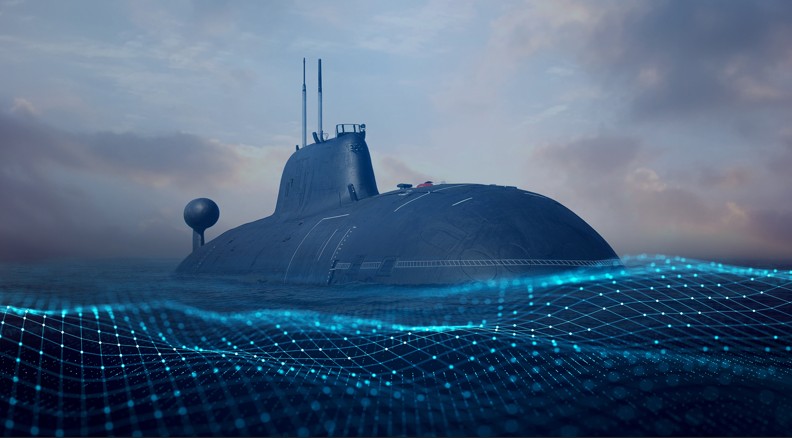
Sonar is how navies see in a medium where light fails within meters, and the difference between active pinging and silent listening is the difference between finding a submarine and becoming its target. From hull arrays to helicopter dipping sets and kilometer-long towed lines, here is how underwater detection actually works, and why the ocean itself is the hardest opponent.
Active vs passive, the fundamental choice
Active sonar transmits a pulse and reads the echo: range and bearing in one ping, at the price of announcing the sender, audible to a target at roughly twice the distance the echo returns from. Passive sonar transmits nothing, classifying ships and submarines by their radiated noise, blade counts, machinery tones, each hull’s acoustic fingerprint. The operational grammar follows: submarines live passive and ping almost never; surface hunters mix both; and the modern trick is multistatic, one platform pinging while silent partners listen from elsewhere.
How the ocean bends sound
Sound in water refracts along temperature and pressure gradients, and mastering those curves is half of anti-submarine warfare. The thermocline, the sharp temperature drop tens of meters down, bends energy and shadows whatever hides beneath it, which is why a submarine’s favorite trick is simply depth. Deeper still, the SOFAR channel ducts low frequencies across entire oceans, the physics behind Cold War surveillance arrays, while convergence zones return annular detection rings tens of kilometers out for those with sensors to catch them. Sonar performance is therefore weather: the same set detects at 5 or 50 kilometers depending on the day’s water column.
The sensor toolkit, hulls to sonobuoys
| Type | How it works | Strength / weakness |
|---|---|---|
| Hull-mounted | Array in the bow or keel | Always available / hostage to own-ship noise and layer above |
| Towed array | Hydrophone line trailed kilometers astern | Quiet, long baseline for faint low frequencies / constrains maneuver |
| Variable-depth | Winched body placed below the layer | Beats the thermocline / handling limits in sea state |
| Dipping (helicopter) | Sonar lowered at hover | Repositions faster than any ship / snapshot coverage |
| Sonobuoys | Air-dropped disposable listeners | Fields entire patterns cheaply / minutes-to-hours endurance |
What each platform carries
A destroyer pairs a hull set with a towed line and its helicopter’s dipping sonar; a frigate optimized for ASW adds quieting so its own screws do not blind it; maritime patrol aircraft like the P-8 seed sonobuoy fields and prosecute contacts; and submarines carry the best passive suites afloat, bow spheres, flank arrays and thin-line tails, because their survival is listening. The kill chain is layered exactly like air defense: wide-area cueing, localization, then a torpedo’s own active seeker finishing the geometry.
The quieting arms race
Detection is only half the contest; the other half is the target’s silence budget. Rafted machinery, anechoic tiles, seven-bladed skewed screws and pump-jets, natural-circulation reactor modes and AIP’s near-silent fuel cells have dropped submarine signatures by orders of magnitude across generations, which is why modern ASW leans on low frequencies, multistatics and magnetic or wake anomalies as acoustic margins thin. Every decibel shaved forces hunters toward longer arrays and smarter processing, the spiral that keeps both sonar and submarine builders’ order books full.
Limits, countermeasures and whales
Sonar’s counters are old and effective: silence and depth first, then decoys and jammers that mimic or mask signatures, knuckles of turbulent water, and the simple exploitation of bad acoustics, shallow littorals cluttered with traffic are notoriously merciless to hunters. And the transmissions themselves carry an environmental bill: high-power active sonar is implicated in marine mammal strandings, so NATO navies operate under mitigation rules, ramp-up procedures, watch requirements, exclusion conditions, that are now as much a part of ASW planning as the physics. The fuller electronic-warfare view of this underwater contest sits in our acoustic warfare explainer.
Frequently asked questions
What is the difference between active and passive sonar?
Active transmits pulses and reads echoes, revealing itself; passive only listens, classifying targets by their own noise.
Why do submarines avoid active sonar?
A ping betrays the sender’s position at up to twice its useful detection range; submarines survive by silence.
What is the thermocline?
The sharp temperature gradient tens of meters down that bends sound and shadows submarines beneath it.
How far can sonar detect?
From a few kilometers to convergence-zone rings tens of kilometers out, wholly dependent on frequency, sensor and water conditions.
Does sonar harm whales?
High-power active transmissions are linked to strandings; navies apply mitigation procedures to reduce the risk.
- Wikipedia – Sonar (accessed October 2026)
- Open naval literature on ASW layering and acoustics
- Defence & Tech underwater warfare coverage