
Baykar’s Bayraktar KIZILELMA: Turkey’s Unmanned Fighter Jet Takes Shape
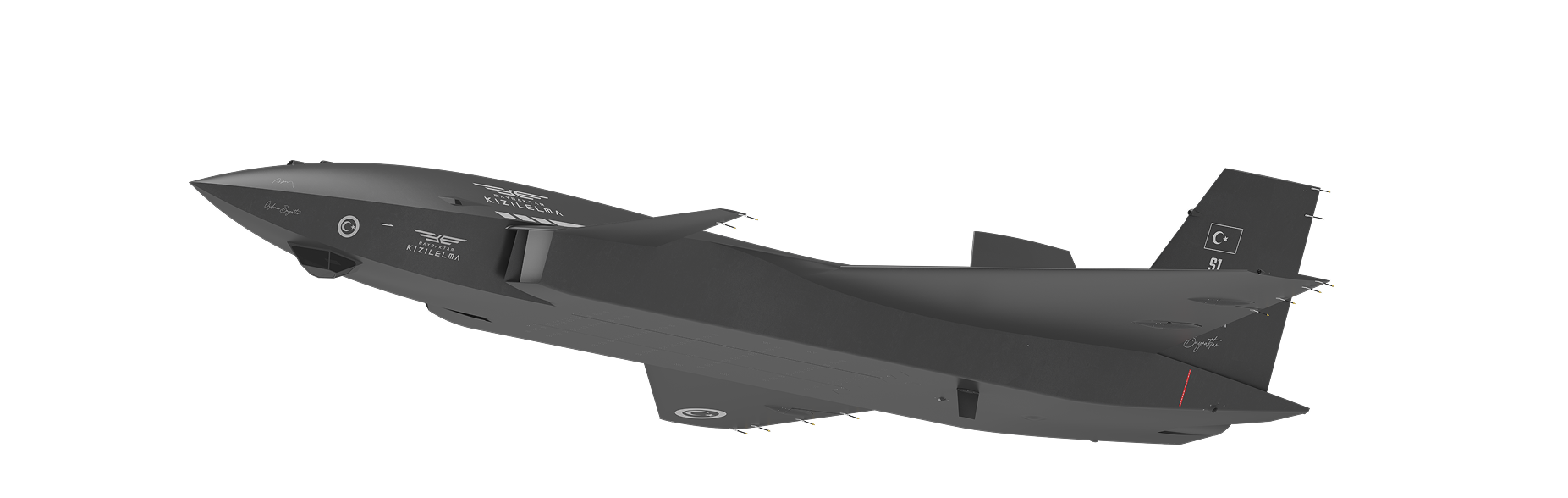
Baykar’s Bayraktar KIZILELMA — “Red Apple” in Turkish — is the company’s most audacious project yet: a turbofan-powered, low-RCS unmanned combat aircraft that can operate from aircraft carriers and approach the speed of sound. It is less a drone and more a pilotless fighter, pushing Turkish air power into territory previously occupied only by the United States and China.
| Specification | Value |
|---|---|
| Max Takeoff Weight | 8,500 kg |
| Payload Capacity | 1,500 kg |
| Endurance | 3+ hours |
| Max Speed | 0.9 Mach |
| Cruise Speed | 0.6 Mach |
| Combat Radius | 500 nautical miles |
| Service Ceiling | 45,000 ft |
| Operating Altitude | 25,000 ft |
| Engine | Turbofan |
| Wingspan | 10 m |
| Length | 14.5 m |
| Radar Signature | Low RCS design |
| Carrier Ops | Short-runway carrier capable |
Redefining What “Drone” Means
Most UCAVs — including TB2 and AKINCI — operate at subsonic cruise speeds with relatively low maneuverability. KIZILELMA breaks that mold with a turbofan engine, a 0.9 Mach top speed, and a low radar cross-section (RCS) design that reduces detectability to adversary air-defense systems. At 8,500 kg MTOW it is significantly heavier than AKINCI, reflecting the structural demands of high-speed maneuvering flight. The ability to conduct air-to-air engagements elevates it from an ISR/strike platform to a genuine aerial combatant.
What It Can Carry and Where It Can Strike
The 1,500-kg payload envelope accommodates air-to-air missiles for self-defense and air superiority roles, laser-guided and GPS-guided munitions for precision ground strikes, standoff weapons for attacking defended targets without entering their engagement envelopes, and cruise missiles for deep strategic strikes. An AESA radar provides high situational awareness; an IR Search and Track (IRST) system enables passive detection of aerial threats without emitting radar signals.
Naval Integration: A Sea-Based Fighter
KIZILELMA’s carrier-compatibility is what makes it strategically extraordinary. Operated from TCG Anadolu alongside TB3s, it would give Turkey a mobile, sea-based strike platform unconstrained by land base vulnerability. A carrier group carrying KIZILELMA could project air power across the Eastern Mediterranean without Ankara having to negotiate overflight rights or worry about adversary missile strikes on fixed airfields.
The Road to Supersonic
Baykar has confirmed three variant lines — subsonic, transonic, and supersonic — mapping a development roadmap that mirrors how conventional fighter programs evolve. The current subsonic prototype is the starting point; the transonic and supersonic variants represent where the technology is heading. If that trajectory holds, Turkey will in the next decade possess an unmanned aircraft capable of engaging peer-level air-defense and aerial threats at supersonic speeds — a capability gap that no customer in the Middle East, Africa, or Central Asia can currently fill from domestic production.