Ethiopia-Eritrea Crisis: Drone Strikes and Severed Ties Raise War Fears
Ethiopia-Eritrea Crisis: Drone Strikes and Severed Ties Raise War Fears
Ethiopia and Eritrea cut diplomatic relations in early October 2026 and have since traded drone strikes and troop movements along their shared border, pushing the Horn of Africa toward what regional analysts describe as the highest risk of renewed interstate war since the two countries’ 1998-2000 conflict. The immediate flashpoint is the border town of Adigrat in Ethiopia’s Tigray region, where Ethiopian drones struck Eritrean forces in early October. The underlying dispute is older and larger: Ethiopia’s push for guaranteed access to the Red Sea through Eritrea’s port of Assab.
What Happened
Ethiopia ordered the closure of its embassy in Asmara on October 2, 2026, citing what it called acts of hostility by Eritrea. Eritrea responded by formally severing diplomatic ties, according to a report that day from the Daily Maverick. Within days, the dispute moved from diplomacy to the battlefield.
On the night of October 7-8, the conflict monitor ACLED reported “multiple drone strikes” on Eritrean troops and military vehicles in the Adigrat area, in Ethiopia’s northern Tigray region near the Eritrean border. Witnesses described destroyed trucks and retreating soldiers, Africanews and Euronews reported on October 8. Eritrean forces had reportedly moved into Ethiopian territory near Zalambessa around October 7, which Addis Ababa characterized as an incursion of roughly 60 kilometers, according to a report in Eurasia Review; neither government has publicly confirmed the details of troop movements on either side.
By October 18, AFP correspondents found burnt-out vehicles still in the center of Adigrat. Some Eritrean units had withdrawn back across the border, while others remained on the Ethiopian side near the frontier, Al Jazeera reported. Residents described a collapse of local policing and administration, with schools closed for several days.
Neither Addis Ababa nor Asmara has responded on the record to detailed questions about the strikes or the fighting. A senior Ethiopian military officer, quoted anonymously in regional reporting, described the situation as “small pockets of the enemy forces still resisting.” Eritrea has accused Ethiopia of manufacturing a pretext to seize Assab by force; Ethiopia maintains it requires a “sovereign seaboard” and denies planning an invasion, Al Jazeera reported on October 11.
By October 23, Eurasia Review and the Africa Defense Forum assessed that the two countries had entered “a high-risk phase of limited but direct military confrontation,” citing continued troop movements, drone strikes and escalating rhetoric from both capitals. One account, less well corroborated, has suggested Ethiopian forces advanced to within roughly 50 kilometers of Assab; this claim has not been independently verified and should be treated with caution. Separate, single-source security reporting has put Eritrean reinforcements moving toward the Tigray border at between 5,000 and 8,000 troops — a figure that likewise has not been independently confirmed.
The Weapons Behind the Strikes
Neither government has officially identified which aircraft carried out the Adigrat strikes. But the strikes fit a pattern established over Ethiopia’s Tigray war since 2021: Ethiopia’s air force has built one of the more diverse armed-drone fleets in sub-Saharan Africa, combining Chinese, Iranian and Turkish systems.
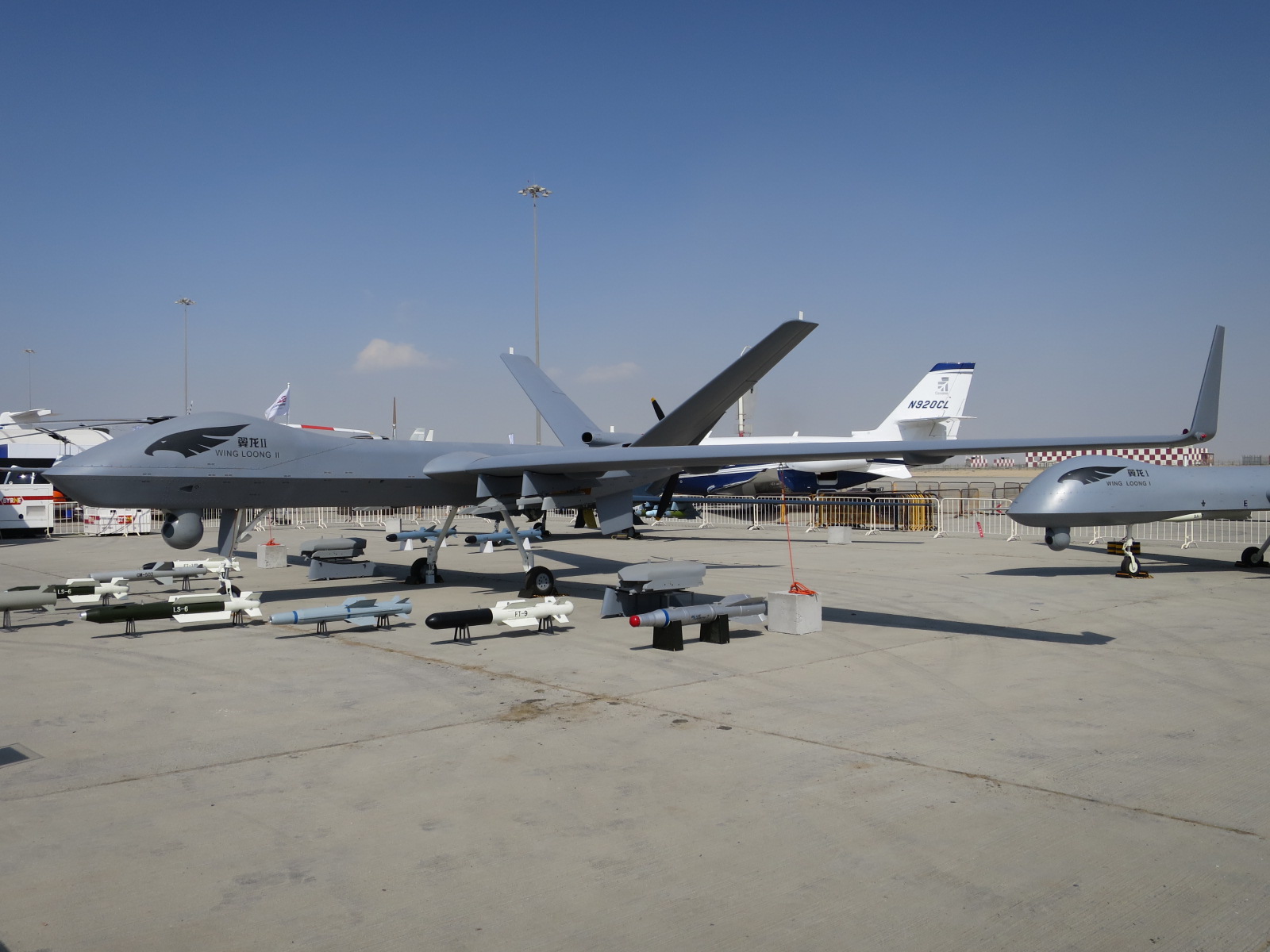
Satellite-imagery analysis by the Dutch research group PAX for Peace identified Chinese-made Wing Loong drones and Iranian-made Mohajer-6 drones based at Harar Meda Air Base near Bishoftu, with a Turkish Bayraktar TB2 confirmed as a third type later in the conflict. Ethiopia has also acquired the larger Bayraktar Akinci, a longer-range strike-capable design built by Turkey’s Baykar — the same aircraft profiled separately by Defense & Tech. Among these types, the Wing Loong is reported to have the longest range, previously giving Ethiopian forces reach as far as Tigray’s regional capital, Mekelle; Adigrat, close to the Eritrean border, sits well within that envelope.
The Wing Loong is manufactured by Chengdu Aircraft Industry Group, a subsidiary of state-owned Aviation Industry Corporation of China (AVIC), and has become one of China’s most widely exported medium-altitude, long-endurance unmanned systems. Reporting on Ethiopia’s acquisition has suggested the aircraft may have reached Addis Ababa through the United Arab Emirates rather than a direct Chinese sale, though this routing has not been officially confirmed by any of the governments involved.
Who Operates Comparable Fleets
Wing Loong variants are confirmed in service with the United Arab Emirates, Saudi Arabia, Egypt, Nigeria, Kazakhstan and Serbia, alongside Ethiopia, making it one of the more proliferated Chinese UCAV families outside the traditional US-European export market. Iran’s Mohajer-6 has a smaller but growing operator list that includes Ethiopia and, reportedly, Sudan’s Rapid Support Forces, as Defense & Tech has reported on drone proliferation elsewhere in the region. Turkey’s TB2 and Akinci remain Ankara’s flagship export drones, with operators spanning Africa, the Gulf, Eastern Europe and Central Asia.
Eritrea, by contrast, has not been confirmed to operate a comparable armed-drone fleet, and no strikes attributed to Eritrean drones have been reported in this round of fighting. Its ground forces rely primarily on older Soviet- and Russian-origin armor and artillery, consistent with decades of reporting on the Eritrean Defence Forces.
Why It Matters
A renewed interstate war between Ethiopia and Eritrea would mark a reversal of the 2018 peace deal between Prime Minister Abiy Ahmed and President Isaias Afwerki that won Abiy the Nobel Peace Prize — and that same partnership later turned into a joint military campaign against Tigrayan forces during the 2020-2022 Tigray war. This time, Eritrea and elements of the Tigray People’s Liberation Front appear aligned against Addis Ababa, with Ethiopia accusing Asmara of backing the TPLF and Amhara Fano fighters, the armed factions that united against the Abiy government in September.
The dispute over Red Sea access adds a harder strategic edge than a purely internal Ethiopian conflict. Ethiopia, landlocked since Eritrea’s 1993 independence, has pushed for years for guaranteed port access, and Abiy has repeatedly argued the country needs a sovereign outlet to the sea. Assab, Eritrea’s main deep-water port, sits at the mouth of the Red Sea’s southern approach to the Bab-el-Mandeb strait — a route already under strain from Houthi attacks on shipping further north. A wider Ethiopia-Eritrea war would add a second active front to one of the world’s most sensitive maritime chokepoints, with knock-on risk for East African fuel and food imports that move through Djibouti and the Red Sea corridor.
The fighting also illustrates how deeply armed drones have embedded themselves in African conflicts short of full interstate war. Ethiopia’s layered fleet of Chinese, Iranian and Turkish systems — a mix increasingly common across the continent, as Chinese air-defense systems arriving in Ethiopia this month also showed — gives Addis Ababa strike options against a neighbor with limited means to intercept them.
What Happens Next
The International Crisis Group has called for urgent diplomatic intervention to “pull Ethiopia and Eritrea back from war,” and regional analysts have urged African Union or Gulf-state mediation. One Somalia-based outlet reported that Moscow was preparing to host talks between the two sides; this has not been corroborated by other sources and should be treated as unconfirmed. The US has also engaged: Ethiopian officials said Abiy spoke with Washington on October 14 about the rising tensions, according to a regional weekly report.
Whether the current standoff stabilizes into another frozen, low-intensity border confrontation — as it did for two decades after the 1998-2000 war — or escalates into open interstate conflict will likely hinge on whether outside mediation can address the underlying Red Sea access dispute, rather than only the immediate border incidents. No ceasefire or mediation framework had been publicly agreed as of this writing.
FAQ
Why are Ethiopia and Eritrea on the brink of war in 2026?
The immediate trigger was Ethiopia’s October 2 closure of its embassy in Asmara and Eritrea’s subsequent severing of ties, followed by cross-border troop movements and drone strikes near Adigrat. The deeper cause is Ethiopia’s long-standing push for guaranteed access to the Red Sea, which Eritrea views as a threat to its control of the port of Assab.
What drones has Ethiopia used against Eritrean forces?
Neither government has officially named the aircraft used in the October strikes near Adigrat. Ethiopia’s confirmed armed-drone inventory from the Tigray war includes Chinese Wing Loong drones, Iranian Mohajer-6 drones, and Turkish Bayraktar TB2 and Akinci drones, with the longer-range Wing Loong previously used to strike deep into Tigray.
Is Eritrea’s port of Assab at risk of attack?
Reports that Ethiopian forces advanced to within about 50 kilometers of Assab have not been independently verified and are not treated as confirmed. Analysts nonetheless cite Ethiopia’s desire for Red Sea access through Assab as the strategic core of the dispute.
Has the Tigray war restarted because of this crisis?
Fighting in Tigray and surrounding regions has continued intermittently since 2022. The October 2026 escalation is distinct in that it involves direct Ethiopia-Eritrea cross-border incidents, rather than solely Ethiopian operations against domestic armed groups.
Has any international mediation begun?
The International Crisis Group and other analysts have called for African Union or Gulf-brokered mediation, and Ethiopian officials say Prime Minister Abiy Ahmed discussed the tensions with US officials in mid-October. No confirmed ceasefire or formal mediation track had been announced as of this writing; a single, uncorroborated report named Moscow as a possible venue for talks.
Sources
- Daily Maverick, “Eritrea severs diplomatic ties with Ethiopia after Addis Ababa orders closure of embassy in Asmara,” October 2, 2026 — dailymaverick.co.za — confirms the diplomatic rupture and its trigger.
- Africanews, “Ethiopian drones strike Eritrean forces near Adigrat,” October 8, 2026 — africanews.com — reports the initial drone strikes.
- Euronews, “Ethiopian drones hit Eritrean forces accused of backing rebels in Tigray,” October 8, 2026 — euronews.com — attributes the strike reporting to ACLED and details Ethiopia’s accusations against Eritrea.
- Al Jazeera, “Ethiopia, Eritrea ramp up rhetoric: Are they inching towards war?,” October 11, 2026 — aljazeera.com — covers both governments’ public positions.
- Al Jazeera, “Residents recount drone strikes in Ethiopia’s northern Tigray region,” October 18, 2026 — aljazeera.com — on-the-ground account of the Adigrat aftermath.
- Eurasia Review / Africa Defense Forum, “Tensions Along Eritrea-Ethiopia Border Risk Erupting Into War,” October 23, 2026 — eurasiareview.com — risk assessment and troop-movement claims, some unverified.
- International Crisis Group, “Pulling Ethiopia and Eritrea Back from War” — crisisgroup.org — mediation recommendations and conflict background.
- PAX for Peace, satellite-imagery analysis of Ethiopian drone basing and types — cited via paxforpeace.nl — basis for Ethiopia’s confirmed drone inventory.