F-22 Pilot Commands YFQ-44A Fury Drone in Flight for the First Time
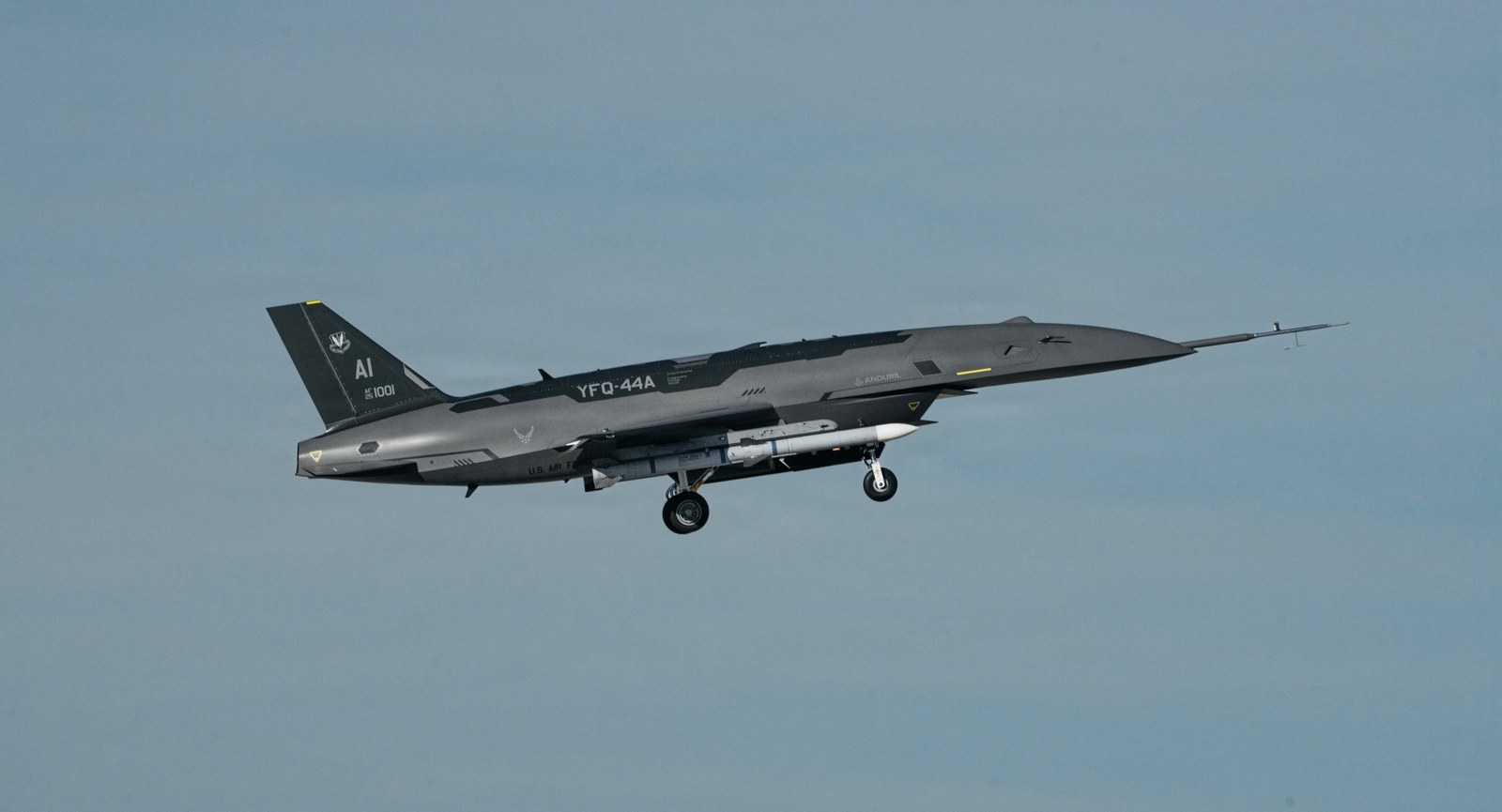
A U.S. Air Force F-22 Raptor pilot has, for the first time, commanded an Anduril YFQ-44A Fury Collaborative Combat Aircraft (CCA) while both jets were in the air. The Department of the Air Force announced on October 16, 2026 that the test took place earlier this month at Edwards Air Force Base, California, with the F-22 pilot acting as an airborne “quarterback” and sending the uncrewed Fury high-level tactical orders that its onboard autonomy software carried out in real time.
What the Air Force tested
According to the Air Force release, the F-22 pilot issued directives to a single YFQ-44A, and the drone’s autonomy software interpreted them and flew “dynamic flight maneuvers and simulated combat tasks.” The Air Force did not describe the specific tasks or how the Raptor was modified for the demonstration.
Anduril added more detail in statements reported by Air & Space Forces Magazine. Mark Shushnar, the company’s vice president of autonomous airpower, said both aircraft took off from Edwards during the week of October 5 and joined up in the air. The Raptor pilot then sent the Fury an updated mission plan over a tactical data link. Shushnar said the mission lasted several hours.
Several organizations took part: the 412th Test Wing, the 422nd Test and Evaluation Squadron, the 309th Software Engineering Group, the CCA Experimental Operations Unit, the F-22 System Program Office and the CCA Software Autonomy and Teaming Branch. The Air Force says data from the flight will feed into software integration, developmental testing and future CCA concepts.
“This flight shows the power of crewed-uncrewed teaming and the advantage it provides our warfighters,” said Air Force Chief of Staff Gen. Ken Wilsbach. Secretary of the Air Force Troy Meink said the result showed what is possible “when we are aligned with industry.”
Why this test matters
The CCA concept depends on a fighter pilot directing drones without a ground crew flying them stick-and-throttle. Earlier this year the Air Force ran the same idea with a stand-in aircraft: in February an airborne F-22 controlled a General Atomics MQ-20 Avenger, and in May an F-35 on the ground controlled an airborne Avenger, Air & Space Forces Magazine reported. This is the first time the control link was exercised with an actual Increment 1 CCA prototype and a fighter both in flight.
It is still one drone and one fighter. The Air Force’s stated goal is for each pilot to eventually manage several CCAs as a formation, and it is also developing ground stations from which airmen can command them.
What is the YFQ-44A Fury?
The YFQ-44A is Anduril’s entry in the first increment of the CCA program, a jet-powered, semi-autonomous drone designed to fly alongside crewed fighters. The “Y” marks the prototype; production aircraft are designated FQ-44. The other Increment 1 design is General Atomics’ YFQ-42A.
Key milestones
- October 31, 2025: first flight of the YFQ-44A, according to Anduril and Reuters.
- June 17, 2026: the Air Force awarded engineering, manufacturing development and production contracts to General Atomics (FQ-42) and Anduril (FQ-44), four months ahead of schedule. The same announcement set up a pool of six mission-autonomy software vendors (Anduril, General Atomics, Lockheed Martin, Northrop Grumman, RTX Collins Aerospace and Shield AI), with a primary provider to be chosen by summer 2027.
- Early October 2026: first in-flight tactical control from an F-22.
How many CCAs does the Air Force want?
In June, Meink spoke of procuring “over 150 combat capable CCA by the end of the decade.” The October release says the service intends to have 500 combat-ready, semi-autonomous systems by 2032 and an overall fleet of about 1,000. These are planning targets, not orders or deliveries. Air & Space Forces Magazine reports that the Air Force wants each air vehicle to cost no more than $20 million, excluding sensors and weapons. Increment 1 is focused on air-to-air missions. For the wider picture, see our explainer on the F-47 and its CCA drone wingmen.
Türkiye’s comparable program: Kızılelma
The closest Turkish equivalent is Baykar’s Bayraktar Kızılelma unmanned fighter. In May 2026, during the K-SWARM trials with Leonardo at Çorlu, M-346 pilots commanded formation changes, separations and rejoins that Kızılelma flew autonomously, according to Baykar and FlightGlobal. Leonardo and Baykar have said more complex tests will follow. On September 30, Baykar chairman Selçuk Bayraktar said serial production was speeding up and the aircraft would enter Turkish Armed Forces service “very soon,” without giving a date.
One dependency should be stated plainly. Kızılelma currently flies with the Ukrainian-made AI-322F engine. TEI’s domestic TF6000 turbofan is expected to be delivered to Baykar for integration testing around the end of 2026 or early 2027, according to statements by TEI reported in Turkish media. It has not yet flown in Kızılelma.
| Criterion | YFQ-44A Fury (US) | Kızılelma (Türkiye) |
|---|---|---|
| Developer | Anduril | Baykar |
| Teaming test with a crewed aircraft | Commanded in flight by an F-22 (Oct 2026) | Formation commands from an M-346FA (May 2026) |
| Production status | EMD and production contract awarded June 2026 | Serial production under way, entry into service announced as imminent |
| Engine | Not detailed in the sources cited here | Ukrainian AI-322F today, TEI TF6000 in integration |
| Export path | Not mentioned in Air Force announcements | Leonardo-Baykar joint venture (LBA Systems) plans production in Italy |
More on Türkiye’s unmanned fleet: What drones does Turkey have? Anduril’s rise is covered in our top defense startups list.
FAQ
Did an F-22 really control a drone in flight?
Yes. The U.S. Air Force says an F-22 pilot issued tactical directives to a YFQ-44A in flight at Edwards Air Force Base in early October 2026, and the drone’s autonomy software executed them.
Who makes the YFQ-44A Fury?
Anduril Industries. It is one of two Increment 1 CCA designs, alongside General Atomics’ YFQ-42A.
Was the drone flying itself?
Partly. The pilot gave high-level orders and an updated mission plan; the drone’s onboard autonomy decided how to fly them. That is what the Air Force calls semi-autonomous.
When will CCAs enter service?
The Air Force has not given a public operational date. Its stated goal is 500 combat-ready systems by 2032.
Sources
- U.S. Air Force: F-22 directs Collaborative Combat Aircraft in airborne tactical-control demonstration (Oct 16, 2026)
- U.S. Air Force: Air Force advances future of air superiority with CCA contracts (Jun 17, 2026)
- Air & Space Forces Magazine (Oct 16, 2026)
- Aviation Week (Oct 16, 2026)
- Anduril: YFQ-44A begins flight testing
- Baykar: K-SWARM live trials with Leonardo