US Navy Destroyers and Cruisers: Arleigh Burke, Zumwalt, Ticonderoga
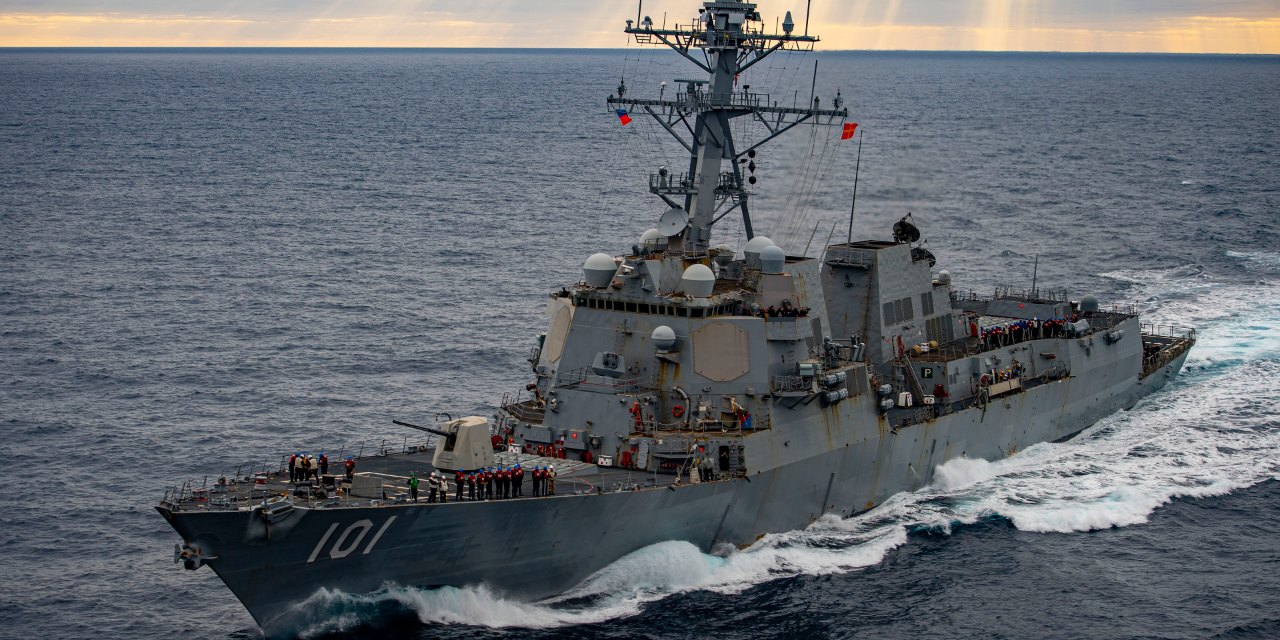
The US Navy’s surface combat fleet rests on one design: the Arleigh Burke-class destroyer, of which about 76 are in commission. Beside them are seven ageing Ticonderoga-class cruisers, the unusual Zumwalt-class destroyers and 27 lightly armed littoral combat ships.
This guide explains what each class does, how many missiles it carries, and what the Navy plans to build next: a new frigate and, more controversially, a battleship.
What surface warships does the US Navy have?
A modern destroyer is a floating missile battery. Its value is measured in vertical launch cells, each of which holds one large missile or four small ones, and in the radar and combat system that direct them. American ships use the Mk 41 launcher and the Aegis combat system. Their main jobs are to protect aircraft carriers, shoot down missiles and fire Tomahawks at targets ashore.
| Class | Type | In commission | Full-load displacement | Missile cells |
|---|---|---|---|---|
| Arleigh Burke | Destroyer | About 76 | 8,300 to 9,700 tonnes | 90 or 96 |
| Ticonderoga | Cruiser | 7 | About 10,000 tonnes | 122 |
| Zumwalt | Destroyer | 2, with a third fitting out | About 16,000 tonnes | 80, plus 12 hypersonic missiles after conversion |
| Freedom and Independence | Littoral combat ship | 27 | About 3,000 to 3,500 tonnes | None; anti-ship missiles on deck launchers |
| FF(X) | Frigate | First ship due in 2030 | Based on a 4,600-tonne cutter | None in the first ships |
Arleigh Burke class: 35 years in production
The first Arleigh Burke was commissioned in 1991 and the class is still being built, the longest production run of any American surface warship. A late-model ship is 155 metres long, makes more than 30 knots and carries 96 cells for SM-2, SM-3 and SM-6 interceptors, Tomahawk cruise missiles and anti-submarine rockets, plus two helicopters. The Congressional Research Service puts the price at about $2.7 billion each.
The current version is Flight III. It replaces the SPY-1 radar with the far more sensitive SPY-6 and has the extra power and cooling to run it. The third of the type, USS Ted Stevens, joined the fleet on 3 October 2026, as we reported in its commissioning in Alaska. Two yards build them, Bath Iron Works in Maine and Ingalls in Mississippi, and more are on the way, including USS John E. Kilmer.
These ships have been in near-constant action. In the Red Sea from late 2023 they shot down hundreds of Houthi drones and missiles, and they have defended Israel and American bases against Iranian ballistic missiles in every exchange since 2024. Their interceptors are covered in our guide to US air defense systems.
Ticonderoga class: the last cruisers
The Ticonderoga class was the first to carry Aegis. With 122 missile cells and extra command space, a cruiser traditionally served as the air defense headquarters of a carrier group. Twenty-seven were built. Seven remain, with hulls worn by four decades at sea, and the Navy has decided to keep the last three until 2029 only because it needs their missile cells.
There is no replacement cruiser. Flight III destroyers are taking over the air defense command role.
Zumwalt class: from gun ship to hypersonic missile ship
The Zumwalt class was planned as 32 stealthy destroyers built around two long-range guns for shore bombardment. Costs rose, the order was cut to three, and the guns’ special ammunition was cancelled as too expensive, leaving them useless. Counting development, each ship cost more than $8 billion.
The Navy has found them a new purpose. The gun turrets are being removed to fit launch tubes for 12 Conventional Prompt Strike hypersonic missiles, with USS Zumwalt the first to be converted. The weapon is described in our guide to US hypersonic missiles.
Frigates and littoral combat ships
The Navy has had no frigates since 2015, and its attempts to get some have gone badly. The littoral combat ship, built in two versions, proved fragile and under-armed, and several were retired early. Its successor, the Constellation class, was cancelled in November 2025 after years of redesign had left the lead ship about three years late.
The replacement is the FF(X), based on the Coast Guard’s National Security Cutter, a ship already in production. Ingalls received a $282.9 million contract in April 2026 to finish the design and start work. The Navy wants the first hull in the water in 2028 and delivered in 2030. Early ships will have a 57 mm gun and 16 Naval Strike Missiles but no vertical launch cells. The Navy has also been studying foreign designs, as we reported in its evaluation of Japanese, Korean and Turkish frigates.
The battleship plan and what comes next
On 22 December 2025 the Trump administration announced a class of guided-missile battleships, known as BBG(X). The Congressional Research Service describes ships of more than 35,000 tonnes and up to 268 metres, armed with missiles, guns and, eventually, lasers and a railgun. The Navy envisages 15 to 25 of them. The first, to be named Defiant, would be ordered in the early 2030s.
The Congressional Budget Office estimates the first ship at $17.6 billion to $18.9 billion and later ones at about $12 billion to $13 billion, more than four times the price of a destroyer. Work on the planned next destroyer, DDG(X), has been suspended to make room. The Navy is also buying medium uncrewed vessels to carry extra missiles, described in its order for 30 of them. For comparison, China’s largest surface combatant is the 13,000-tonne Type 055.
Frequently asked questions
How many destroyers does the US Navy have?
About 78: roughly 76 Arleigh Burke class and two Zumwalt class in commission, with a third Zumwalt fitting out.
How many missiles does an Arleigh Burke destroyer carry?
It has 90 or 96 vertical launch cells, depending on the version. Each holds one large missile or four small ones.
Does the US Navy still have cruisers?
Yes, seven Ticonderoga-class ships. The last are due to retire by 2029.
Does the US Navy have frigates?
Not at present. The Constellation class was cancelled in 2025, and the first FF(X) frigate is due in 2030.
Is the US building battleships again?
A guided-missile battleship was announced in December 2025. It has not been ordered, and the first ship would not enter service before the late 2030s.
- Congressional Research Service – Navy Guided Missile Battleship (BBG[X]) Program (January 2026): everycrsreport.com
- USNI News – Navy awards $282.9M FF(X) frigate contract to HII’s Ingalls Shipbuilding (April 2026): news.usni.org
- The War Zone – Full retirement of Ticonderoga cruisers on hold, trio to remain in service into 2029: twz.com
- Congressional Research Service – Navy Force Structure and Shipbuilding Plans (January 2026): everycrsreport.com
- Wikipedia – List of current ships of the United States Navy: en.wikipedia.org