Ukraine Says Neptune Missiles and Drones Hit Russia’s Kamensky Rocket Propellant Plant
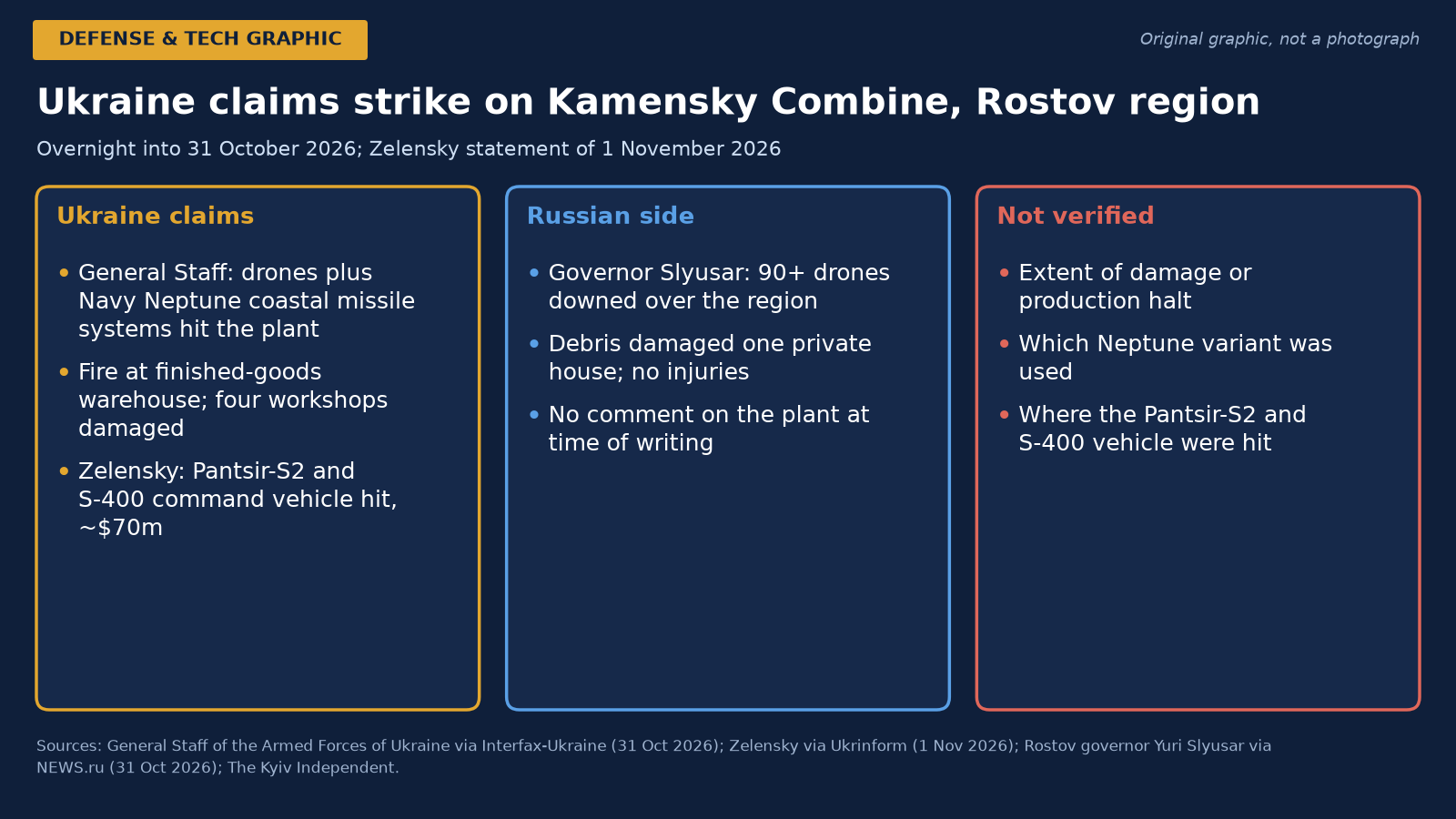
Ukraine says it hit the Kamensky Combine, a Russian chemical plant that makes solid rocket propellant, with attack drones and Neptune missiles overnight into Saturday, 31 October 2026. The plant is in Kamensk-Shakhtinsky in Russia’s Rostov region, about 15 km east of the Ukrainian border. According to Ukraine’s General Staff, a fire broke out in a finished-goods warehouse and four production workshops were damaged (Interfax-Ukraine, The Kyiv Independent).
- Ukraine’s General Staff says drones and Navy Neptune coastal missile systems hit the Kamensky Combine in Kamensk-Shakhtinsky overnight into 31 October
- It claims a fire at a finished-goods warehouse and damage to four production workshops; this has not been independently verified
- President Zelensky said on 1 November that a Pantsir-S2 system and an S-400 command-and-staff vehicle, worth about $70 million together, were also hit
- Rostov’s governor reported more than 90 drones shot down but did not mention the plant; Russian officials have not commented on it
What Ukraine’s military says
The General Staff described a “complex” strike combining attack drones and the Ukrainian Navy’s Neptune coastal missile systems. It said the Kamensky Combine produces solid rocket fuel for the Uragan, Smerch and Tornado-S multiple-launch rocket systems, as well as for other missile systems and air-launched weapons, and that hitting such production “reduces the Russian army’s capability” to shell Ukrainian towns (Interfax-Ukraine, Kyiv Post). The same night, it said, Ukrainian forces hit four Russian supply depots near Khartsyzk and Dokuchaievsk in Donetsk region, Novovasylivka in Zaporizhzhia region and Novoaidar in Luhansk region.
On Sunday, 1 November, President Volodymyr Zelensky said Ukraine’s “long-range sanctions” had targeted the Rostov region. He said a Pantsir-S2 air defence system and a command-and-staff vehicle of the S-400 Triumf system were also hit, putting the value of the air defence assets at “around $70 million”. He thanked the Security Service of Ukraine (SBU) and other units (Ukrinform, Ukrainska Pravda). Zelensky did not say where these air defence systems were hit or how the value was calculated.
What Russia says
Rostov governor Yuri Slyusar said on 31 October that air defences destroyed more than 90 drones overnight over Kamensk-Shakhtinsky and four districts of the region. He reported damage to the roof, windows and an outbuilding of a private house from falling debris, and no casualties. He did not mention the plant (NEWS.ru). Russian officials had not commented on the General Staff’s claim, and The Kyiv Independent said it could not verify it independently (The Kyiv Independent). Defense and Tech has not seen satellite imagery or other independent evidence of the damage.
The plant and the weapons
The Kamensky Combine has been sanctioned by the EU, the UK and the US for its role in Russia’s war against Ukraine, according to The Kyiv Independent. Solid propellant is a production bottleneck for rocket artillery and missiles in many countries, not only Russia; see our explainer on the solid rocket motor shortage. For the Pantsir and S-400 systems Zelensky named, see our guide to Russia’s S-300, S-400 and S-500 air defence systems.
Neptune is a Ukrainian cruise missile developed by the Luch design bureau in Kyiv. The original R-360 was built as an anti-ship missile with a range of about 280 km. In October 2025 the state concern Ukroboronprom disclosed specifications for a land-attack version, the RK-360L of the Neptune-D system, which it said has a range of up to 1,000 km and a 260 kg warhead (The Defender, citing Defense Express). The General Staff did not say which Neptune variant was used in this strike. For the wider picture of Ukraine’s forces, see how strong Ukraine’s military is.
What is still unknown
The scale of the damage, whether production has stopped and for how long, and the location of the Pantsir-S2 and S-400 vehicle strikes have not been confirmed by any independent source. Defense and Tech will update this report if verified imagery or official Russian comment emerges.
Sources: General Staff of the Armed Forces of Ukraine (31 October 2026) via Interfax-Ukraine and Kyiv Post; President Zelensky (1 November 2026) via Ukrinform and Ukrainska Pravda; Rostov governor Yuri Slyusar via NEWS.ru; The Kyiv Independent; The Defender.