UK Defence Spending: Healey Calls 3% by 2030 a ‘Target Date’ After Budget Plugs £4.7bn Gap
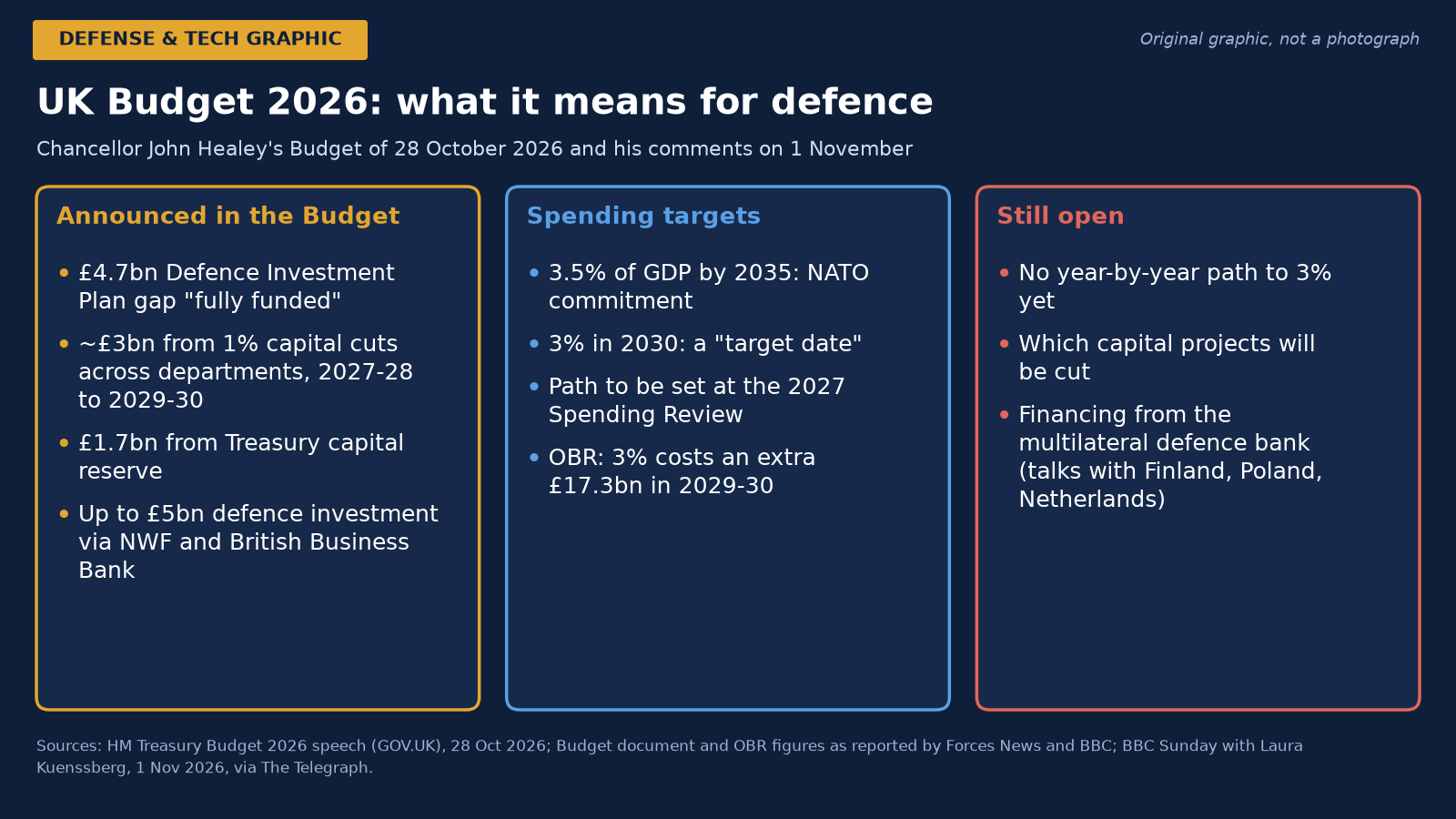
UK defence spending will reach 3% of GDP on a “target date” of 2030, but the government will not set out how it gets there until next year’s Spending Review, Chancellor John Healey said in his Budget on 28 October 2026 (HM Treasury). Speaking on the BBC’s Sunday with Laura Kuenssberg on 1 November, Healey again described 2030 as a “target date” rather than a firm commitment, while committing to NATO’s 3.5% goal for 2035, The Telegraph reported (The Telegraph).
- The Budget of 28 October ‘fully funds’ the Defence Investment Plan, closing a £4.7bn gap, mostly through 1% cuts to other departments’ capital budgets
- The UK keeps its NATO commitment of 3.5% of GDP on defence by 2035 and sets a ‘target date’ of 2030 for 3%; the detailed path is due at next year’s Spending Review
- On Sunday, 1 November, Healey again called 2030 a ‘target date’ and did not give a firm commitment, according to The Telegraph
- New financing tools include a defence finance taskforce, treaty talks on a multilateral defence bank and up to £5bn from the National Wealth Fund and British Business Bank
What the Budget did for defence
Healey told MPs he was “fully funding the Defence Investment Plan, including through capital reprioritisation across Whitehall”. The plan promised an extra £15bn for defence but had committed only £10.3bn, leaving a £4.7bn shortfall (BBC News). According to the Budget document, as reported by Forces News, departments will cut their capital budgets by 1% between 2027-28 and 2029-30 to raise about £3bn, and the remaining £1.7bn will come from an unallocated contingency in the Treasury’s capital reserve. Forces News said the extra money takes defence spending to 2.7% of GDP by 2027.
Healey also said this year’s defence budget was £14bn higher than in the last year of the previous Conservative government. He announced £10bn of additional economic and military support for Ukraine, based on loans and export finance guarantees, including half a billion pounds of urgent military funding for this winter (Budget speech).
The 3% question
The wording matters because Healey resigned as defence secretary in June, arguing that the government was not providing enough money and that 3% by 2030 was essential (BBC News). In the Budget he said: “At the Spending Review next year, I confirm that I will set out the details of how we will meet our NATO commitment to spend 3.5% of GDP on defence by 2035, with a target date for 3% in 2030.”
The cost is large. The Office for Budget Responsibility estimates that reaching 3% would cost an extra £17.3bn in 2029-30 (Forces News), and that the 3.5% target for 2035 would cost £35bn (BBC News). On Sunday, Healey said he remained “absolutely certain we have to meet the rising threats that Britain faces”, according to The Telegraph, but he did not name a firm deadline for 3%.
New ways to pay
Alongside spending cuts elsewhere, the Budget set out four financing steps: an Innovative Defence Finance Taskforce; treaty negotiations with Finland, Poland and the Netherlands on a Multilateral Defence Mechanism, or bank, to support defence investment and joint procurement; more private investment through public-private partnerships; and up to £5bn of investment and lending over four years from the National Wealth Fund and the British Business Bank for defence, dual-use technology and “sovereign capability” (HM Treasury). The defence bank plan is separate from the Canada-led institution the UK chose not to join, as we reported in October.
Reaction
NATO Secretary General Mark Rutte said the UK was on “a credible path” towards the alliance commitment, while Conservative leader Kemi Badenoch called the plan “a plan to have a plan” (BBC News). Tan Dhesi, the Labour chair of the Commons defence committee, said key decisions had “lamentably been delayed”. Former defence secretary Sir Ben Wallace claimed on X that the Ministry of Defence faces a real-terms cut of nearly 0.5% in day-to-day spending in 2027-28, citing the OBR and the Treasury’s Budget ‘Red Book’ (Forces News); the Treasury has not commented on that claim in the sources we reviewed.
Why it matters for industry
For contractors, the near-term signal is that the Defence Investment Plan is funded, while the bigger rise to 3% remains a 2027 decision. Healey said the investment would help places such as Barrow, Rosyth, Aldershot, Plymouth, Glascoed and Belfast to be “reindustrialised and transformed”. The UK is also a major exporter: programmes such as the Eurofighter Typhoon depend in part on the domestic order book that this budget supports.
Sources: HM Treasury, Budget 2026 speech (28 October 2026); BBC News; Forces News; The Telegraph (1 November 2026). OBR estimates as reported by BBC News and Forces News.