Iranian Strikes Damaged 26 US Bases and Sites, Radars Hit First, AP Analysis Says
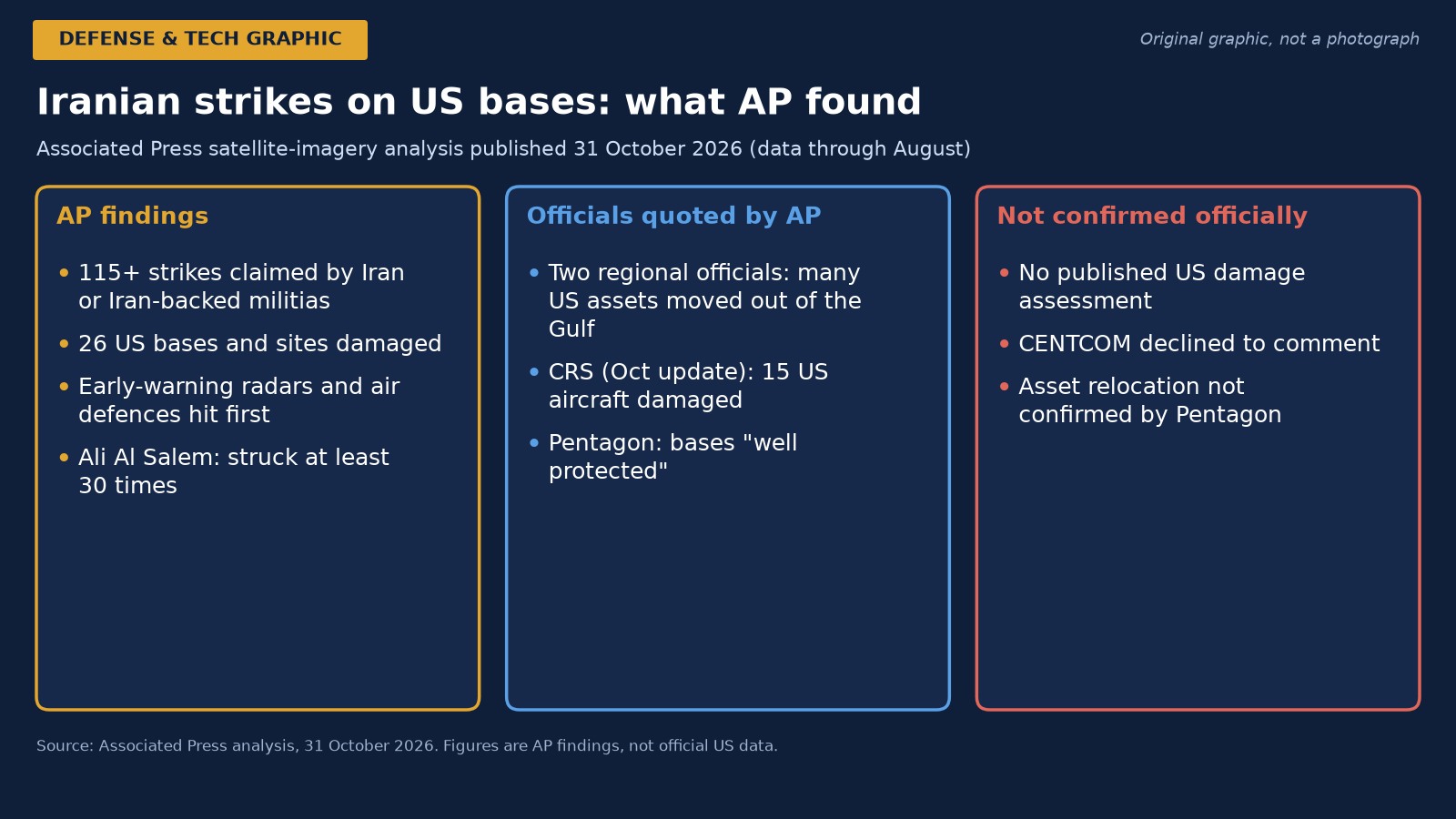
Iranian drone and missile strikes damaged or destroyed structures at 26 US military bases and other sites with US equipment in the Middle East through August, focusing first on early-warning radars and air defences, according to an Associated Press analysis published on 31 October 2026. AP said it verified the damage with satellite imagery from several providers and interviews with four regional officials; it counted more than 115 strikes claimed by Iran or Iranian-backed militias (Associated Press). The US military has not published its own damage assessment.
- AP says more than 115 drone or missile strikes claimed by Iran or Iranian-backed militias damaged or destroyed structures at 26 US bases and other sites through August
- According to AP, Iran first targeted early-warning radars, air defences and hangars, then warehouses, troop housing and other facilities
- Two regional officials told AP the US has moved many assets out of the Persian Gulf; this has not been confirmed by the Pentagon
- US Central Command declined to comment; Pentagon spokesman Sean Parnell said US forces and bases are ‘well protected’
Radars first, then hangars and housing
According to AP, Iran destroyed enclosures protecting US radar systems at Camp Arifjan in Kuwait and Naval Support Activity Bahrain within the first two days of the war, which began in late February, and hit portable radars at Prince Sultan Air Base in Saudi Arabia and Muwaffaq Salti Air Base in Jordan. AP said a radar in Jordan was reported destroyed; it described it as one of only 13 such radars the US Army has, citing the manufacturer Raytheon, and said budget documents put the cost of each at about half a billion dollars. A radar in Qatar, bought in a 2013 deal valued at $1.1bn, was significantly damaged, AP said, but it is unclear whether it was destroyed.
After the radars, AP said, Iran carried out more than 50 successful strikes on 18 locations with US equipment in the first month of the war, prioritising areas with aircraft. Most attacks were in Kuwait, with US sites in Bahrain, Iraq, Jordan, Oman, Qatar, Saudi Arabia and the UAE also targeted.
Base-by-base claims
AP reported that Ali Al Salem Air Base in Kuwait was struck at least 30 times, damaging or destroying at least 15 aircraft hangars, numerous warehouses and 10 buildings near a residential area. At Camp Buehring, also in Kuwait, AP said most hangars were made inoperable and more than 30 structures were damaged or destroyed between early March and August. AP also said a March strike on Prince Sultan Air Base damaged the rear half of a Boeing E-3 Sentry surveillance aircraft, and that another strike hit a CIA unit at the US Embassy in Riyadh. A regional military official told AP the attack on Prince Sultan also damaged other aircraft, including two aerial refuelling tankers. A Congressional Research Service report updated in October said 15 US aircraft had been damaged at regional bases, according to AP.
The deadliest known strike on US troops in the war was the 1 March drone attack at Port Shuaiba in Kuwait, in which six soldiers were killed, AP noted.
What Washington says
US Central Command, which has generally declined to detail base damage on operational security grounds, did not comment for the AP story. Pentagon spokesman Sean Parnell said in a statement to AP that US “forces and bases are well protected and America’s military is stronger than ever”. Two regional officials told AP that the US has moved many assets, including aircraft, air defence and communications systems, out of the Persian Gulf. Defense and Tech has not seen official US confirmation of that relocation.
AP also reported that major satellite imagery providers with US contracts had blocked or delayed public release of imagery at US officials’ request, and that it relied on Airbus’s OneAtlas service for parts of its analysis.
Why it matters
Analysts quoted by AP drew a broader lesson. Raphael Cohen of the RAND School of Public Policy said modern militaries are “susceptible to large-scale, cheap drone attacks” and called the findings “a wake-up call”, while N.R. Jenzen-Jones of Armament Research Services said hitting early-warning radars was likely meant to degrade the ability of the US and its allies to respond to further strikes. Long-range radars are among the scarcest parts of layered air defence; for how these layers fit together, see our guide to US air defence systems.
The findings come as tensions in the Gulf remain high. AP said President Donald Trump is considering new strikes after the US midterm elections on Tuesday, while Tehran has vowed major retaliation. On Sunday, a Qatari LNG carrier was also hit in the Gulf; see our report on the Al Mayeda incident.
Source: Associated Press analysis, 31 October 2026, including statements by the Pentagon and comments by RAND and Armament Research Services quoted by AP.