
Su-25 Frogfoot Explained: Russia’s Armoured Ground-Attack Jet, Specs, Weapons and Ukraine War Role
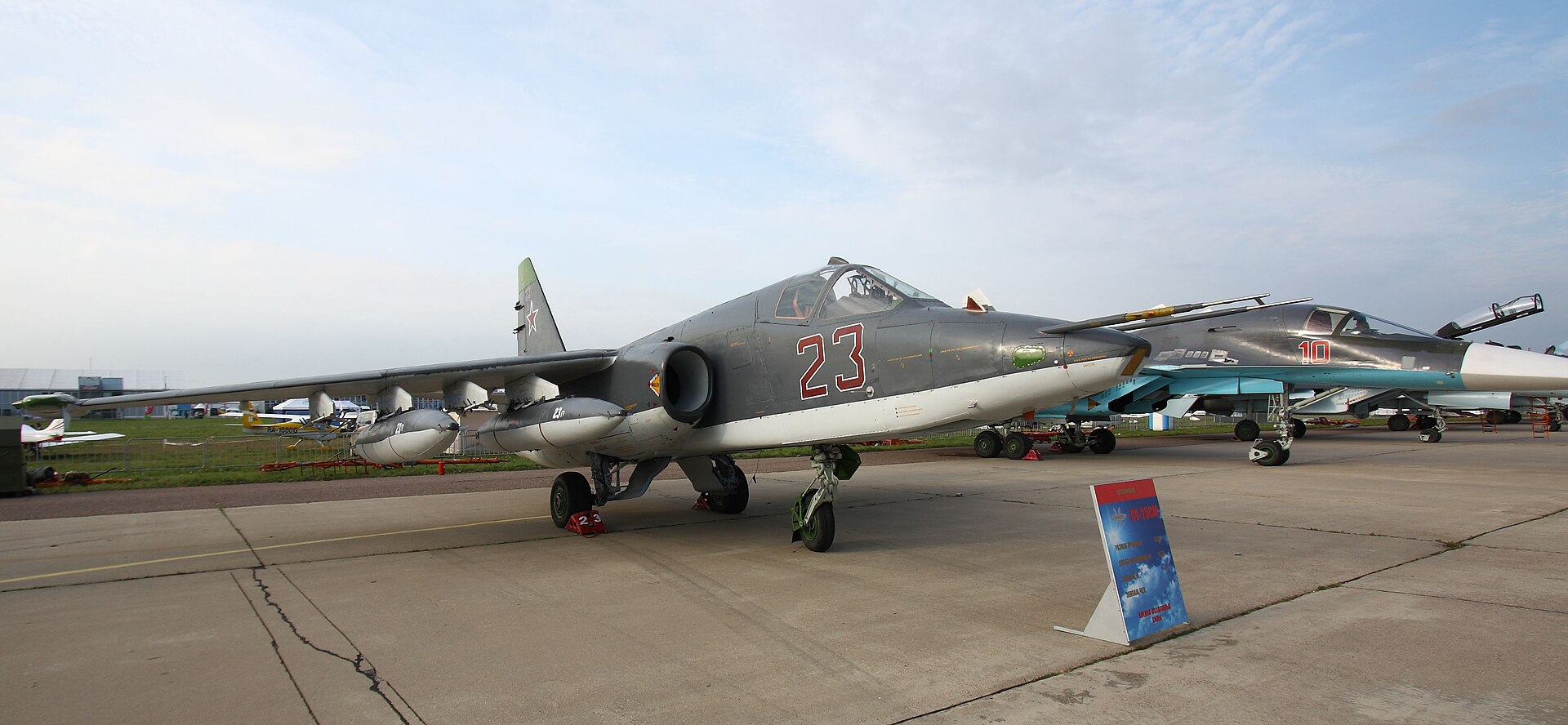

The Sukhoi Su-25, known to NATO as the Frogfoot and to Russian pilots as the Grach (“Rook”), is the Soviet answer to the American A-10 Warthog: a tough, heavily armoured jet built to fly low over the battlefield and attack enemy troops and vehicles. Almost 50 years after its first flight, it is still in combat over Ukraine.
- Subsonic close air support aircraft designed by Sukhoi
- First flight in 1975; entered Soviet service in 1981
- Titanium-armoured cockpit and protected fuel and control systems
- Twin-barrel 30mm cannon and about 4 tonnes of weapons on 10 hardpoints
- Main modernised Russian version: Su-25SM3
What is the Su-25?
The Su-25 was designed in the 1970s for a simple purpose: provide close air support to Soviet ground forces. It is a straight-winged, twin-engine jet built to be cheap, rugged and easy to maintain at rough forward airfields. Its pilot sits in a titanium “bathtub” that protects against heavy machine-gun fire, and its engines are separated so a hit on one is less likely to destroy the other.
Specifications and weapons
The Su-25 is powered by two R-95Sh turbojet engines and has a top speed of around 950 km/h. It carries a GSh-30-2 twin-barrel 30mm cannon and can load about 4 tonnes of weapons on 10 underwing pylons, including unguided rockets, bombs, laser-guided missiles such as the Kh-25 and Kh-29, and short-range air-to-air missiles for self-defence.
Combat history
The Su-25 earned its reputation in Afghanistan in the 1980s, flying tens of thousands of sorties against mujahideen positions. Losses to shoulder-fired Stinger missiles led to added armour and decoy flares. It later fought in Chechnya, Georgia in 2008 and Syria, and has been used by many air forces in Africa, the Middle East and Asia.
Su-25SM3 upgrade
Russia’s modernised Su-25SM3 introduces the SOLT-25 targeting system with a laser rangefinder and thermal imaging, satellite navigation and a modern self-protection suite designed to detect and jam incoming missiles. These upgrades allow more accurate strikes from higher altitude and greater distances.
Su-25 in Ukraine
Both Russia and Ukraine fly the Su-25, and both have suffered heavy losses to air defences. Because flying over the front is so dangerous, Russian Su-25s often use “lofted” rocket attacks, pitching up to throw unguided rockets several kilometres towards the target before turning away. The tactic reduces risk but also accuracy.
Verdict
The Su-25 is a classic example of a robust, simple design that has outlived expectations. In the age of drones and dense air defences its traditional role is increasingly dangerous, but as long as Russia lacks enough cheap precision strike platforms, the Frogfoot will keep flying.
Featured image: Doomych / Public domain, via Wikimedia Commons