Solar Industries, the Indian Explosives Maker Moving Into Defense
Solar Industries is India’s largest private explosives maker and a fast-growing defense supplier, a Nagpur-based company founded in 1995 that now says it sells to customers in more than 60 countries. Once known mainly for mining explosives, it has moved into rocket motors, warheads, propellants and loitering munitions for the Indian armed forces.
Solar Industries at a glance
Solar Industries India Limited is listed on Indian exchanges and run from Nagpur, in Maharashtra. The group grew from a modest packaged-explosives business into a vertically integrated manufacturer that makes its own raw materials, including ammonium nitrate, then turns them into cartridge explosives, bulk emulsions and initiating systems such as detonators and detonating cord.
| Item | Detail |
|---|---|
| Full name | Solar Industries India Limited |
| Headquarters | Nagpur, Maharashtra, India |
| Founded | 1995, by Satyanarayan Nuwal |
| Core business | Commercial explosives, initiating systems and, increasingly, defense products |
| Defense arm | Solar Defence and Aerospace Limited, with Economic Explosives Limited as a key subsidiary |
| International footprint | Plants and operations reported in Africa, the Middle East, Asia and Australia |
Who owns Solar Industries
The company is still controlled by its founder’s family. The promoter group, led by Satyanarayan Nuwal and his relatives, holds roughly three quarters of the equity, according to recent filings, with institutions and retail investors holding the rest. That ownership pattern matters for defense customers because it points to long-horizon investment rather than quarterly pressure, and it makes the group one of the larger privately owned suppliers in India’s defense ecosystem alongside groups profiled elsewhere on this site, such as Tata Advanced Systems.
What does Solar Industries make
| Segment | Examples |
|---|---|
| Commercial explosives | Packaged and bulk explosives, detonators and boosters for mining, quarrying and infrastructure |
| Propellants and energetics | Solid propellant and high-energy compositions for rocket motors |
| Rockets and warheads | Warheads, rocket motors and ammunition for multi-barrel rocket launchers |
| Bombs and ammunition | Aerial bombs and other explosive-filled munitions |
| Unmanned and loitering systems | Nagastra loitering munition family |
The business logic is simple. Explosives are a regulated, capital-heavy and quality-sensitive field, and India’s long dependence on state ordnance factories left little private capacity. Solar built scale in mining, where volumes are large and margins steady, then reused the same chemistry, permits and plant know-how for military energetics.
Solar Defence and Aerospace, Pinaka and Nagastra
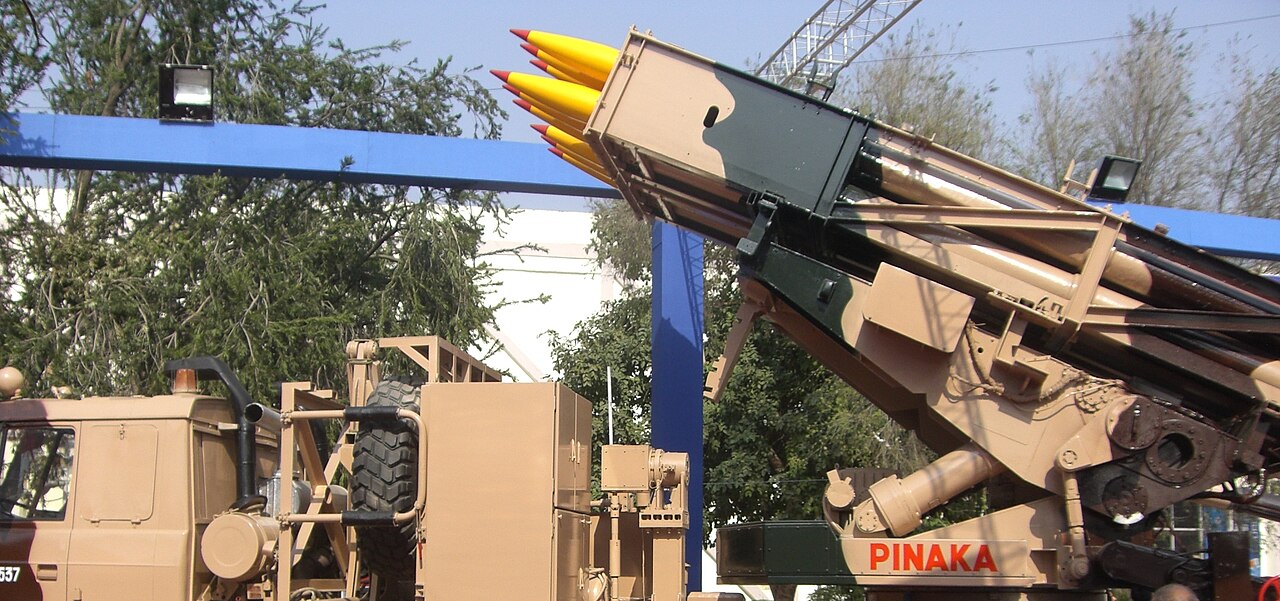
The defense push centers on three areas. The first is ammunition for the Pinaka multi-barrel rocket launcher, the Indian-developed system that has become a sales showcase for domestic industry. As reported in early 2025, Indian defense authorities signed contracts worth roughly 10,000 crore rupees for area denial and high-explosive pre-fragmented Pinaka rockets, with Economic Explosives and a state-owned firm as the suppliers.
The second is propulsion and energetics. Rocket motors and propellants for missiles and launchers are among the hardest items to source, a problem NATO members also face, as our report on Avio’s US plant illustrates. Solar has positioned itself as a domestic source of such energetics for Indian programs.
The third is the Nagastra family. The Nagastra-1 is an Indian-made loitering munition supplied to the Indian Army, reported to fly to a range of roughly 30 kilometers and to be recoverable by parachute if not used. It has been ordered in the hundreds, according to reports, and is often cited as an early example of a private Indian firm delivering an indigenous loitering system.
Solar Industries revenue and exports
Group revenue has run in the range of several thousand crore rupees a year, reported, roughly equivalent to between 0.7 and 0.9 billion US dollars, with commercial explosives still the larger share and defense the fastest-growing one. The company has said exports, including defense exports, are a rising slice of sales, and it reports overseas manufacturing in several countries, which gives it a base to serve mining customers and military buyers outside India.
Its growth story is tied to two forces. One is domestic: India’s push for indigenous procurement has opened ammunition and energetics categories to private firms. The other is global, where depleted Western stockpiles have lifted demand for shells, rockets and propellants. A comparable European supplier is profiled in our look at Nammo, while India’s state champion is covered in our HAL profile.
Solar Industries frequently asked questions
What does Solar Industries do?
It makes commercial and military explosives, detonators, propellants, rocket motors, warheads and loitering munitions.
Who owns Solar Industries?
The Nuwal family holds the majority through the promoter group, reported at roughly 73 percent, with the remainder publicly traded.
Where is Solar Industries headquartered?
In Nagpur, Maharashtra, India.
What is the Nagastra loitering munition?
A portable Indian loitering munition made by the company for the Indian Army, reported to have a range of around 30 kilometers.
Does Solar Industries export?
Yes. The company says it serves customers in more than 60 countries, mostly in mining, with defense exports growing.
- Solar Industries India Limited annual reports and investor presentations
- Indian Ministry of Defence press releases (accessed October 2026)
- Wikipedia – Solar Industries (accessed October 2026)
- Defence & Tech reporting on Indian defense manufacturing