Russia and Azerbaijan Sign Deal to Rebuild Armor Repair Plants, Eye Pantsir-S1 Sale
Russia and Azerbaijan Sign Deal to Rebuild Armor Repair Plants, Eye Pantsir-S1 Sale
Russia and Azerbaijan have signed a program to build and modernize maintenance facilities for Azerbaijan’s Russian-made armored vehicles, Dmitry Shugayev, director of Russia’s Federal Service for Military-Technical Cooperation, announced on November 1. Shugayev said in the same remarks, broadcast on Russian state channel Zvezda, that Moscow is separately pursuing a sale of Pantsir-S1 short-range air defense systems to Baku, though no such contract has been signed.
What Happened
Shugayev described the signed program as covering “the modernization and construction of facilities to repair armored vehicles” in service with the Azerbaijani army. Russian specialists are set to help design, build and upgrade the maintenance, repair and overhaul (MRO) infrastructure that supports Azerbaijan’s existing fleet of Russian-origin armor, which includes roughly 100 T-90S main battle tanks, BMP-3 infantry fighting vehicles and BTR-80A armored personnel carriers delivered mostly between 2011 and 2016.
Neither side has disclosed the program’s cost, the number or location of facilities involved, or a completion timeline. The announcement came two days after the Organization of Turkic States summit in Ankara, which Azerbaijani President Ilham Aliyev skipped despite an invitation from Turkish President Recep Tayyip Erdoğan; Foreign Minister Jeyhun Bayramov represented Baku instead. Several outlets, including Times of Central Asia and Kyiv Post, linked the timing to friction between Baku and Ankara over Turkish criticism of restrictions on religious dress in Azerbaijani schools, though Russian and Azerbaijani officials have not framed the repair agreement as a response to that dispute.
In the same interview, Shugayev said he expects Azerbaijan to eventually agree to buy the Pantsir-S1, a combined missile-and-gun air defense system, telling Zvezda that Baku “will come around to it.” He did not name a quantity, price or delivery schedule, and Azerbaijani officials have not confirmed any intent to buy the system. Aviation A2Z and Caspian Post both reported the talks as being at an early, exploratory stage rather than a signed contract.
The Product/System
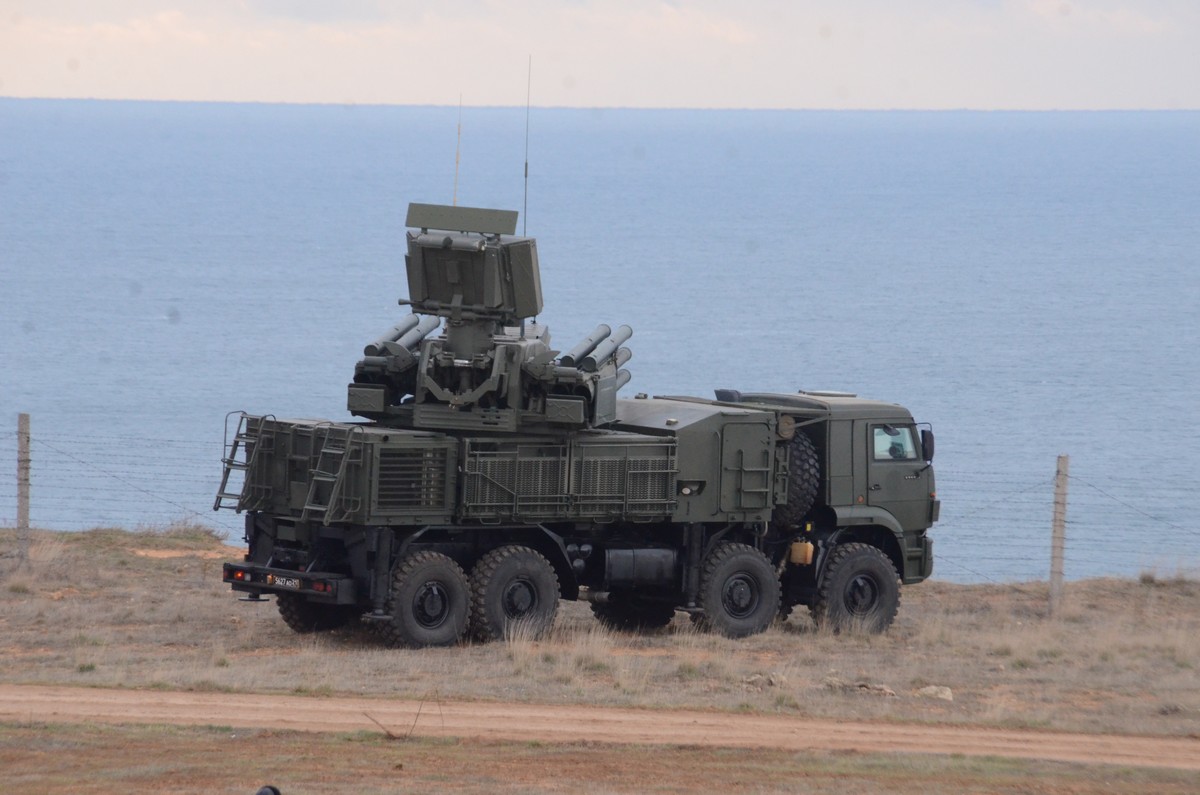
The Pantsir-S1 (NATO: SA-22 Greyhound), built by Russia’s state-owned Almaz-Antey, mounts up to 12 short-range surface-to-air missiles alongside two 30 mm automatic cannons on a mobile truck chassis. It is designed to defend airfields, command posts and longer-range air defense batteries such as the S-300 and S-400 against aircraft, helicopters, cruise missiles and drones at ranges up to about 20 kilometers, according to the Center for Strategic and International Studies. Russia has fielded the system heavily in Ukraine, where the open-source monitoring project Oryx has visually confirmed more than 50 Pantsir losses since February 2022, a record that has fed skepticism in Baku about the system’s survivability against modern drone threats.
The armored vehicles covered by the new MRO agreement are older Russian exports rather than new equipment. Azerbaijan’s T-90S tanks and BMP-3 vehicles arrived under contracts signed in the early 2010s as part of a broader arms relationship; the Stockholm International Peace Research Institute estimates Russian-made weapons accounted for roughly 60 percent of Azerbaijan’s major arms imports between 2011 and 2020.
Who Uses It
Azerbaijan is the confirmed operator of the armored fleet covered by the repair program. For the Pantsir-S1, Russia has previously exported the system to several customers, including the United Arab Emirates, Algeria and Syria, though neither Shugayev nor Russian state media named any existing Pantsir customers in the Azerbaijan remarks, and Azerbaijan is not currently listed as an operator.
Export/Procurement History
Russian-Azerbaijani military-technical ties have been under strain since December 2024, when an Azerbaijan Airlines Embraer 190 flying from Baku to Grozny was damaged, Moscow later acknowledged, by Russian air defense fire near Grozny before crashing in Kazakhstan and killing 38 of the 67 people aboard. Russian President Vladimir Putin acknowledged Russian air defense involvement in October 2025, and the two governments announced a compensation settlement on April 15, 2026, alongside a pledge to expand cooperation. Russia’s full-scale invasion of Ukraine has also squeezed Rosoboronexport’s capacity to fulfill foreign contracts on schedule; Aliyev himself flagged delivery delays in December 2024.
The November 1 announcement is the clearest sign yet that Moscow and Baku are moving past that friction, even as Baku visibly diversifies away from exclusive reliance on either Russia or Turkey.
Global Competitors
Azerbaijan has spent 2026 spreading its procurement across multiple suppliers rather than deepening dependence on any single one. At the ADEX 2026 defense exhibition in Baku, Azerbaijan signed Turkish agreements reportedly worth more than $500 million, covering 14 Hürkuş-II trainer aircraft from Turkish Aerospace, Baykar’s Mızrak loitering munition and Roketsan’s Barbaros coastal defense system. Baku has also shown interest in Israeli systems and in domestic production, while regional rival Armenia has pursued Indian-made Pinaka rocket systems and French air defense equipment. For Moscow, the Pantsir pitch to Azerbaijan runs alongside parallel efforts to sell the same system, and the export Su-57E fighter, to other former Soviet and Middle Eastern markets, including Algeria, Kazakhstan and Egypt, as Russia tries to rebuild an arms-export order book it says has already passed $60 billion despite sanctions and wartime production strain.
Why It Matters
The repair-facility program is a low-cost, politically useful way for Moscow to re-anchor itself in Azerbaijan’s defense-industrial life without committing new combat systems or large sums upfront, at a moment when Baku has publicly cooled toward Ankara. For Baku, restoring Russian maintenance support for a tank and infantry-vehicle fleet it already owns is a pragmatic hedge, even as it keeps building parallel relationships with Turkey, Israel and domestic manufacturers. The episode also illustrates a broader pattern across the Caucasus and Central Asia this year: states that depend on Russian-origin hardware are managing that dependence carefully, extracting sustainment and modernization deals from Moscow while declining, so far, to commit to major new Russian weapons purchases such as the Pantsir-S1.
Former Azerbaijani deputy defense minister Isa Sadigov publicly questioned the logic of the deal in comments to Kyiv Post, arguing Azerbaijan has its own repair capacity, warning the program could be used to funnel Azerbaijani-held equipment toward Russia’s war effort, and noting Moscow’s own wartime demand for spare parts and ammunition makes timely Pantsir deliveries doubtful. Neither government has addressed that claim, and no evidence has been presented that equipment transfers are planned.
What Happens Next
Watch for the release of financial and scheduling details on the MRO program, which neither Moscow nor Baku has published, and for whether Azerbaijan takes any public step toward a Pantsir-S1 contract beyond Shugayev’s expectation that it eventually will. Azerbaijan’s continued engagement with Turkish, Israeli and domestic suppliers will be the clearer signal of how much weight Baku actually places on the Russian repair offer.
FAQ
What did Russia and Azerbaijan actually sign?
A program covering the construction and modernization of maintenance, repair and overhaul facilities in Azerbaijan for armored vehicles already in Azerbaijani service, such as T-90S tanks, BMP-3 infantry fighting vehicles and BTR-80A armored personnel carriers. It does not involve new weapons purchases.
Has Azerbaijan agreed to buy the Pantsir-S1?
No. Russian officials have said they are pursuing such a sale and expect Azerbaijan to eventually agree, but no contract, quantity or price has been announced, and Azerbaijan has not confirmed an intent to buy.
Why are Russia-Azerbaijan ties improving now?
The two sides reached a compensation settlement in April 2026 over the December 2024 Azerbaijan Airlines crash that Russian air defenses caused, removing a major point of friction. The timing also coincides with visible tension between Azerbaijan and Turkey after Aliyev skipped the Organization of Turkic States summit in Ankara.
Is Azerbaijan moving away from Turkey as a supplier?
There is no indication of that. Azerbaijan signed more than $500 million in new Turkish defense agreements at ADEX 2026 in Baku in the same period, suggesting Baku is diversifying its supplier base rather than replacing one partner with another.
What is the Pantsir-S1’s combat record?
The system has seen heavy use, and heavy losses, in Russia’s war in Ukraine. The open-source project Oryx has visually confirmed more than 50 Russian Pantsir losses since February 2022, a record that has raised questions among potential buyers about its performance against drones.
Sources
- Aviation A2Z, “Russia Moves To Rebuild Azerbaijan Military Ties,” Nov. 2, 2026 — primary account of Shugayev’s remarks, equipment details and Turkish competing contracts.
- Kyiv Post, Nov. 3, 2026 — reporting on the agreement, Pantsir talks, Oryx loss data and Isa Sadigov’s criticism.
- Caspian Post, “Russia Seeks Pantsir-S1 Air Defense Deal With Azerbaijan,” Nov. 2, 2026 — corroborating account of Shugayev’s Zvezda interview.
- Times of Central Asia, “Russia–Azerbaijan Military Cooperation Expands Amid Baku–Ankara Tensions” — context on the Ankara summit timing and Baku-Ankara friction.
- Stockholm International Peace Research Institute (SIPRI) arms transfer data, cited via multiple outlets — basis for the 60 percent figure on Russian arms share in Azerbaijani imports, 2011-2020.
- Center for Strategic and International Studies, Missile Defense Project, Pantsir-S1 system profile — technical specifications.
- Oryx (oryxspioenkop.com), open-source equipment loss tracker — Pantsir loss count in Ukraine.