

Kongsberg Signs $404 Million Marine Corps Deal for Naval Strike Missile Launchers

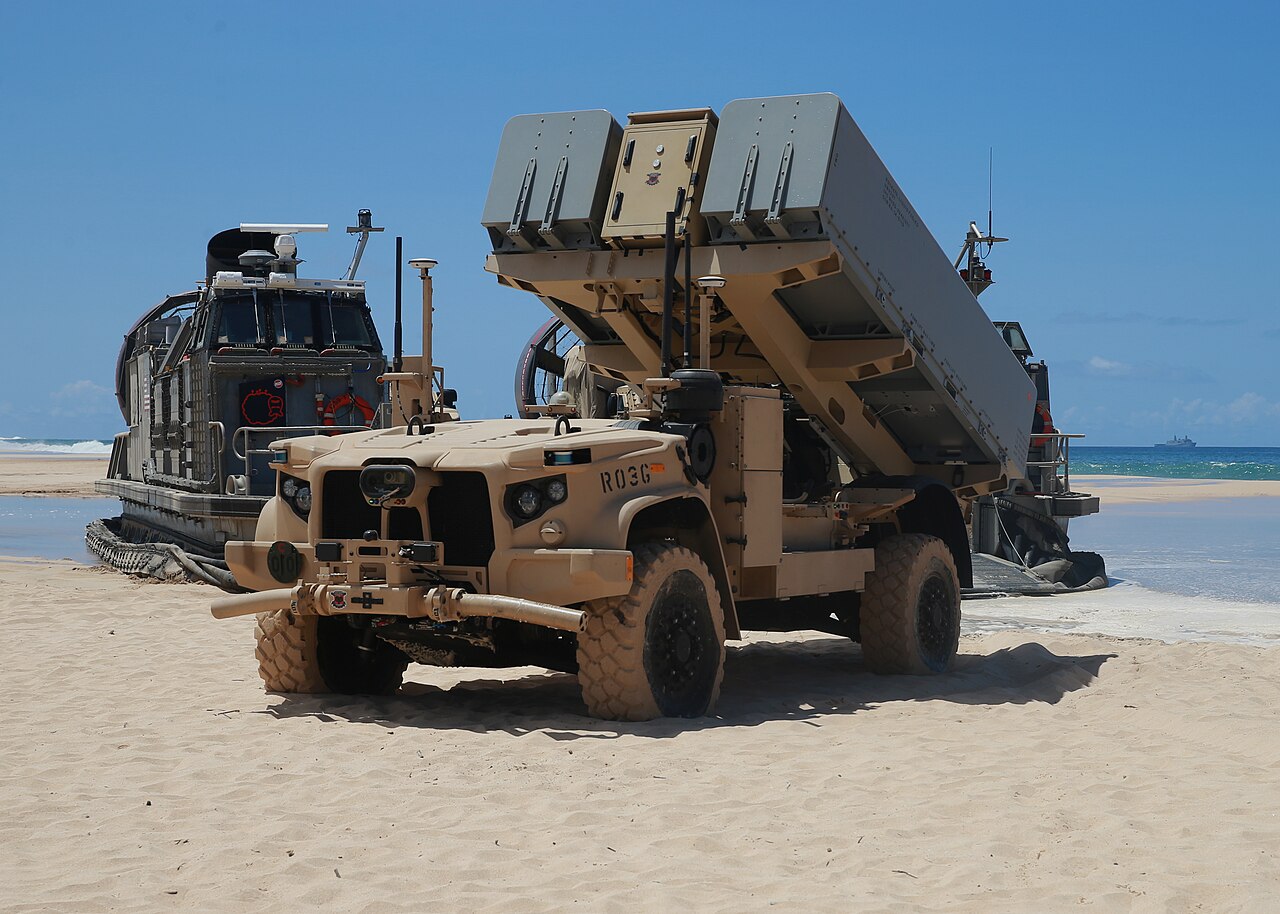
Kongsberg has signed a framework agreement with the US Marine Corps covering Naval Strike Missile launchers, weapon control systems and support equipment, with a potential value of up to $404 million and deliveries that could run through 2034. The Norwegian company announced the deal on September 28.
The figure is a ceiling, not a firm order. The Marine Corps will place individual call-offs under the framework, and Kongsberg said it will announce significant orders as they arrive. According to the contract notice, no funds were obligated at award, so actual quantities will depend on later delivery and task orders.
Kongsberg Naval Strike Missile Contract With the US Marine Corps
The agreement covers full-rate production and sustainment of the launcher unit, the weapon control system and ancillary equipment. That separates it from the missile purchases that have dominated Naval Strike Missile headlines. Here the money goes to the shooters and the gear that manages them, plus long-term support for firing units that operate away from fixed bases.
| Item | Detail |
|---|---|
| Parties | Kongsberg Defence & Aerospace and the US Marine Corps |
| Instrument | Framework agreement with individual call-offs |
| Potential value | Up to $404 million (about $404.35 million in the contract listing) |
| Scope | Launcher unit, weapon control system, ancillary equipment, production and sustainment |
| Period | Work expected to finish by September 24, 2034 |
| Work share | About 85 percent in Kongsberg, Norway; 15 percent in Johnstown, Pennsylvania |
| Funding at award | None obligated; funds flow through delivery and task orders |
| Announced | September 28, 2026 (Kongsberg) |
The deal follows a multi-year missile contract signed in November 2024 for the US Navy and Marine Corps, valued at about NOK 10 billion (roughly $900 million) and up to NOK 12 billion with options. Read together, the two agreements cover both the missiles and, now, the launchers that fire them.
What Is the Naval Strike Missile (NSM)?
The Naval Strike Missile, or NSM, is a long-range, sea-skimming anti-ship and land-attack missile developed and built by Kongsberg Defence & Aerospace. It originated in Norway as a successor to the Penguin missile, and its original Norwegian designation translates as “new sea target missile.” The initial serial production contract was signed in June 2007.
The missile passed its final development milestone with tests at Point Mugu in June 2011. The Royal Norwegian Navy made the first firing from the frigate HNoMS Glimt in October 2012, and a live warhead test against the decommissioned frigate HNoMS Trondheim followed in June 2013. On May 31, 2018, the US Navy selected the NSM as the over-the-horizon anti-ship weapon for its Littoral Combat Ships and designated it RGM-184A.
Naval Strike Missile Range, Speed and Specifications
Kongsberg describes the missile as having a range of more than 300 kilometres, a passive seeker and autonomous target recognition, and it says the seeker is designed to identify the intended target before impact. Public references list earlier figures of more than 200 kilometres for the baseline missile and about 250 kilometres for the NSM 1A, so the 300-kilometre figure reflects newer extended-range work.
| Parameter | Value |
|---|---|
| Length | 3.96 m with booster; 3.48 m without |
| Mass | About 400 kg with booster; 350 kg without |
| Warhead | 120 kg titanium-cased penetrating blast and fragmentation warhead |
| Speed | High subsonic, about Mach 0.93 |
| Range | More than 200 km baseline; about 250 km NSM 1A; Kongsberg cites more than 300 km |
| Engine | Turbojet with solid rocket booster |
| Guidance | GPS-aided inertial navigation, terrain referencing, laser altimeter, imaging infrared seeker |
| Reported unit cost | About $2.19 million (FY2021 dollars, per public references to US budget data) |
The missile flies a sea-skimming profile to complicate defence by modern shipboard air defence systems. A subsonic missile gives up speed but gains low cost and low observability compared with supersonic designs, a trade Kongsberg has leaned on for years.
What Is NMESIS? The Marine Corps Anti-Ship Missile System
NMESIS is the Navy/Marine Expeditionary Ship Interdiction System, a land-based, unmanned anti-ship missile launcher built for Marine Littoral Regiments in the Indo-Pacific. The launchers feed the Marine Corps concept of expeditionary advanced base operations, in which small units spread across islands and coastlines, fire, and move before an adversary can respond. Marines describe the tactic as “scoot and shoot.”
| Element | What it is | Notes |
|---|---|---|
| Naval Strike Missile | Sea-skimming, high-subsonic anti-ship and land-attack missile | Kongsberg cites range above 300 km; passive infrared seeker with terrain-referenced navigation |
| ROGUE-Fires launcher | Unmanned launcher on a Joint Light Tactical Vehicle chassis | Carries two missiles per launcher |
| Command-and-control vehicle | Separate vehicle that controls the launchers | Part of the launcher and weapon control scope covered by the framework |
| Missile supply | Multi-year missile contract signed in November 2024 | About NOK 10 billion, up to NOK 12 billion with options |
NMESIS Fielding Timeline
| Date | Event |
|---|---|
| May 2018 | US Navy selects NSM for Littoral Combat Ships as the RGM-184A |
| November 2024 | Kongsberg wins multi-year NSM contract for the US Navy and Marine Corps |
| December 2024 | Hawaii-based Marine Littoral Regiment receives its first NMESIS (USNI News) |
| September 2025 | Marines train with NMESIS in Japan for the first time (USNI News) |
| June 2026 | 12th Marine Littoral Regiment receives NMESIS in Okinawa; 3rd MLR operates it during KAMANDAG 10 in the Batanes Islands |
| September 28, 2026 | Kongsberg announces the $404 million launcher framework |
The June 2026 exercise activity is notable because it put NMESIS in the Philippines’ Batanes Islands, close to the Luzon Strait, alongside the Marine Air Defense Integrated System. Public references also cite long-term Marine Corps plans for roughly 260 NMESIS systems in the early 2030s, though the contract notice for this framework does not specify quantities.
Which Countries Use the Naval Strike Missile?
The NSM has become one of the most widely adopted Western anti-ship missiles, and its customer list keeps growing.
| Country | Platforms and roles |
|---|---|
| United States | Arleigh Burke-class destroyers, Littoral Combat Ships, Constellation-class frigates; Marine Corps NMESIS |
| Norway | Skjold-class corvettes, Fridtjof Nansen-class frigates |
| United Kingdom | Type 23, Type 45 and Type 31 ships |
| Australia | Anzac-, Hobart- and Hunter-class ships |
| Netherlands | De Zeven Provinciën-class frigates |
| Poland | Wicher-class frigates under construction; Coastal Missile Squadron |
| Announced or planned | Belgium, Canada, Denmark, Germany, Romania and Spain for naval platforms; Denmark, Latvia, Romania and Bulgaria for coastal defence |
The Royal Navy’s Type 31 frigates are set to receive Mk 41 cells and strike missiles, one of several European programmes built around the NSM.
Kongsberg Defence & Aerospace Company Profile
| Item | Detail |
|---|---|
| Headquarters | Kongsberg, Norway |
| Founded | 1814 |
| Employees | About 14,600 (2024) |
| Revenue | NOK 48.9 billion (2024) |
| Ownership | Norwegian state holds about 50 percent |
| Defence unit | Kongsberg Defence & Aerospace: missiles, command and control, weapon control and surveillance |
| Key defence products | Naval Strike Missile, Penguin, NASAMS air defence, Protector remote weapon stations |
Why Launcher Production Matters for the Marine Corps
Mobility is the point of the concept. A launcher that can move, fire and relocate is harder to find and target than a fixed coastal battery, and the Marine Corps has built much of its distributed maritime thinking on that idea. But every launcher carries only two missiles, so each additional firing unit adds to the missile requirement as well as the vehicle count.
That arithmetic is why a launcher-focused framework matters after a missile contract. The 2024 deal secured the weapons; this one gives the Marine Corps a way to buy the platforms and control equipment that make them usable, without committing to a fixed quantity up front. The flip side is uncertainty. With no funds obligated, the real size of the programme will only show up as call-offs are issued.
The work split also carries a supply-chain angle. With about 85 percent of the work in Norway, deliveries depend on a transatlantic line, while the 15 percent in Johnstown gives the programme a US production foothold. Neither company has said how that split might shift if quantities rise.
Naval Strike Missile FAQ
How far can the Naval Strike Missile fly?
Kongsberg cites a range of more than 300 kilometres. Earlier public figures put the baseline missile above 200 kilometres and the NSM 1A at about 250 kilometres.
Who makes the Naval Strike Missile?
Kongsberg Defence & Aerospace in Norway developed and builds it. Raytheon produces the missile for US customers in partnership with Kongsberg.
What is the $404 million Kongsberg agreement worth?
It has a potential value of up to $404 million, but it is a framework agreement. No funds were obligated at award, and the Marine Corps will place call-offs over time through 2034.
How many missiles does an NMESIS launcher carry?
Each launcher carries two Naval Strike Missiles.
How much does a Naval Strike Missile cost?
Public references to US budget data cite about $2.19 million per missile in FY2021 dollars. Current prices may differ.
Which navies use the NSM?
Users include the United States, Norway, the United Kingdom, Australia, the Netherlands and Poland, with several more countries announced or planned.
- Naval News – “Kongsberg Signs $404 Million Framework Agreement for USMC NSM Equipment” (September 2026)
- Defence-Industry.eu – “Kongsberg secures U.S. Marine Corps Naval Strike Missile launcher agreement with potential value of $404 million through 2034” (September 28, 2026)
- Naval Today – “Kongsberg to supply NSM equipment to US Marine Corps” (September 28, 2026)
- Army Recognition – “U.S. Marines Expand NMESIS Anti-Ship Missile Force With $404M Kongsberg Award” (2026)
- USNI News – “Hawaii Marine Littoral Regiment Receives First Anti-ship Missile System” (December 2, 2024) and “U.S. Marines Train with NMESIS Anti-ship Launcher in Japan for First Time” (September 5, 2025)
- Naval News – “KONGSBERG awarded contract to deliver NSM to US Navy and Marine Corps” (November 2024)
- Wikipedia – Naval Strike Missile; Kongsberg Gruppen (specifications, history and company data)


[…] It is also the standard interceptor for NASAMS, the ground-based air defense system built by Kongsberg and Raytheon and used by a dozen or more countries. That dual role has pushed orders up as European and Middle Eastern governments restock air defenses. Readers following that side of the market may want to see Kongsberg’s $404 million Marine Corps launcher deal. […]