MKE: Company Profile, Products, Exports and Role in the Turkish Defense Industry (2026)
MKE (Makine ve Kimya Endüstrisi A.Ş.) is the oldest institution in the Turkish defense industry and the country’s main maker of ammunition, artillery, rifles and explosives. The company traces its roots to the Ottoman imperial arsenal of the 15th century, and today it is a state-owned joint-stock company under the Ministry of National Defence. In 2025 it delivered more than 95 million small-arms rounds and over 450 heavy weapon systems, and it has quickly turned into an exporter, opening joint ventures in the Gulf and Egypt.
- Roots: the Tophane-i Âmire imperial arsenal, dated by the company to 1453; reorganised as MKEK in 1950; became MKE A.Ş., a joint-stock company, in 2021
- Ownership: 100% state-owned; shareholder rights exercised by the Ministry of National Defence; cannot be privatised by law
- General manager: İlhami Keleş
- Revenue: about $1.14 billion in 2024; Defense News Top 100 2026 ranks it 81st with $1.42 billion in FY2025 defence revenue
- Factories: more than ten, mainly in Kırıkkale, Ankara and Çankırı
- Exports: to more than 105 countries; production facilities set up in nine countries
- Key products: 155 mm and other artillery ammunition, MPT-76/MPT-55 rifles, BORAN howitzer, ALTAY 120 mm tank gun, TOLGA air defence system, aircraft bombs
Overview
MKE produces more than 1,000 different items, from pistol cartridges and hand grenades to heavy artillery shells, aircraft bombs, rocket motors, propellants and weapons. It is the main supplier of ammunition to the Turkish Armed Forces and a key supplier of energetic materials to other Turkish companies. Since 2021 it has operated as a joint-stock company. The Treasury owns all of its capital, and the Ministry of National Defence exercises the shareholder rights. Deputy Defence Minister Alpaslan Kavaklıoğlu chairs the board and İlhami Keleş is general manager.
The company’s revenue was about $1.14 billion in 2024. In the Defense News Top 100 list published in 2026, MKE ranked 81st in the world with $1.42 billion in defence revenue for fiscal 2025, up from 80th the year before on a different base. SIPRI also added MKE to its global top 100 for the first time for 2024. The company reports a local content rate above 80%.
History
MKE says its history began in 1453 with the founding of the Tophane-i Âmire, the imperial cannon foundry in Istanbul. Over the following centuries the Ottoman state built gunpowder mills, small-arms workshops and shipyards that later formed the core of the Republic’s military industry. The organisation was reformed in 1832, attached to the Ministry of War in 1908 and turned into the General Directorate of Military Factories in 1923, soon after the founding of the Republic.
On 15 March 1950 the factories were reorganised as the Mechanical and Chemical Industry Corporation (MKEK), a state economic enterprise with factories across central Anatolia. For decades MKEK built licensed weapons such as the G3 and MG3, ammunition and civilian products. A law published in July 2021 turned it into MKE A.Ş., a joint-stock company with greater commercial freedom, which has since invested heavily in new lines and export markets.
Products by domain
Ammunition and explosives
Ammunition is MKE’s core business. The company makes small-arms rounds in all NATO calibres, mortar and tank rounds, artillery shells including long-range 155 mm ammunition, aircraft bombs, rocket motors, propellants and explosives. Its Kırıkkale complex houses ammunition, brass, explosives, heavy weapons and small-arms factories, while plants in Ankara make propellants, pyrotechnics and the MAKSAM gas masks.
Rifles and small arms
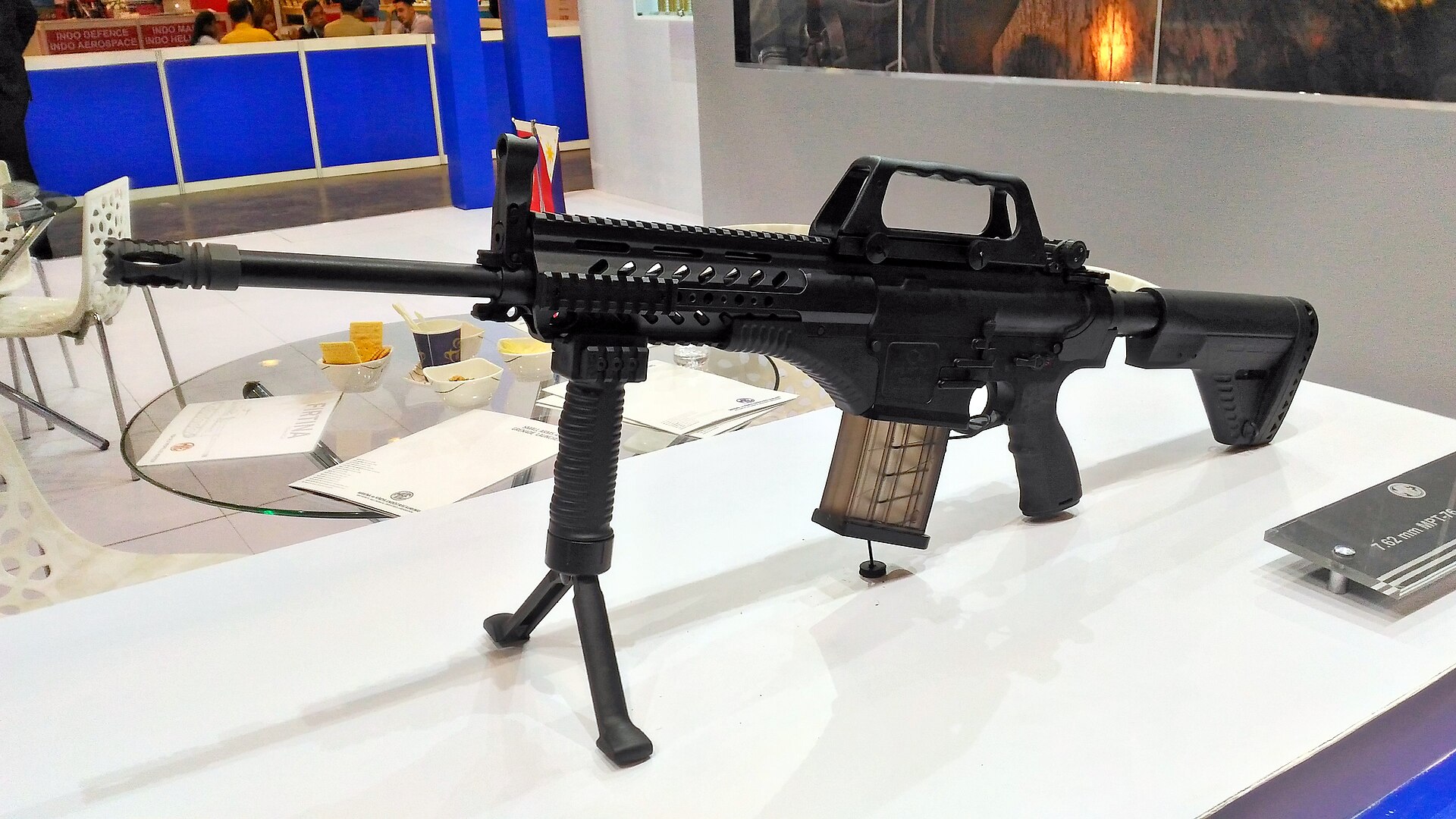
The MPT-76 (7.62×51 mm) became the standard Turkish infantry rifle in 2014-2016, followed by the 5.56 mm MPT-55. Around 66,000 had been built by 2019, and a further order for more than 350,000 followed. A lighter MPT-76 MH variant was delivered to the Land Forces in July 2026. For a wider view, see our guide to the Turkish small arms industry and our profile of private rifle maker Canik.
Artillery and heavy weapons
MKE builds the BORAN 105 mm lightweight towed howitzer at its Çankırı factory and supplies the 120 mm/55-calibre smoothbore gun for the ALTAY tank, built under licence from Hyundai WIA. It also makes 76 mm naval guns and is developing a 127 mm gun. These systems sit alongside the larger artillery covered in our guide to Turkish artillery and rocket launchers.
Air defence and missiles
TOLGA is a short-range air defence and counter-drone gun system that forms part of the close-in layer of Türkiye’s Steel Dome. At SAHA 2026 MKE also displayed the ENFAL-17 missile, a sign that it wants to move up the value chain.
Exports and international deals
MKE says it sells to more than 105 countries and has built production facilities in nine, most recently in Mongolia and Jordan in 2025. BORAN howitzers were exported to Bangladesh in 2024 and North Macedonia in 2025. The company has a legal entity in Azerbaijan and is setting up joint ventures in Canada.
2026 brought a wave of Middle Eastern deals. In January, at DIMDEX in Doha, MKE signed a memorandum with Qatar’s Barzan Holdings to set up a joint venture and explosives production, and TOLGA won its first export order for Qatar. In February the Turkish defence ministry announced three contracts with Egypt worth a combined $350 million, covering a 155 mm ammunition plant, cartridge production and TOLGA. The same month, at the World Defense Show in Riyadh, MKE signed memorandums with Saudi Arabia’s Al Talbiah for joint production of TOLGA and 122 mm rockets and with Saudi Chemical Co. for energetic materials. Talks on 42 BORAN howitzers for Saudi Arabia are also under way.
Recent contracts and news (2025-2026)
At the end of 2025 MKE reported record deliveries for the year: more than 95 million small-arms rounds, over 990,000 rockets, explosives and heavy rounds, more than 2,950 aircraft bombs, over 17,000 small arms and more than 450 heavy weapon systems. It invested about TRY 150 million in the Çankırı factory in 2025 and planned about TRY 1 billion for 2026.
In May 2026, at SAHA, it signed a rifle export agreement with US firm Century Arms covering 12 semi-automatic models. In September 2026 it set up Zafer, a wholly owned subsidiary in Cairo, as explained in our report on MKE’s Egyptian subsidiary, and signed a memorandum with Egypt’s Ministry of Military Production. MKE is also bidding in a Malaysian tender.
Role in the Turkish defense industry
MKE is the foundation of the munitions supply chain. Missile makers such as ROKETSAN rely on its explosives and propellants, the army relies on its artillery shells and rifles, and the air force on its bombs. The war in Ukraine showed how quickly modern conflicts consume ammunition, which has made MKE’s capacity a strategic asset for the Turkish defense industry and for allies looking for new suppliers of 155 mm rounds.
Outlook
MKE’s priorities are to expand ammunition capacity, grow exports through local production partnerships and add higher-value products such as air defence systems and missiles. The Gulf and North Africa are its fastest-growing markets, and the joint-venture model lets it meet demands for local industry. The main challenges are modernising old factories, raising productivity and competing with larger European and Korean munitions makers.
FAQ
Who owns MKE?
MKE is fully state-owned. The Treasury holds the capital and the Ministry of National Defence exercises shareholder rights. By law it cannot be privatised.
How old is MKE?
The company dates its origins to the Ottoman imperial arsenal founded in 1453. It was reorganised as MKEK in 1950 and became a joint-stock company in 2021.
What does MKE produce?
It makes ammunition of all calibres, artillery shells, aircraft bombs, explosives, rifles such as the MPT-76, the BORAN howitzer, the ALTAY tank gun and the TOLGA air defence system.
Where does MKE rank globally?
It was 81st in the Defense News Top 100 2026, with $1.42 billion in defence revenue.
Featured image: Rhk111, CC BY-SA 4.0, via Wikimedia Commons