H-6K Bomber Specs, Range, Weapons and Variants
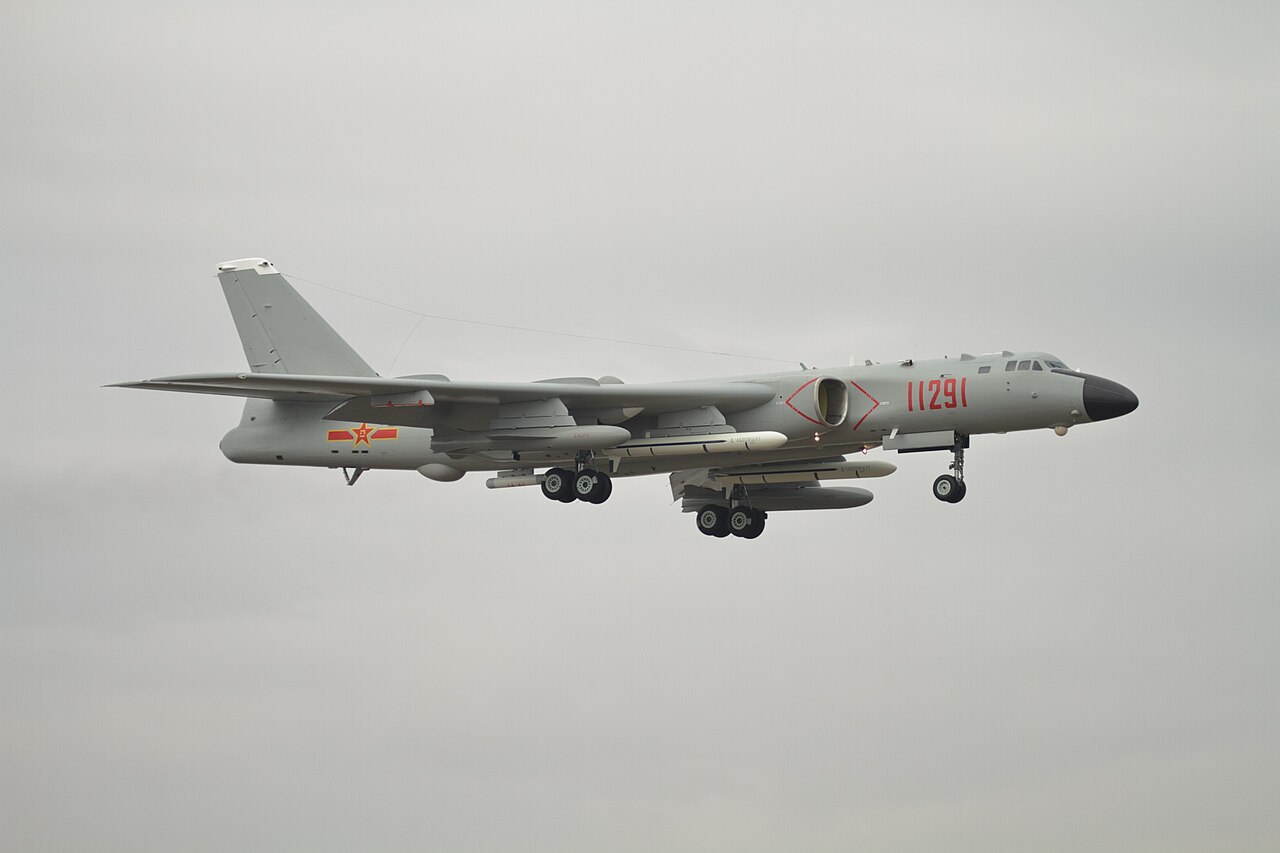
The Xian H-6K is China’s most capable in-service bomber, a modernized Tu-16 derivative that Chinese sources credit with a combat radius of about 3,500 km and six underwing hardpoints for long-range cruise missiles. It is not stealthy and it is not fast, but it gives the People’s Liberation Army a standoff strike platform that can reach US bases at Guam when paired with its missiles.
What is the H-6K bomber
The H-6K is a twin-engine, subsonic strategic bomber built by Xi’an Aircraft Industrial Corporation, part of AVIC. Its lineage goes back to the Soviet Tu-16 Badger, which China received in the late 1950s and began producing under license. Sixty-plus years later, the airframe is still flying, with new engines, avionics and weapons making it a very different aircraft from its ancestor.
The H-6K first flew in 2007 and appeared in public form around 2009, according to Chinese reporting. Its purpose is straightforward. It carries air-launched cruise missiles from outside the reach of most air defenses, and it does so in numbers that can saturate a target.
H-6K specifications
| Parameter | Value |
|---|---|
| Role | Long-range bomber and missile carrier |
| Manufacturer | Xi’an Aircraft Industrial Corporation (AVIC) |
| Crew | About 3, according to Western analysts |
| Length / wingspan | Roughly 35 m / 33 m |
| Engines | 2 x Chinese-built WS-18 turbofans, derived from the Russian D-30KP-2 |
| Maximum speed | About Mach 0.75 (roughly 800 km/h) |
| Combat radius | About 3,500 km (Chinese claim) |
| Maximum weapons load | About 12,000 kg (Chinese claim) |
| Hardpoints | 6 underwing, plus an internal bay in some variants |
| Air refueling | Probe fitted in the nose, reported |
The most visible changes from earlier H-6 bombers are the larger nose, which houses a modern radar, and the new engines, which give better range and lower fuel use. Reducing the crew and upgrading the cockpit with glass displays also modernized how the aircraft is flown and how its weapons are managed.
H-6K weapons and range
The H-6K’s primary weapon is the CJ-20 (also reported as CJ-10K), an air-launched land-attack cruise missile that Chinese sources give a range of about 2,000 km or more. With six of them and a combat radius of around 3,500 km, the bomber could in theory strike targets more than 5,000 km from its base. That is a claim rather than a demonstrated figure, and it assumes the aircraft survives long enough to launch.
The platform also carries anti-ship missiles and land-attack weapons, which fits its role in any Western Pacific contest. China’s intermediate-range ballistic missiles, such as the DF-26 and the anti-ship DF-21D, cover similar ground from the land, and bombers add a flexible, recallable strike option. Its survivability depends on the fact that a large, non-stealthy aircraft is easy to spot with modern radar, a point explained in this site’s guide to radar cross section.
H-6 variants, including H-6N and H-6J
| Variant | Operator | Notable features |
|---|---|---|
| H-6K | PLA Air Force | New engines, new radar, six hardpoints for CJ-20 missiles |
| H-6N | PLA Air Force | In-flight refueling probe, modified fuselage to carry a large air-launched missile, reported ballistic |
| H-6J | PLA Navy | Anti-ship variant carrying YJ-12 missiles, per Chinese sources |
| H-6G | PLA Navy | Older naval anti-ship variant with YJ-83 missiles |
| H-6U | PLA Air Force | Tanker conversion, reported |
The H-6N is the variant to watch. Its recessed fuselage and air-refueling probe point to a bomber built to carry a large missile, widely reported as an air-launched ballistic missile with possible hypersonic ambitions. Chinese officials have not published specifications, so the details remain analytic inference.
H-6K operators and deployments
The H-6K is operated by the People’s Liberation Army Air Force, with naval variants flown by the PLA Navy. It has no combat record, but it has been visible. H-6Ks have flown patrols around Taiwan and the Japanese islands, landed at Woody Island in the South China Sea in 2018, and joined Russian Tu-95 bombers on joint patrols near Japan and Korea from 2019 onward. These flights send political messages as much as they train crews.
H-6K frequently asked questions
What is the range of the H-6K?
Chinese sources give a combat radius of about 3,500 km. That is a claim, not verified data, and the radius shrinks with heavy loads.
Is the H-6K based on a Soviet bomber?
Yes. It descends from the Tu-16 Badger, which China produced under license as the H-6 from the late 1950s.
Can the H-6K carry nuclear weapons?
Western analysts assess that some H-6 variants are nuclear-capable, but China has not published details.
What is the difference between the H-6K and H-6N?
The H-6N adds an air-refueling probe and a modified fuselage for a large air-launched missile, and is reported to have a more strategic role.
Does the H-6K have a stealth design?
No. It is a conventional subsonic airframe, and China is reportedly developing a separate stealth bomber.
- Chinese state media and AVIC publications (manufacturer claims)
- Wikipedia – Xian H-6 (accessed October 2026)
- US Department of Defense annual report on Chinese military power
- Defence & Tech reporting on Chinese military aviation