General Atomics Unveils Ranger Glider UUV That Can Launch Drones
General Atomics Electromagnetic Systems has shown its Ranger and GA-Ray (GRay) unmanned underwater vehicles at Euronaval 2026, pitching Ranger as a glider-based extra-large UUV that can carry dozens of smaller drones, large payloads and even launch a quadcopter. Naval News reported the presentation from the Paris show on November 9, 2026.
The vehicles come from GA-EMS, the San Diego group’s electromagnetic systems business, not from its better-known aircraft arm GA-ASI. Rolf Ziesing, GA-EMS vice president of maritime programmes, briefed Naval News on the concept. No customer or contract has been announced.
Ranger and GRay UUVs Shown at Euronaval 2026
GA-EMS describes Ranger and GRay as glide-based reconnaissance and effects systems for intelligence, surveillance, reconnaissance, strike and underwater warfare. Its product sheet places Ranger in the extra-large UUV (XLUUV) class and the 22-foot GRay in the large displacement (LDUUV) class.
Ziesing told Naval News that the company’s energy system lets a UUV operate for “multiple years or tens of thousands of kilometers.” The GA-EMS product page puts it at tens of thousands of nautical miles, depending on configuration.
| Item | Detail |
|---|---|
| Developer | General Atomics Electromagnetic Systems (GA-EMS) |
| Vehicles | Ranger (XLUUV) and GA-Ray / GRay (LDUUV) |
| Size | Ranger 100–135 ft; GRay 22 ft |
| Endurance | Ranger multi-year; GRay weeks to months |
| Propulsion | Buoyancy-driven blended-wing glider with thrusters and control surfaces |
| Navigation | INS, Doppler Velocity Log, optical communications, emerging quantum-enabled sensors |
| Missions | ISR, mine deployment, strike, underwater warfare |
| Testing to date | Submerged operations of up to 70 days |
| Status | Concept work; 22-ft vehicle used for risk reduction; no announced customer |
A Glider Design Instead of Propellers
GA-EMS chose a buoyancy-driven glider over propeller propulsion to stretch range and endurance. Ranger and GRay still carry thrusters and purpose-designed control surfaces, and the blended-wing body is meant to maximise internal volume, the company says.
The product sheet claims near-silent propulsion, a low acoustic signature and no mast, snorkel or routine surfacing. Navigation is designed to work without GPS.
A 22-foot dual-purpose vehicle is already in use for risk reduction and concept development, Naval News reported. The company plans to scale that work to a 100-foot-wingspan platform with cargo space roughly the size of a CONEX shipping container.
Payloads From Sub-UUVs to Quadcopters
Depending on variant, the host vehicle can carry 16 to 96 smaller sub-UUVs, and GA says both types have operated at sea. Alternative loads include two large-diameter UUVs, or a CONEX box dropped so the vehicle can stay on station. Ranger can also settle on the seabed and release payloads through a top-opening door.
The most unusual item on the stand was a submarine-launched quadcopter, fired from a tube on the UUV. GA did not disclose its specifications.
Ranger vs Other Large UUVs
Ziesing compared the glider’s range with today’s LDUUV and XLUUV designs and said it was “orders” of magnitude greater. That is a company claim, and the most mature vehicle in the comparison below has already proved part of its range at sea.
| Vehicle | Size and endurance | Status |
|---|---|---|
| GA-EMS Ranger | 100–135 ft; multi-year endurance claimed; 16–96 sub-UUVs | Concept shown at Euronaval 2026; no announced customer |
| GA-EMS GRay | 22 ft; weeks to months | 22-ft vehicle in use for risk reduction |
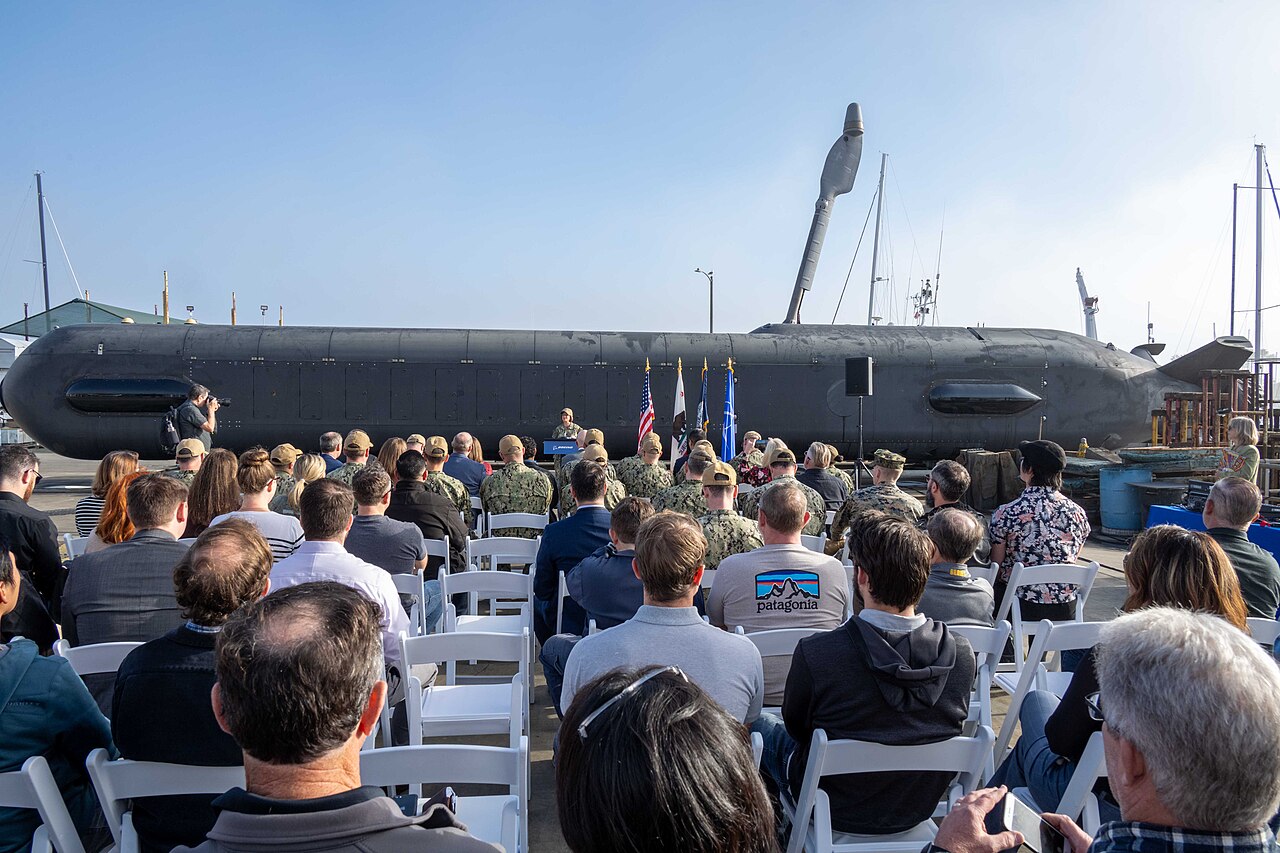
| Boeing Orca XLUUV | 51 ft plus 34-ft payload module; up to 6,500 nautical miles; up to 8 tons of payload or 48 small UUVs | US Navy vehicle; 1,000-nautical-mile Pacific transit in July 2026 |
| Northrop Grumman Manta Ray | Dimensions not disclosed; designed for long range and low power use | DARPA prototype; at-sea tests off Southern California in 2024 |
Orca is a real Navy vehicle with a demonstrated transit, while Ranger is still a concept scaled up from a 22-foot test vehicle. That reading is analysis, not a company claim. Large uncrewed submarines are not only an American trend, as China’s suspected XXLUUV mothership in Shanghai shows.
Hedge Force and the Pacific Case
Naval News tied the vehicles to the US Navy’s Hedge Force idea, introduced by Chief of Naval Operations Adm. Daryl Caudle at Surface Navy Association 2026, which pairs unmanned systems with warships, aircraft and submarines. GA-EMS argues its UUVs can take over some missions now flown by nuclear attack submarines and stay on station for months or years.
Concept graphics showed launches from Okinawa and Guam reaching First Island Chain chokepoints and waters near mainland China. A slow, quiet glider that rarely surfaces would be hard to find with the methods described in our explainer on anti-submarine warfare. That reading is analysis, not a company claim. Ziesing said the work has drawn “many interested parties” but named none.
General Atomics Company Profile
General Atomics is privately held by the Blue family, so it does not publish revenue. GA-EMS, the unit behind Ranger, is better known for electromagnetic aircraft launch and recovery systems for the US Navy.
| Item | Detail |
|---|---|
| Headquarters | San Diego, California |
| Founded | 1955, as a division of General Dynamics; acquired by the Blue family in 1986 |
| Ownership | Private |
| Employees | Over 14,000 (company figure, 2026) |
| Chairman and CEO | Neal Blue |
| Main businesses | GA-ASI (unmanned aircraft and sensors), GA-EMS (electromagnetic systems), Energy Group, Uranium Resources |
| Known programmes | Predator and Reaper UAVs, electromagnetic aircraft launch and recovery systems, DIII-D fusion research, TRIGA research reactors |
Ranger UUV FAQ
Which General Atomics company makes Ranger?
General Atomics Electromagnetic Systems (GA-EMS), not the aircraft maker GA-ASI.
How big is the Ranger UUV?
GA-EMS lists Ranger at 100 to 135 feet. The smaller GRay is 22 feet long.
What can Ranger carry?
Between 16 and 96 sub-UUVs depending on variant, two large-diameter UUVs, or a container-sized payload. GA also showed a tube-launched quadcopter.
Has the US Navy ordered Ranger?
No order has been announced. A 22-foot vehicle is being used for risk reduction, and tests have included submerged runs of up to 70 days.
- Naval News – “General Atomics Ranger UUV to Support Large Payloads, UAVs” (Euronaval 2026, November 9, 2026): navalnews.com
- General Atomics Electromagnetic Systems – “Unmanned Underwater Vehicles (UUVs)” (product page): ga.com
- General Atomics Electromagnetic Systems – “RANGER / GRay UUVs” (product sheet, Rev A): ga.com
- Naval News – “U.S. Navy Orca XLUUV Completes 1,000-Mile Pacific Transit” (August 2026): navalnews.com
- Boeing – “Orca XLUUV” (product page): boeing.com
- C4ISRNET – “Northrop’s colossal Manta Ray underwater drone passes at-sea tests” (May 2024): c4isrnet.com
- General Atomics – “About” (company page): ga.com