China’s Nuclear Submarines Explained: Type 094, Type 096 and the JL-3 Missile

For decades China’s nuclear arsenal lived almost entirely on land. That has changed. Today the People’s Liberation Army Navy keeps nuclear-armed ballistic missile submarines (SSBNs) on patrol, giving Beijing a survivable second-strike capability similar to those of the United States, Russia, Britain and France. Here is how China’s sea-based deterrent works and where it is going.
- Six Type 094 Jin-class SSBNs in service, per the Pentagon
- Each boat carries 12 submarine-launched ballistic missiles
- JL-3 can reach the continental US from Chinese waters
- Main base: Yulin on Hainan Island
- Quieter Type 096 is the next generation
The Type 094 Jin class
The Type 094, known in the West as the Jin class, is China’s first operational SSBN design. According to the Pentagon’s annual China Military Power Report, the PLA Navy operates six of them. Each boat is roughly 135 metres long and carries 12 submarine-launched ballistic missiles in a raised “hump” behind the sail. Improved Type 094A boats added better sensors and quieting, but Western analysts still consider the class noisier than modern American or Russian submarines.
From JL-2 to JL-3
The early Jin boats carried the JL-2 missile, with a range of about 7,000 kilometres. That was enough to hit Alaska or Hawaii from the South China Sea, but not most of the continental United States. The newer JL-3 changes that. US officials assess that the JL-3 has a range of more than 10,000 kilometres, allowing Chinese submarines to target the continental US while staying in protected waters close to home. The missile is believed to be able to carry multiple warheads.
The bastion strategy
China’s SSBNs are based at Yulin, near Sanya on Hainan Island, where underground tunnels give direct access to the deep waters of the South China Sea. Instead of sailing into the open Pacific, where American and Japanese anti-submarine forces are waiting, the boats can patrol a defended “bastion” protected by surface ships, aircraft and island bases. This is one reason Beijing’s military build-up in the South China Sea matters far beyond territorial disputes.
Type 096: the next generation
The Type 096 is China’s next-generation SSBN. Few verified details are public, but it is expected to be larger and much quieter than the Type 094 and to carry more JL-3 or follow-on missiles. US assessments suggest construction began in the first half of the 2020s. Once it enters service, it will make Chinese submarines far harder to track.
Why it matters
China’s nuclear arsenal is growing fast, with the Pentagon projecting more than 1,000 operational warheads by 2030. With New START expired in 2026 and no arms control framework covering China, the sea leg of its triad is a key part of a changing nuclear balance. A survivable submarine force means China no longer has to fear that a first strike could disarm it, which shapes crisis behaviour in the Taiwan Strait and beyond.
Limits and challenges
China still lacks the long experience in continuous deterrent patrols that the US, Britain and France have, and its command and control of submarines at sea is largely untested in a crisis. Noise remains a weakness for the Type 094. But the direction is clear: each new boat and missile narrows the gap with the established nuclear powers.
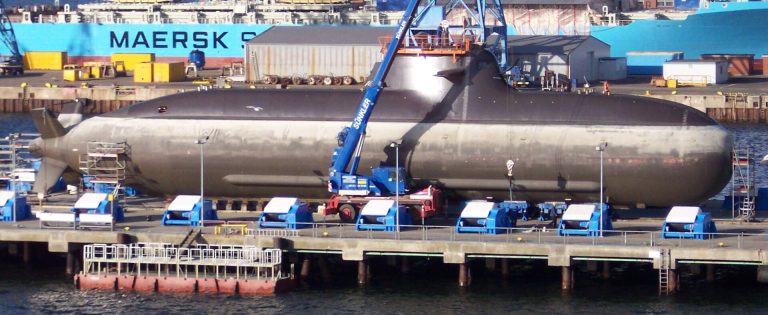
Featured image: CSR Report RL33153 China Naval Modernization: Implications for U.S. Navy Capabil / Public domain, via Wikimedia Commons