Bulava Missile Explained: Range, Warheads and Russia’s Borei Submarine Deterrent
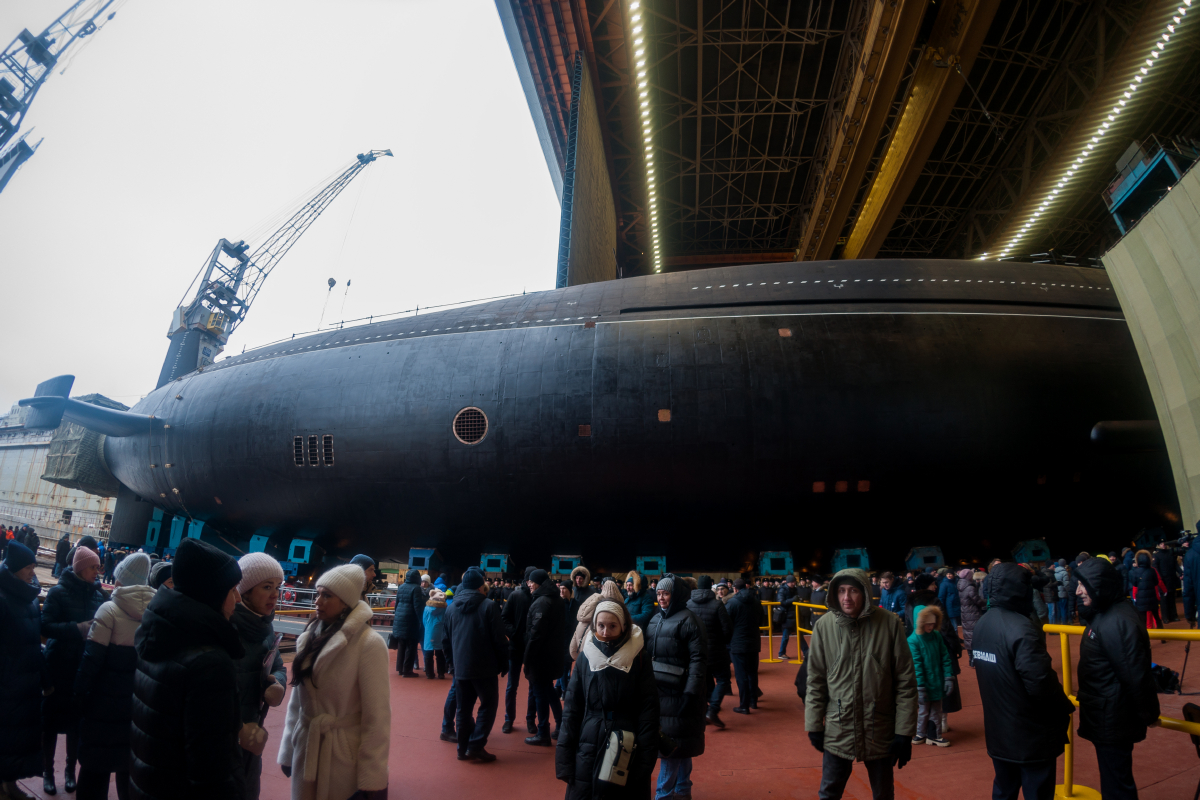
Russia’s most survivable nuclear weapons are not in silos or on trucks. They are hidden beneath the Arctic ice and the Pacific in Borei-class submarines, each armed with 16 Bulava missiles. The Bulava is now the backbone of Russia’s sea-based nuclear deterrent, but its road to service was one of the rockiest in modern missile history.
- Russian designation RSM-56 / 3M30 Bulava; NATO name SS-N-32
- Three-stage, solid-fuel submarine-launched ballistic missile
- Range of around 8,000 to 9,300 km
- Reportedly carries up to six to ten independently targeted warheads
- 16 missiles per Borei-class submarine
What is the Bulava?
The Bulava (“mace”) was developed by the Moscow Institute of Thermal Technology, the same design bureau behind the Topol-M and Yars land-based ICBMs. Russia chose it in the late 1990s to replace older liquid-fuel submarine missiles and to arm a new generation of ballistic missile submarines. It weighs about 37 tonnes at launch, light for a missile of its class, which lets it fit into the Borei’s launch tubes.
Range and warheads
Open sources usually put the Bulava’s range at around 8,000 to 9,300 km, enough to strike the United States from protected waters near Russia, such as the Barents Sea or the Sea of Okhotsk. It carries multiple independently targetable re-entry vehicles (MIRVs). Most estimates say six warheads of around 100 to 150 kilotons, although some sources suggest up to ten. It is also designed with manoeuvring features and decoys to complicate missile defence.
A troubled test history
The Bulava’s early trials were notoriously unreliable. Between 2005 and 2009 roughly half of its test launches failed, prompting calls in Russia to cancel it. After design and quality-control fixes, tests became more successful, including salvo launches, and the missile was declared operational in the 2010s.
The Borei-class submarines
The Bulava’s carrier is the Project 955/955A Borei class. The first boat, Yury Dolgoruky, entered service in 2013. Russia has since commissioned further improved Borei-A boats, including Knyaz Pozharsky in 2025, and plans a fleet of around a dozen split between the Northern and Pacific Fleets. Each submarine carries 16 Bulavas, potentially close to a hundred warheads per boat.
Why it matters
Submarine-launched missiles are the most survivable part of any nuclear triad, because hidden submarines are very hard to destroy in a first strike. As Russia retires its Soviet-era Delta-class submarines, the Bulava and Borei combination is becoming the core of its second-strike capability.
Verdict
The Bulava overcame a difficult start to become a mature strategic weapon. With new Borei-A boats joining the fleet, it will remain central to Russian nuclear strategy for decades, and a key factor in any future arms control talks between Moscow and Washington.
Featured image: Ministry of Defence of the Russian Federation / CC BY 4.0, via Wikimedia Commons