
How Fast Is the F-35? Top Speed, Ceiling and Agility
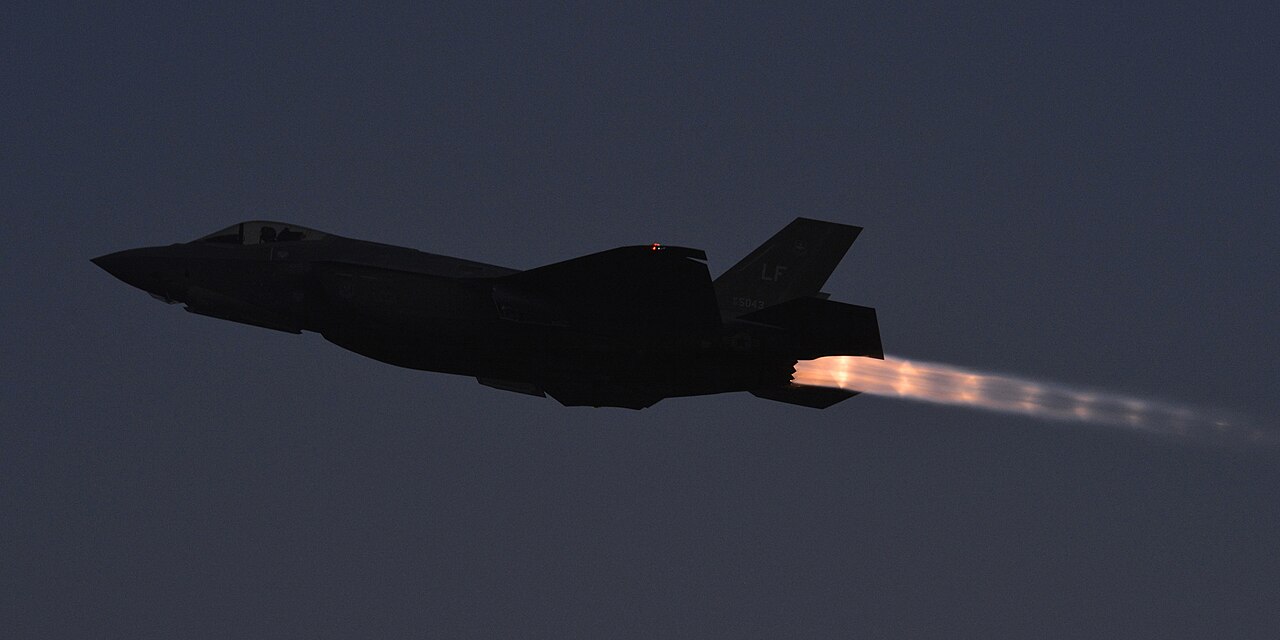
The F-35’s top speed is Mach 1.6, about 1,200 mph or 1,930 km/h, and the figure is the same for all three variants. That makes it slower than the F-16 it replaces and much slower than the F-22, a choice its designers made on purpose.
Speed was traded for stealth, internal fuel and internal weapons. The useful point is that the F-35 reaches Mach 1.6 with a full combat load inside, while older jets are well short of their brochure speeds once bombs and tanks hang under the wings. This guide covers the F-35 top speed, ceiling, g limits and what they mean in practice.
What is the top speed of the F-35?
The limit is Mach 1.6 at altitude. In everyday units that is roughly 1,200 mph, or 1,930 km/h. The F-35A, F-35B and F-35C share the same figure even though they differ in weight and wing size.
The jet gets there on one engine, the Pratt & Whitney F135, which produces about 28,000 lbf of thrust dry and 43,000 lbf with afterburner in the A and C models. It is the most powerful fighter engine in service, but it has a lot of aircraft to push: an F-35A weighs about 29,300 lb empty and carries 18,250 lb of fuel inside.
| Measure | F-35A | F-35B | F-35C |
|---|---|---|---|
| Top speed | Mach 1.6 | Mach 1.6 | Mach 1.6 |
| Service ceiling | 50,000 ft | 50,000 ft | 50,000 ft |
| Load limit | 9 g | 7 g | 7.5 g |
| Afterburning thrust | 43,000 lbf | 41,000 lbf | 43,000 lbf |
| Wingspan | 35 ft (10.7 m) | 35 ft (10.7 m) | 43 ft (13.1 m) |
Why is the F-35 slower than older fighters?
Three design choices cap its speed. Weapons and fuel are carried inside, which makes the fuselage wide and adds drag. The air inlets are fixed bumps with no moving ramps, a design that is lighter and stealthier but less efficient above Mach 1.6. And there is one engine, not two.
The comparison with older jets is less one-sided than it looks. An F-16 can reach Mach 2 only when it is clean. With two drop tanks, a targeting pod and bombs it is limited to well below that, and it burns fuel quickly getting there. The F-35 carries the same mission load internally with no extra drag.
| Aircraft | Top speed | Notes |
|---|---|---|
| F-35 Lightning II | Mach 1.6 | With full internal fuel and weapons |
| F-22 Raptor | About Mach 2.25 | Supercruises at about Mach 1.8 |
| F-16 Fighting Falcon | Mach 2.0 | Clean configuration |
| F/A-18E/F Super Hornet | Mach 1.6 to 1.8 | Clean configuration |
| Dassault Rafale | Mach 1.8 | Clean configuration |
| Eurofighter Typhoon | Mach 2.0 | Limited supercruise |
| Sukhoi Su-57 | Mach 2.0 | Manufacturer figure |
| Chengdu J-20 | About Mach 2.0 | Reported, not confirmed |
For more on those aircraft, see our profiles of the F-22 Raptor and the F-16 Fighting Falcon.
Can the F-35 supercruise?
Not in the way the F-22 can. Supercruise means sustained supersonic flight without afterburner. Lockheed Martin has said the F-35 can hold about Mach 1.2 for a dash of roughly 150 miles without afterburner, which is a short sprint, not a cruise.
There are also limits on how long the B and C models can stay supersonic. Testing found that prolonged afterburner use at high speed could damage the coatings and antennas on the tail. Defense News reported in 2020 that the Pentagon chose to close the problem with time limits on supersonic flight for those variants instead of redesigning the tail.
How agile is the F-35?
The F-35A is cleared to 9 g, the same as an F-16. The B is limited to 7 g and the C to 7.5 g. The jet can be flown at angles of attack up to 50 degrees, well beyond an F-16, which lets the pilot point the nose at a target at low speed.
Sustained turning is weaker. In 2013 the Pentagon lowered the required sustained turn rates and lengthened the required acceleration times for all three variants after tests fell short. In a 2015 test a pilot reported that an F-35A was at an energy disadvantage against a two-seat F-16 in close manoeuvring.
Air forces accept this because the F-35 is not meant to win by turning. Its sensors, stealth and missiles are intended to end the fight before it becomes a dogfight. How that works is covered in what the F-35 is and in our guide to F-35 missiles.
How high can the F-35 fly?
The service ceiling is 50,000 ft, about 15 km. That is typical for a modern fighter and somewhat below the F-22, which operates above 60,000 ft. Flying high extends radar and missile range and saves fuel, which matters for how long the F-35 can stay in the air.
Frequently asked questions
How fast is the F-35 in mph?
About 1,200 mph, or 1,930 km/h, which is Mach 1.6 at altitude.
Is the F-35 faster than the F-16?
No. The F-16 can reach Mach 2 when clean. The F-35 is limited to Mach 1.6 but reaches it with a full internal load.
Is the F-35 faster than the F-22?
No. The F-22 reaches about Mach 2.25 and can cruise at about Mach 1.8 without afterburner.
Can the F-35 supercruise?
Only briefly. It can hold about Mach 1.2 for roughly 150 miles without afterburner, according to Lockheed Martin.
How many g can the F-35 pull?
The F-35A is rated at 9 g, the F-35B at 7 g and the F-35C at 7.5 g.
How high can the F-35 fly?
Its service ceiling is 50,000 ft.
- Lockheed Martin – F-35 Lightning II programme site: f35.com
- Defense News – The Pentagon will have to live with limits on F-35’s supersonic flights (2020): defensenews.com
- Wikipedia – Lockheed Martin F-35 Lightning II: en.wikipedia.org
- Wikipedia – Pratt & Whitney F135: en.wikipedia.org