
A New Geopolitical Axis: The Strategic Depth of the Turkey-Saudi Arabia-Pakistan Defense Pact
By Abdullah Ağar – Security and Terrorism Expert
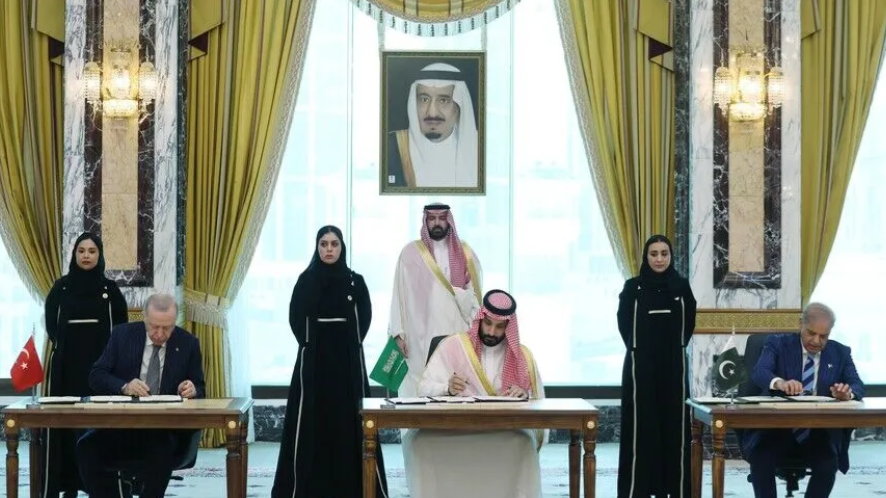
The recently signed mutual defense agreement between Turkey, Saudi Arabia, and Pakistan is far more than a conventional military pact. It is a landmark initiative with the potential to project immense “Geopolitical, Historical, Theological, and Civilizational” value. If managed with a unified strategic vision, this tripartite architecture possesses the capacity to fundamentally alter the security equilibrium of the Middle East and beyond.
Here are my initial assessments on the initiatives, risks, and profound impacts this alliance could generate.
A Post-October 7 Security Paradigm
The events that unfolded after October 7, 2023, have triggered a seismic geopolitical rupture in the Middle East. The ensuing Israel-Hamas war, the broader climate of conflict, and the most recent escalations between Iran and the U.S./Israeli axis have drastically altered the regional security environment. This volatility has actively pushed regional powers to seek new solutions, fresh security guarantees, and alternative alliances.
The defense pact between Ankara, Riyadh, and Islamabad stands as the most concrete manifestation of these long-standing pursuits for regional cooperation. By consolidating the military, economic, energy, nuclear, and geopolitical capacities of these three nations, this structure could establish a highly effective, geopolitically deterrent, and globally decisive new security axis.
However, such a formidable structure cannot survive on signatures alone. It requires a shared strategic intellect, a unified threat perception, and a common vision for the future. Without these, it risks being dragged into the region’s relentless power struggles and proxy wars.
An Impact Beyond the Middle East
Historically, all three nations have maintained robust bilateral defense ties—most notably seen in Turkey-Pakistan and Saudi Arabia-Pakistan relations. This new agreement elevates those bilateral ties into a cohesive, tripartite security architecture.
The ripple effects of this alliance will not be confined to the Middle East. It has the capacity to influence a vast geopolitical corridor stretching from the Indian Ocean to the Eastern Mediterranean, and from the Red Sea to the Persian Gulf. In the foreseeable future, this nucleus could expand, integrating other nations into a broader security umbrella.

The Chemistry of the Alliance: Defining the Threat
The ultimate success of this pact hinges on a critical factor: the strategic doctrine upon which it is built. Defense alliances are inherently shaped by shared threat perceptions. Much like the foundational questions that define NATO, this tripartite pact must answer several vital questions:
What will be the alliance’s foundational security approach?
Against which specific threats will these nations act collectively?
Within what strategic framework will their defense reflexes take shape?
How will the decision-making mechanism function during acute crises?
How will the political and military boundaries of their shared deterrence be defined?
Until these parameters are clarified, any definitive judgment on the alliance’s future remains premature.
The Proxy Trap: Israel, Iran, and the Great Powers
Israel and Iran remain the definitive actors in the region’s current security equation. This new defense pact will inevitably be influenced by the linear and asymmetric friction between these two powers.
There is a severe risk that global powers may attempt to manipulate this alliance—either positioning it as a Western proxy force against Iran or an Iranian proxy buffer against Israel. Falling into either trap would be disastrous. “It is of paramount importance that Turkey, Saudi Arabia, and Pakistan operate with strict strategic, geopolitical, and conceptual autonomy,” free from the conflicting interests of the U.S., Israel, and Iran.
Given the catastrophic costs of any potential ground conflict with a nation as large as Iran, it is highly unlikely that this tripartite alliance would voluntarily allow itself to become a party to such a war.

The Synergy of Power: Nukes, Tech, and Capital
What makes this alliance truly unprecedented is the unique convergence of its members’ distinct power elements:
Pakistan’s nuclear deterrence capabilities.
Turkey’s combat doctrine, advanced defense-industrial complex, and operational military experience.
Saudi Arabia’s immense energy resources and economic gravity.
When combined with their respective geopolitical leverage across different geographies, this synergy could birth a new center of power effective on a global scale—potentially leading to joint defense projects, shared military bases, and integrated operational commands.
Conclusion: The Core Matter is “Chemistry”
Modern warfare is no longer waged solely with military hardware; it advances through geopolitical intrigue, proxy conflicts, cognitive operations, and multi-layered power struggles. Therefore, the most crucial issue regarding this pact is its internal chemistry.
Will it be built upon a conceptual unity, a shared civilizational vision, or merely geographic necessity?
Today, the greatest lost asset of the Islamic world is the concept of Tawhid (Unity) and a collective consciousness. In this geopolitical context, Tawhid is not merely a theological doctrine; it is a civilizational framework that generates shared belonging, builds trust, rejects fragmentation, and ensures strategic cohesion. Conversely, a sectarian approach only deepens fractures, invites exploitation, paves the way for foreign intervention, and breeds a crisis of trust.
If this alliance is forged not just against common enemies, but upon a shared civilizational consciousness, mutual respect for sovereignty, and a unity-centric vision, it will not merely be a new defense pact—it will establish an entirely new geopolitical equilibrium and security paradigm for the modern era.