United Shipbuilding Corporation Profile, Yards, Ships and Sanctions
United Shipbuilding Corporation (USC) is Russia’s state-owned naval and commercial shipbuilding holding, built in 2007 by merging the country’s main yards, and it now produces every Russian ballistic missile submarine through its Sevmash subsidiary. Sanctioned by the United States, European Union and United Kingdom, it is the main industrial answer to the question of whether Russia can rebuild its fleet.
What is United Shipbuilding Corporation
USC, known in Russian as OSK, was created in 2007 to reverse decades of decline. After the Soviet collapse, Russian shipyards lost orders, workers and suppliers, and several key factories ended up in Ukraine or the Baltic states. A single state holding was meant to consolidate what remained, modernize the yards and win both naval and civilian orders.
| Item | Detail |
|---|---|
| Full name | United Shipbuilding Corporation (OSK) |
| Base | Saint Petersburg and Moscow, Russia |
| Created | 2007, by Russian presidential decree |
| Ownership | Russian state |
| Business | Warships, submarines, icebreakers, commercial vessels, ship repair |
| Sanctions | US, EU and UK measures since 2014, widened after 2022 |
Who owns USC
The Russian state owns USC through federal asset-management bodies. It works closely with the Navy, which is its largest customer, and with state programs for Arctic icebreakers and energy carriers. Its leadership is appointed by the government, and its finances are affected by shifts in the state armament program, which sets how many ships and submarines the Navy can buy.
USC shipyards and subsidiaries
| Yard | Location | Known for |
|---|---|---|
| Sevmash | Severodvinsk | Borei-class ballistic missile submarines, Yasen-M attack submarines, Khabarovsk and Belgorod special-purpose boats |
| Admiralty Shipyards | Saint Petersburg | Project 636.3 Kilo-class diesel submarines, Lada-class boats, icebreakers |
| Severnaya Verf | Saint Petersburg | Admiral Gorshkov-class frigates, Gremyashchy-class corvettes |
| Baltic Shipyard | Saint Petersburg | Nuclear-powered Project 22220 icebreakers for Rosatom |
| Yantar | Kaliningrad | Frigates, including Project 11356 ships built for Russia and India |
| Zvezda | Bolshoy Kamen | Far East shipyard, mainly large commercial and Arctic vessels |
USC warships and submarines
USC’s prestige programs are submarines. Sevmash builds the Borei-class missile boats that carry the sea-based leg of Russia’s nuclear deterrent, and the Yasen-M class, a multipurpose guided-missile submarine. Our comparison of the Virginia class and Yasen-M covers how it stacks up against its American counterpart, with Russian figures being manufacturer claims.
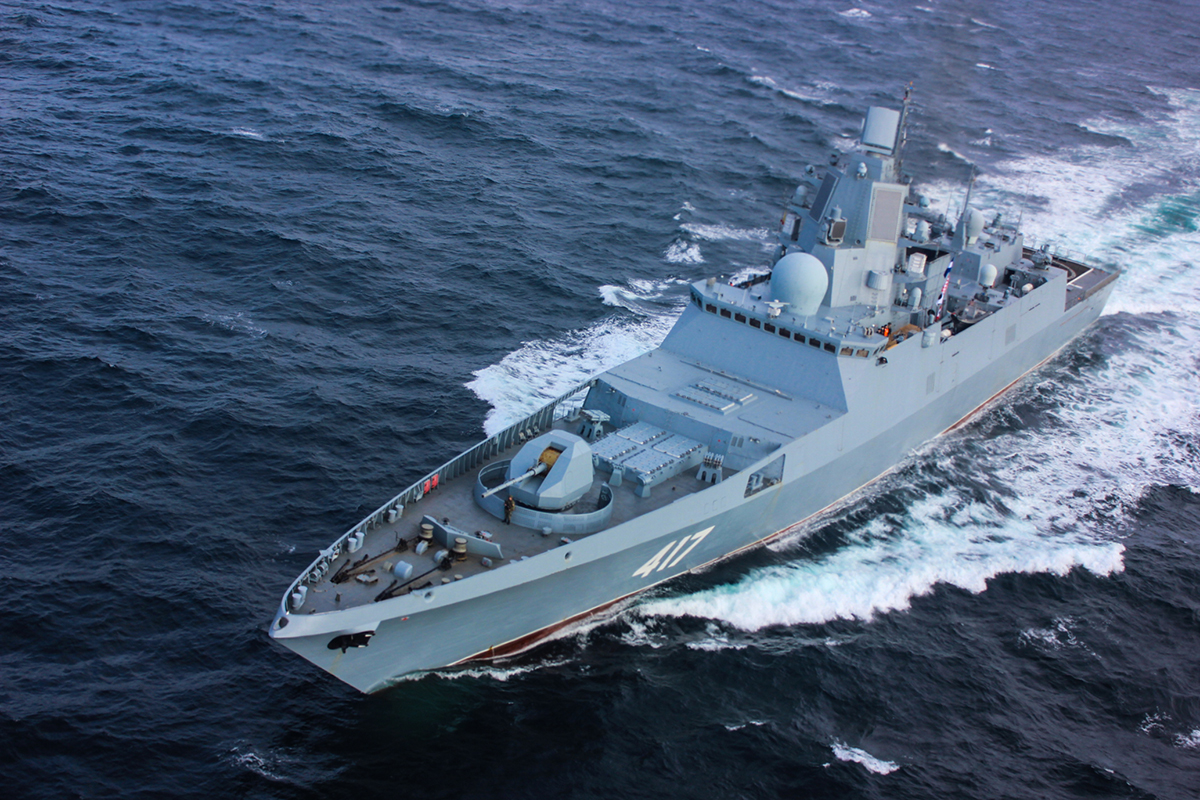
On the surface, the highlight is the Project 22350 Admiral Gorshkov frigate, built at Severnaya Verf and the first ship armed with the Zircon hypersonic missile. It also carries the Kalibr cruise missile, a weapon family that has become a staple of Russian strikes. Yet the larger surface fleet has struggled. The Project 22350 line has been delayed by engine and gearbox problems after Ukrainian-built turbines became unavailable, and the long refit of the cruiser Admiral Nakhimov has run far behind schedule.
USC exports, sanctions and the war
USC yards have delivered Kilo-class submarines to Vietnam, Algeria and China, and frigates to India, where Yantar-built Project 11356 ships joined the Indian Navy. Export wins have slowed. Sanctions make payment and shipment harder, and Russian yards have to prioritize their own Navy.
The 2022 invasion brought new restrictions on parts, financing and shipping. Ukraine has reported striking Russian naval vessels and shipyard infrastructure in occupied Crimea, including with drones and missiles, but those claims are operator-reported and only some have been independently confirmed. The Black Sea Fleet’s loss of the cruiser Moskva in 2022, which was built in Ukraine, showed how much the war has changed Russian naval planning.
USC revenue and outlook
USC does not publish audited figures that outside analysts can easily check. Russian media have cited annual revenue in the hundreds of billions of rubles, with a long order book that stretches into the 2030s. That backlog is a sign of state commitment rather than proof of delivery speed. The real constraints are labor, machine tools, electronics and the dwindling supply of western-origin components.
For a wider view of how USC compares with yards in South Korea, Japan and the US, see our ranking of the top 10 naval shipbuilders.
USC frequently asked questions
What is United Shipbuilding Corporation?
A Russian state holding created in 2007 that owns the country’s main naval and civilian shipyards.
Who owns USC?
The Russian state.
What does USC build?
Ballistic missile and attack submarines, frigates, corvettes, icebreakers and commercial vessels.
Is USC sanctioned?
Yes, by the United States, the European Union and the United Kingdom, with restrictions widened after 2022.
Which yard builds Russian nuclear submarines?
Sevmash in Severodvinsk builds the Borei and Yasen-M classes, and is part of USC.
- Company information published by USC and Russian state media (manufacturer claims)
- Wikipedia – United Shipbuilding Corporation (accessed October 2026)
- SIPRI Arms Transfers Database
- Defence & Tech reporting on Russian naval programs