
Kalibr, the Cruise Missile Russia Fires From Everywhere
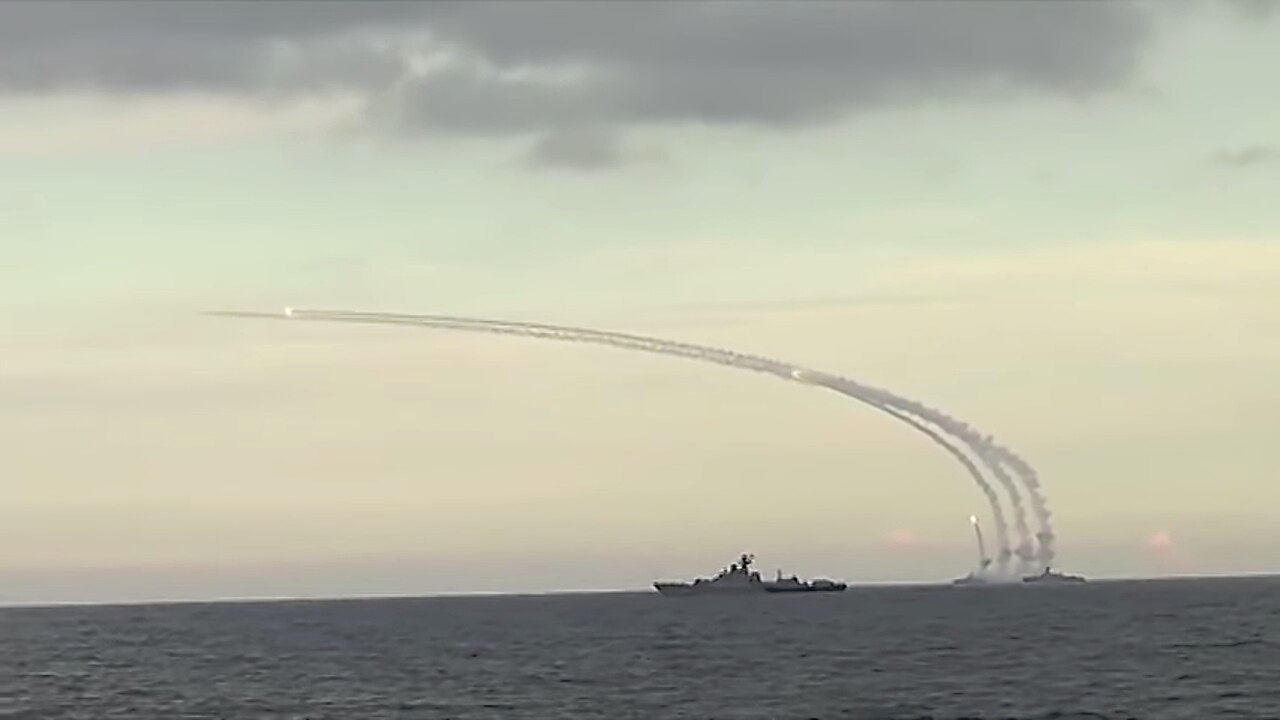
Since October 2015, when small Caspian Flotilla corvettes lofted missiles 1,500 kilometers into Syria, Kalibr has been Russia’s signature conventional deep-strike weapon. It launches from frigates, submarines, small missile ships and, in one marketed variant, an innocent-looking shipping container. Ukraine knows its arrival by the air-raid sirens that follow ship movements in the Black Sea.
One family, three killers
Kalibr, developed by NPO Novator, is a modular family rather than a single missile. The 3M14 is the land-attack member, cruising subsonic at terrain-hugging altitude to ranges Western analysts put between 1,500 and 2,500 kilometers for the domestic version. The 3M54 anti-ship variant flies most of its route subsonic, then sheds its cruise stage and sprints the final approach supersonic to beat ship defenses. The 91R family delivers a homing torpedo to a distant submarine contact. Export versions, branded Club, are capped near 300 kilometers by missile technology control rules.
How it flies
Guidance combines inertial navigation with satellite updates and, on land-attack rounds, terminal accuracy sufficient for aimpoints like power substations and command bunkers. Flying low and slow is a deliberate trade, a subsonic sea-skimmer or terrain-follower arrives with little warning to point defenses even though patrolling fighters and alert SAM crews can catch it en route. Ukraine’s air force claims high intercept percentages against Kalibr salvos, operator-reported figures Russia disputes, which is precisely why Russian planners mix them with ballistic Iskanders and drones to split defensive attention.
Launch platforms, the real trick
| Platform | Example | Note |
|---|---|---|
| Frigates | Admiral Gorshkov, Grigorovich classes | 8-16 cells each |
| Small missile ships | Buyan-M, Karakurt corvettes | Strategic reach from 900-ton hulls |
| Submarines | Kilo, Yasen classes | Torpedo-tube and VLS launch |
| Surface combatants (refit) | Cruisers, destroyers | 3S-14 universal cells |
| Club-K container | Marketed export concept | Missiles in a standard shipping container |
The distribution is the strategy. By pushing strategic-range missiles onto corvettes and diesel submarines, Russia made every small combatant in the Black, Baltic and Caspian Seas a national-level threat, and the same 3S-14 cells now integrate Zircon, so NATO targeteers cannot tell from the outside which missile a hull carries. The Club-K container concept, though never confirmed in service, forces navies and port authorities to consider every merchant vessel a potential launcher.
From Syria to Ukraine
Syria was Kalibr’s advertisement, with launches from the Caspian and Mediterranean demonstrating reach the world had associated only with Tomahawk. Ukraine became its consumption. From the war’s first night, when at least 30 cruise missiles opened the assault, Kalibr salvos from Black Sea ships and submarines have struck power grids, airfields and cities, tapering when Ukrainian attacks on the fleet pushed launch platforms east and when stocks ran thin, then resurging as production recovered. Its role in the terror campaign against civilian infrastructure has made it, alongside Shahed drones, the face of Russia’s deep-strike war.
Production under sanctions
Sanctions were expected to strangle Kalibr output, since its guidance electronics lean on imported components. The documented reality is grimmer, procurement contracts for hundreds of missiles running through 2026, with components rerouted through intermediary countries. Western estimates of monthly production have risen repeatedly, a reminder that export controls slow but rarely stop a determined wartime economy, and that defenders must plan against the arsenal Russia builds, not the one sanctions were supposed to allow.
The Black Sea Fleet Problem
Kalibr gave Russia’s Black Sea Fleet its strategic purpose in this war, and Ukraine responded by hunting the launchers rather than the missiles. Strikes with Storm Shadow cruise missiles and naval drones on Sevastopol damaged submarines and landing ships, forced the fleet’s cruise-missile shooters to redeploy eastward to Novorossiysk, and at times pushed launch activity to the Caspian. Fewer hulls within launch geometry means smaller salvos and longer gaps between them, arithmetic that matters as much as any interceptor.
The campaign is the clearest modern case of counterforce against a naval missile threat, attacking the archer’s harbor because the arrows are too numerous to stop individually, and it is being studied closely by every navy that expects to face distributed missile ships in its own war.
Frequently asked questions
What is the range of the Kalibr missile?
The domestic 3M14 land-attack variant is estimated at 1,500-2,500 km; export Club versions are limited to about 300 km.
Can Kalibr be intercepted?
Yes, it is subsonic in cruise, and Ukrainian operators report intercepting large shares of Kalibr salvos, though the supersonic-sprint 3M54 anti-ship variant is far harder in its terminal phase.
What launches Kalibr missiles?
Russian frigates, corvettes as small as 900 tons, Kilo and Yasen-class submarines, and refitted larger combatants via the 3S-14 vertical cell.
Is Kalibr nuclear-capable?
Yes, the family is dual-capable, though all observed combat use in Syria and Ukraine has been conventional.
- Wikipedia – 3M-54 Kalibr (accessed October 2026)
- Ukrainian Air Force salvo reports (operator-reported)
- Investigative reporting on Russian missile production and sanctions evasion