
Chaff, Flares and Lasers, How Aircraft Cheat Death
Every missile fired at an aircraft is a race between a seeker and a bag of tricks. The tricks began as foil strips and burning magnesium; they have evolved into laser turrets that stare into a missile’s eye and lie to it at the speed of light. This is the unglamorous technology that decides whether aircrews come home.
Chaff, the oldest trick still flying
Chaff is millions of metallized glass or aluminum fibers, each cut to resonate at radar wavelengths, blooming into a cloud that a radar sees as a target bigger than the aircraft that dispensed it. RAF bombers first dropped it, as Window, over Hamburg in 1943 and collapsed German fighter control overnight. Modern radars strike back with Doppler filtering, since a chaff cloud decelerates instantly while the aircraft keeps moving, which is why chaff today is used in careful combination with maneuvers and jamming rather than as a standalone shield.
Flares and the seeker arms race
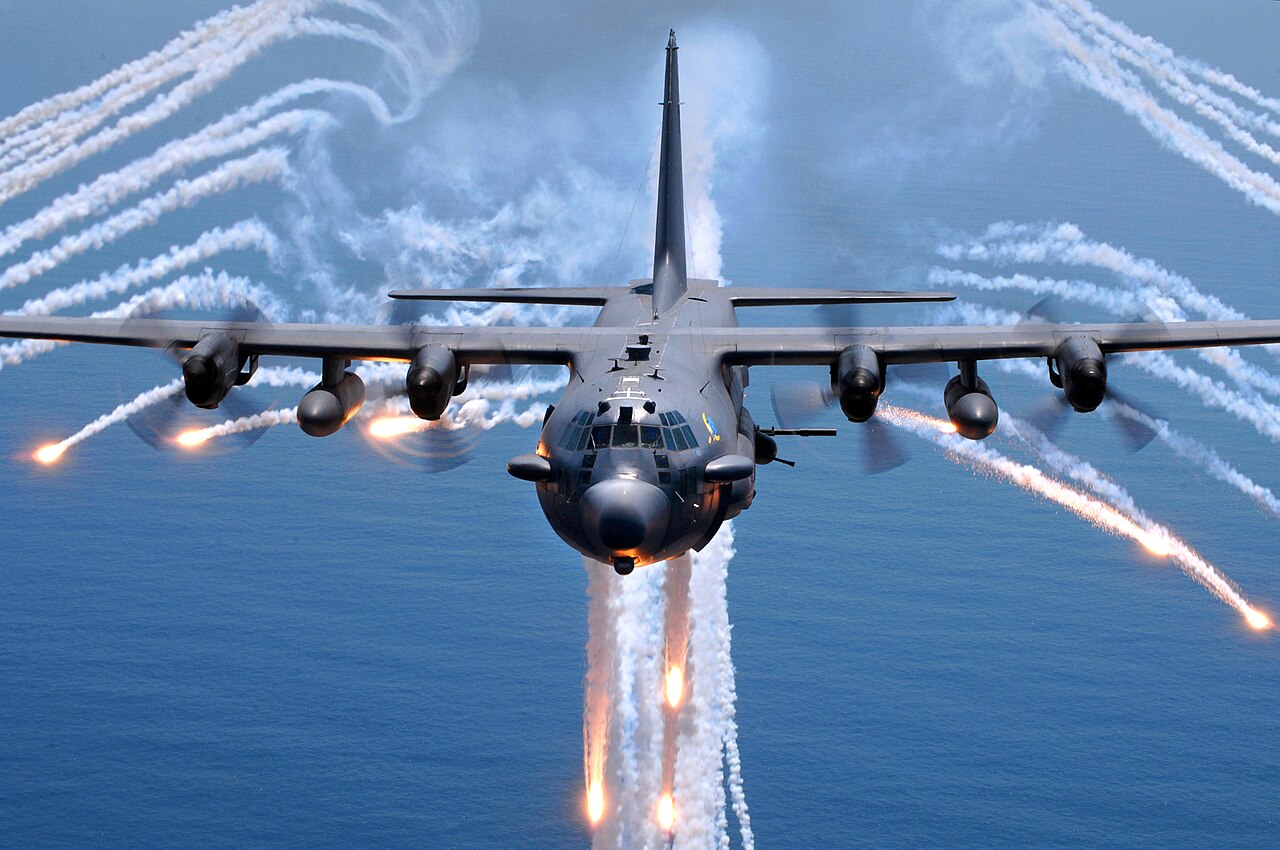
Infrared missiles killed more aircraft in the past half-century than every other weapon combined, and the flare was the first answer, a magnesium-based torch burning hotter than an engine exhaust that convinces a simple seeker to chase the brighter star. Then seekers got clever. Two-color sensors compare infrared and ultraviolet signatures and reject pyrotechnics, imaging seekers recognize the aircraft’s shape, and kinematic logic dismisses objects that suddenly stop and fall behind.
Flares evolved in reply, spectrally matched compositions that mimic engine plumes rather than outshining them, aerodynamic flares that fly alongside the aircraft briefly, and preemptive dispensing programs that seed a trail of decoys through known missile envelopes. Every transport descending into a contested airfield pumping flares in rhythmic patterns is running a statistical argument against a seeker designer’s last move.
The warning problem, knowing you are shot at
A MANPADS gunner offers no radar lock to detect, the launch is silent to older sensors and the flight time can be under five seconds. Missile approach warning systems answer with ultraviolet and infrared detectors watching for the flash and burn of a motor, classifying the threat and cueing dispensers or lasers automatically, since no human reacts reliably inside a two-second engagement. The warning suite, not the countermeasure itself, is where most survivability engineering now lives.
DIRCM, lasers that blind missiles
| Attribute | Flares and chaff | DIRCM |
|---|---|---|
| Magazine | Dozens of shots | Effectively unlimited |
| Counter-counter risk | Seekers learn to reject | Must track and jam each seeker type |
| Signature | Highly visible | Covert, no pyrotechnics |
| Best against | Older IR seekers, radar locks | Modern IR MANPADS |
| Examples | MJU-series flares, RR-series chaff | AN/AAQ-24 LAIRCM, Leonardo Miysis |
Directed infrared countermeasures close the loop. A small turret slews onto the warning cue, acquires the incoming seeker head and fires modulated laser energy into its optics, overwhelming or deceiving the tracking logic until the missile veers away. Systems like the AN/AAQ-24 LAIRCM family guard American transports, tankers and helicopters, European suites like Miysis equip a growing list of fleets, and airliner-protection variants exist for heads of state. Against the proliferating MANPADS threat, a magazine that never runs dry is the decisive virtue.
Layering it all together
No single trick survives contact for long, so modern survivability is a stack, signature reduction to delay detection, warning sensors watching every axis, expendables for the threats lasers cannot service, DIRCM for the heat-seekers, towed decoys and jamming for the radar shots. Ukraine’s skies, thick with MANPADS and radar SAMs alike, have proven the stack’s value and its limits, and every Western helicopter and transport upgrade now budgets for it accordingly.
The Drone Era Rewrites the Problem
Countermeasure suites were designed for missiles that cost more than the aircraft they chase. Small drones invert the economics, a quadcopter with a grenade does not carry a seeker a flare can seduce or a DIRCM can blind, it carries a camera and a human or an algorithm. Helicopters over Ukraine have been lost to FPV drones that no legacy warning system classified as threats, and the survivability community is scrambling to add radar and optical detection of small slow targets to suites built for fast hot ones.
The answers under test borrow from both old and new playbooks, jammers that cut the FPV control link, hard-kill systems firing programmable airburst rounds, and laser dazzlers repurposed against drone optics. The countermeasure stack that emerges from this decade will treat a $500 drone and a $500,000 missile as equally first-class threats, because the battlefield already does.
Frequently asked questions
What is chaff made of?
Millions of aluminum-coated glass fibers cut to radar wavelengths, dispensed to create false radar targets.
Why do flares sometimes fail?
Modern two-color and imaging seekers distinguish pyrotechnic signatures from engine plumes, so flares must be spectrally matched and dispensed in programmed patterns to work.
What is DIRCM?
Directed infrared countermeasures, a turreted laser that tracks an incoming heat-seeking missile and jams its seeker with modulated energy, as in the AN/AAQ-24 LAIRCM.
Do airliners carry countermeasures?
Some head-of-state and Israeli-operated airliners carry DIRCM-class protection; general commercial adoption remains limited by cost and regulation.
- Wikipedia – Chaff, Flare and DIRCM articles (accessed October 2026)
- US Air Force aircraft survivability program materials
- Industry publications on LAIRCM and Miysis