
Turkish Intelligence Shares Historical Document on Deciphering Secret Correspondence


 React
React
Turkey’s National Intelligence Organization (MIT) has released a declassified historical document detailing the covert methods and chemical formulas used to decipher clandestine communications marked “to be opened personally.”
A newly declassified intelligence report has been added to the “Documents” section under the “Special Collection” tab on MIT’s official website, offering a rare and fascinating glimpse into the early technical operations of Turkish intelligence.
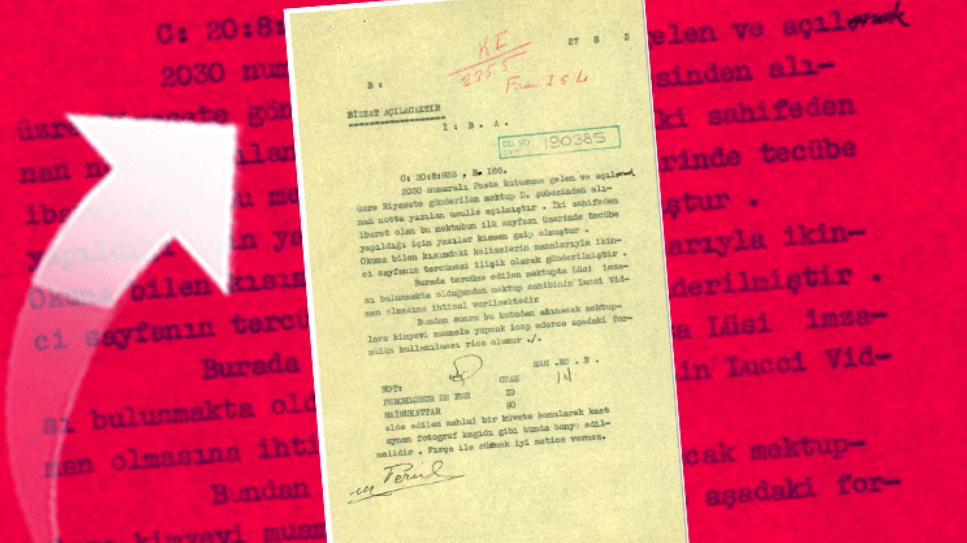
The document, dated August 27, 1933, was dispatched to the Istanbul “B” Directorate. It serves as an operational example of the covert envelope opening, resealing, and secret writing decipherment activities conducted by Branch D (Technical Support) of the National Security Service (MAH), the historical predecessor to modern-day MIT.
The 1933 Intelligence Memo
The archival text outlines the precise operational procedures for intercepting and revealing hidden messages during that era:
“The letter arriving at post office box 230, sent to the Directorate to be opened, was processed using the method prescribed in the note received from Branch D. Because an experiment was conducted on the first page of this two-page letter, the writing has partially disappeared.
The translated meanings of the legible words, along with the translation of the second page, are attached. Since the translated letter bears the signature ‘Lüsi,’ it is highly probable that the author is Lucci Vidman. Should it be necessary to apply chemical treatments to letters retrieved from this box in the future, it is requested that the following formula be utilized.”
A Special Chemical Solution for Secret Documents
At the bottom of the declassified memo, an operational “note” specifies the exact chemical mixture required to expose the invisible ink used in such clandestine correspondence. The formula explicitly calls for a solution consisting of 10 grams of ferric chloride (iron(III) chloride) and 90 grams of distilled water.
The technical instructions provided for the field agents were highly specific regarding the application method to prevent destroying the evidence: “The resulting solution must be placed in a developing tray, and the paper should be bathed in it exactly like photographic paper. Applying the solution with a brush will not yield good results.”
React