KEMANKEŞ 2: Baykar’s Ground-Launched Mini Cruise Missile Specs & Tests
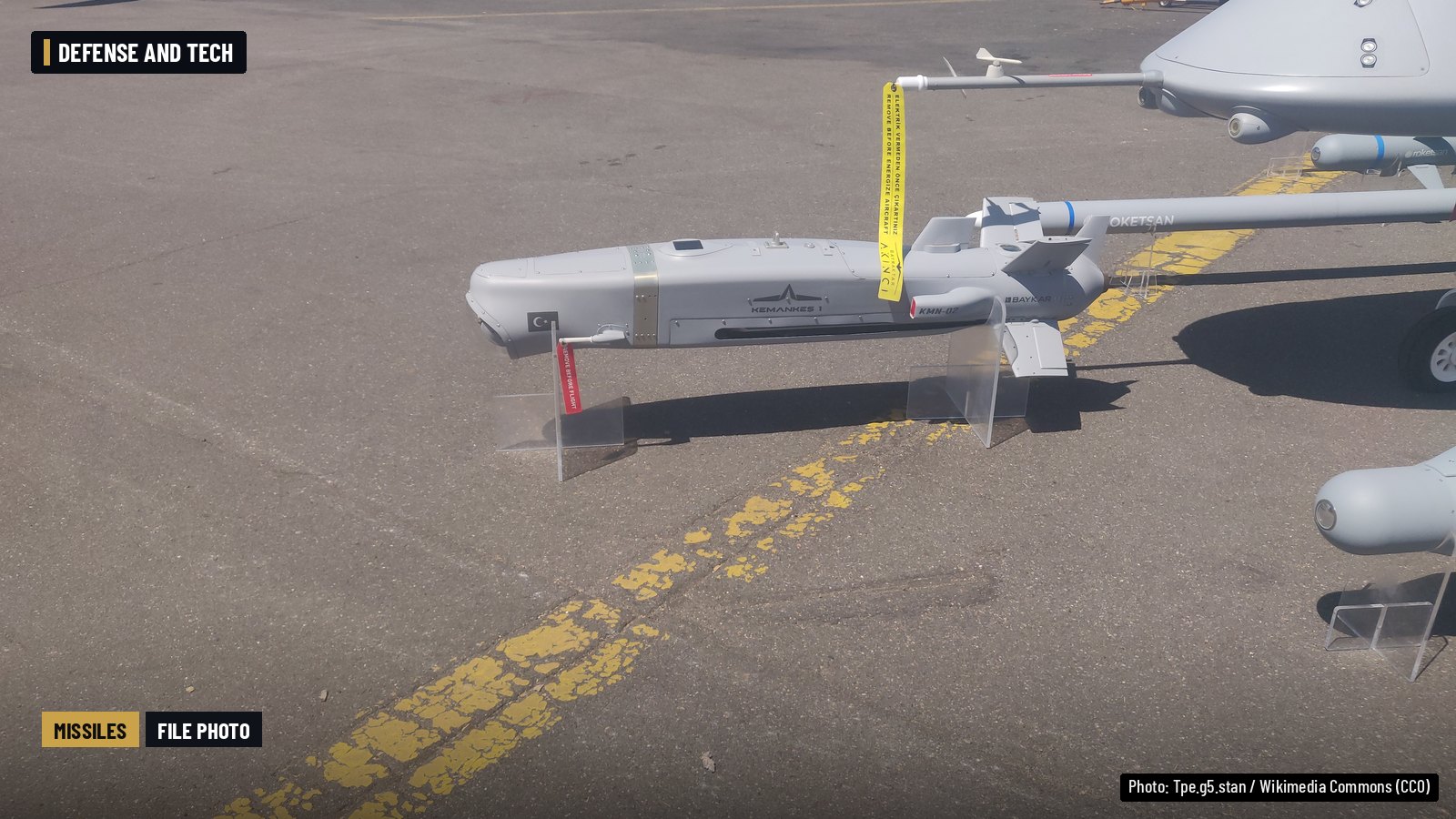

KEMANKEŞ 2 is Baykar’s jet-powered mini cruise missile designed for rocket-assisted take-off and mobile ground launch, with an airdrop path also listed on the product page. Baykar gives a 75 kg maximum take-off weight, a 20 kg payload, a 150 km operational range, 30 minutes’ endurance, 130 KIAS cruise and 160 KIAS maximum speed, and says the missile can be launched from sites without road or runway access — including from pickup trucks — and will also be able to fly missions once integrated with the Bayraktar AKINCI UCAV. The figures below are Baykar’s published numbers, checked on 8 November 2026 (Baykar).
- Maker: Baykar, Türkiye; AI-powered mini cruise missile (manufacturer class)
- Baykar product page: 75 kg MTOW, 20 kg payload, 150 km range, 70+ km comms, 30 min, 130/160 KIAS, jet engine, RATO and airdrop
- Ground launch (Baykar): unconventional sites without road or runway; mobile platforms such as pickup trucks
- AKINCI path (Baykar, still future tense on 8 Nov 2026 page): will also be able to fly missions once integrated
- Tests: Apr 2024 first firing at Keşan (Baykar); Jun 2024 second system validation (Baykar/AA); May 2025 system identification (AA); Mar 2026 AKINCI air-launch only in secondary reports
- No official public inventory date, unit price or KEMANKEŞ 2 export list found; distinct from KEMANKEŞ 1
What is KEMANKEŞ 2?
Baykar describes KEMANKEŞ 2 as an indigenously developed AI-powered mini cruise missile intended to engage strategic targets with precision. The name, Baykar says, draws on historical Turkish archers (kemankeş) associated with accurate shooting under difficult conditions. The manufacturer presents the system as jet-powered, able to fly with an AI-supported autopilot, and fitted with an AI-assisted optical guidance set for target identification and engagement (Baykar). Those are manufacturer role descriptions, not independent combat assessments.
In Baykar’s range, KEMANKEŞ 2 is the ground- and RATO-launched member of the family rather than another airframe. The sibling product KEMANKEŞ 1 is a lighter, air-launched design with its own official page and is not covered here. For the company and the UCAV named on the KEMANKEŞ 2 page, see the Baykar company profile and our guide to the Bayraktar AKINCI.
KEMANKEŞ 2 specifications
The table follows Baykar’s official English and Turkish product pages, which matched when checked on 8 November 2026.
| Parameter | KEMANKEŞ 2 (Baykar figures) |
|---|---|
| Class / role | AI-powered mini cruise missile |
| Maximum take-off weight | 75 kg |
| Payload capacity | 20 kg |
| Operational range | 150 km |
| Communication range | 70+ km |
| Endurance | 30 minutes |
| Cruise / maximum speed | 130 KIAS / 160 KIAS |
| Operational altitude / service ceiling | 7,500 ft / 10,000 ft |
| Wingspan / length / height | 1.35 m / 2.47 m / 0.49 m |
| Power plant | Jet engine (brand not named on the product page) |
| Launch (product page) | RATO and airdrop |
| Ground deployment (Baykar text) | Unconventional sites without road or runway access; mobile platforms such as pickup trucks |
| Air integration (Baykar text) | Will also be able to conduct missions integrated with Bayraktar AKINCI |
| Payload – ISR | AI-assisted electro-optical camera |
| Terminal guidance | EO or GNSS |
| Other listed features | Anti-jamming system; AI-supported autopilot; AI-supported optical cruise set |
Some Baykar press items carry higher marketing lines than the current product page. The 17 April 2024 first-firing release and the 14 June 2024 test-update release both state about one hour’s endurance and an operational or mission range of over 200 km. Defense and Tech uses the product-page table as the baseline (150 km; 30 minutes) and treats the higher press figures as manufacturer statements that are not reconciled on the product page. The previous version of this article, and a March 2026 Army Technology compilation, listed a communications range of more than 80 km; the product page checked for this update says 70+ km, which is the figure used above. The product page gives a 20 kg payload capacity, not a published warhead mass.
Baykar does not publish a named jet-engine brand, unit price, production rate, Turkish Armed Forces inventory-entry date or KEMANKEŞ 2-specific export customer list on the product page checked for this update, so those items are omitted. No Presidency of Defence Industries (SSB) coordination statement specific to this missile was found in the official sources reviewed; Baykar presents the design as an indigenous in-house development.
Launch methods, guidance and communications
The published launch concept is what separates KEMANKEŞ 2 from KEMANKEŞ 1. Baykar says the missile is built to leave sites that have no road or runway, using rocket-assisted take-off, and to ride on mobile platforms such as pickup trucks. The specification table adds airdrop alongside RATO. The same page states that the missile will also be able to conduct missions once integrated with AKINCI — wording that, on 8 November 2026, remained in the future tense (Baykar).
Baykar lists an AI-assisted optical guidance set, an AI-assisted EO camera payload and EO or GNSS terminal guidance, plus an anti-jamming system. April and June 2024 Baykar press items add that the missile is intended for day and night use and that it transmits data and imagery to a ground control station. Those claims are manufacturer statements. This article does not describe targeting procedures, seeker tuning or any modification path.
Flight-test milestones
On 16 April 2024, Baykar said the KEMANKEŞ 2 test process had begun at the Baykar Flight Training and Test Center in Keşan, Edirne (Baykar, 16 April 2024). The following day, Baykar’s English release said the first firing test had been completed at the same centre (Baykar, 17 April 2024). Anadolu Agency published an explainer graphic on 18 April 2024 noting that testing had started (Anadolu Agency).
On 14 June 2024, Baykar reported that the second system-validation test at Keşan had also been completed successfully (Baykar, 14 June 2024). Anadolu Agency’s video gallery restated that result on 13 June 2024 (Anadolu Agency).
On 20 May 2025, Anadolu Agency reported that KEMANKEŞ 2 had completed a System Identification Test. A matching Baykar press URL was not found on the company’s site during this update, so that milestone is cited from the agency report (Anadolu Agency, 20 May 2025).
In March 2026, TURDEF (18 March) and Army Technology (25 March) reported that two KEMANKEŞ 2 missiles had been air-launched from an AKINCI in a first air-launch test. Defense and Tech did not find a matching Baykar press release on baykartech.com for that event, and the product page still describes AKINCI integration as a forthcoming capability. Those accounts are therefore noted as secondary reports, not as an official test record.
Manufacturer test claims are not the same as a cleared fleet weapon fit, inventory entry or combat employment record.
Industry context
KEMANKEŞ 2 extends Baykar’s move into company-made mini cruise or loitering-class munitions, alongside weapons already supplied by firms such as Roketsan and TÜBİTAK SAGE for Baykar UCAVs. A June 2023 commentary republished on Baykar’s site discussed the wider KEMANKEŞ concept; it is commentary on the family, not a KEMANKEŞ 2 specification sheet (Baykar / AA commentary).
On paper, the main difference from KEMANKEŞ 1 is launch method plus size: Baykar’s KEMANKEŞ 1 page is the air-launched, 45 kg / 100 km / 20-minute member of the family, listed for AKINCI, TB2 and TB3. KEMANKEŞ 2 is heavier (75 kg, 20 kg payload) and longer-legged on the product page (150 km, 30 minutes), and is presented first as a RATO and mobile ground-launch system that does not need a runway.
Frequently asked questions
Who makes KEMANKEŞ 2?
Baykar of Türkiye. Baykar presents the mini cruise missile as an indigenous development intended for precision strike against strategic targets.
What are the main KEMANKEŞ 2 specifications?
Baykar lists 75 kg MTOW, 20 kg payload capacity, 150 km operational range, 70+ km communication range, 30 minutes’ endurance, 130/160 KIAS, 7,500/10,000 ft, a jet engine, RATO and airdrop launch, and EO or GNSS terminal guidance, with a 1.35 m wingspan and 2.47 m length.
How is KEMANKEŞ 2 launched?
Baykar describes rocket-assisted take-off from unconventional sites without road or runway access, deployment on mobile platforms such as pickup trucks, and airdrop. The product page also says the missile will be able to conduct missions once integrated with the Bayraktar AKINCI. That AKINCI wording was still forward-looking on the page checked for this update.
How is KEMANKEŞ 2 different from KEMANKEŞ 1?
They are separate Baykar products with separate official pages. KEMANKEŞ 1 is air-launched at 45 kg / 100 km / 20 minutes and is listed for AKINCI, TB2 and TB3. KEMANKEŞ 2 is presented for RATO and mobile ground launch (with an airdrop line and a stated AKINCI integration path) at 75 kg / 150 km / 30 minutes — see our KEMANKEŞ 1 page.
Has KEMANKEŞ 2 entered service or been exported?
This update found no official public Turkish Armed Forces inventory-entry date and no official KEMANKEŞ 2 export customer list or unit price. Do not confuse Baykar’s TB2 or AKINCI export counts with KEMANKEŞ 2 sales.
Why do some articles quote 200 km or one hour?
Those figures appear in Baykar press text from April and June 2024. The current product page lists 150 km and 30 minutes. Defense and Tech follows the product page and flags the press discrepancy.
Sources
- Baykar – KEMANKEŞ 2 product page (EN) (accessed 8 November 2026)
- Baykar – KEMANKEŞ 2 product page (TR) (accessed 8 November 2026)
- Baykar – KEMANKEŞ 1 product page (EN) (sibling product)
- Baykar – first firing test, 17 April 2024
- Baykar – test process starts, 16 April 2024
- Baykar – second system-validation test, 14 June 2024
- Anadolu Agency – KEMANKEŞ 2 infographic, 18 April 2024
- Anadolu Agency – second system-validation report, 13 June 2024
- Anadolu Agency – System Identification Test report, 20 May 2025
- Army Technology – KEMANKEŞ 2 compilation, 25 March 2026
- TURDEF – reported AKINCI air-launch test, 18 March 2026 (secondary; no matching Baykar press URL found)
- Wikimedia Commons – cover photograph (Tpe.g5.stan, CC0)
Last updated: 8 November 2026.