
Why isn’t Trump going to his son’s wedding?
Beyond the family drama: How sudden White House travel cancellations, including his New Jersey golf retreat, signal a critical juncture in the Iran crisis.
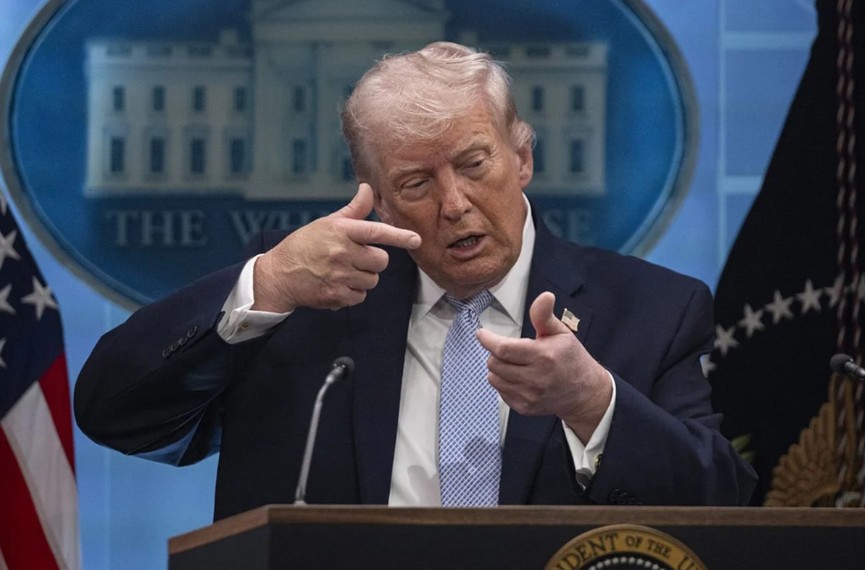
When U.S. President Donald Trump announced he would skip his eldest son Donald Trump Jr.’s wedding to Bettina Anderson in the Bahamas, mainstream media immediately framed it as a personal decision or a PR maneuver to avoid negative press. Trump himself cited the ongoing “Iran problem” as his primary reason.
However, a dramatic last-minute development has turned a family story into a significant national security indicator.
BREAKING: The White House has abruptly altered the President’s weekend schedule. Donald Trump will not be traveling to his golf club in New Jersey, as previously anticipated. Instead, he will remain entirely locked down at the White House.
For defense analysts and geopolitical observers, this sweeping travel freeze confirms a zero-hour scenario. The Commander-in-Chief is anchoring himself in Washington, preparing for a decisive move—either a historic diplomatic breakthrough or a massive military operation in the Middle East.
The Total Travel Freeze: Locking Down the White House
The cancellation of the Bahamas trip was the first domino; the sudden cancellation of the New Jersey retreat confirms the pattern. Over the past week, President Trump has systematically cleared his schedule of all domestic and international travel, shifting completely to what he terms “phone diplomacy.”
From an Open Source Intelligence (OSINT) perspective, when a U.S. President grounds Air Force One for both high-profile family events and personal weekend routines simultaneously, it signals that the Situation Room is operating at peak intensity.
The U.S. currently maintains a stringent naval blockade in the Middle East under “Operation Economic Fury.” Managing a volatile crisis of this magnitude requires real-time command, control, and absolute secure communications—capabilities that cannot be compromised by leisure travel, even to heavily secured private properties like Bedminster.
Reading the Signals: Secretary Rubio’s “Plan B”
To understand the binary outcome the administration is driving toward, one must carefully decode recent statements from Secretary of State Marco Rubio. Speaking on the sidelines of NATO meetings, Rubio confirmed “slight progress” in the ongoing, mediated negotiations with Tehran regarding the Strait of Hormuz and nuclear concessions.
Yet, this diplomatic optimism was heavily caveated. Rubio explicitly emphasized the need for a “Plan B” if Washington and Tehran fail to reach a definitive agreement. He stated unequivocally that the U.S. will not allow Iran to dictate transit in a waterway handling a quarter of the world’s oil trade.
With Trump now officially confined to the White House for the weekend, Rubio’s “Plan B” appears to be fully primed and awaiting a final executive decision.
The Binary Scenario: Strike or Deal?
Based on current defense indicators and the forced White House lockdown, Trump is waiting to trigger one of two major strategic pathways:
| Scenario | Strategic Indicators | Expected Outcome |
| Scenario A: Comprehensive Agreement | Intensive back-channel talks; Rubio’s “slight progress” remarks; Trump’s shift to White House “phone diplomacy.” | Reopening of the Strait of Hormuz, unfreezing of select assets, and strict new nuclear limitations. |
| Scenario B: Escalatory Military Strike | Sudden cancellation of all presidential travel (Bahamas & New Jersey); continuous Situation Room briefings; rhetoric emphasizing “Plan B.” | Targeted, overwhelming strikes on Iranian naval assets, IRGC command centers, and coastal missile batteries. |
The Bottom Line
In strategic communications, actions speak louder than official press releases. The decision to skip both his son’s wedding and his own weekend golf retreat underscores the immense gravity of the intelligence briefings currently crossing the Resolute Desk.
Whether the ultimate outcome this weekend is a signed treaty or a sequence of Tomahawk missile launches, the message for the defense and technology sectors is unambiguous: The President is staying in Washington because the Middle East is on the brink of a major paradigm shift.