

The Death of the CFE Treaty: The Return of Unrestricted Militarization in Europe


 React
React
To comprehend the massive, multi-billion-dollar military buildups currently sweeping across Poland, Germany, and the Baltic States, one must look back to a legal document signed in Paris in the twilight of the Cold War.
For over thirty years, the military balance of the continent was strictly governed by the Treaty on Conventional Armed Forces in Europe (CFE). Widely regarded as the “cornerstone of European security,” the CFE Treaty was arguably the most successful and complex arms control agreement in human history.
Today, it is entirely dead. Here is the engineering behind Europe’s fallen security architecture.
The Objective: Preventing the Blitzkrieg
In 1990, the continent was a powder keg. Massive, heavily armored armies belonging to NATO and the Soviet-led Warsaw Pact faced each other across the Iron Curtain. The primary fear of defense planners was a “surprise attack” or a massive, unreinforced armored blitzkrieg across the Fulda Gap in Germany.
The CFE Treaty was designed to eliminate this threat. Its core objective was to establish a strict, verifiable military balance by mandating massive reductions in conventional (non-nuclear) weaponry in the geographic space spanning from the Atlantic Ocean to the Ural Mountains.

The Mechanics: The Five Categories
The treaty did not limit infantry or small arms; it strictly capped the offensive hardware required to conquer and hold territory. The CFE mandated equal numerical ceilings for both NATO and the Warsaw Pact across five specific categories of conventional armaments:
-
Battle Tanks (Capped at 20,000 per bloc)
-
Armored Combat Vehicles (ACVs) (Capped at 30,000)
-
Heavy Artillery Pieces (Capped at 20,000)
-
Combat Aircraft (Capped at 6,800)
-
Attack Helicopters (Capped at 2,000)
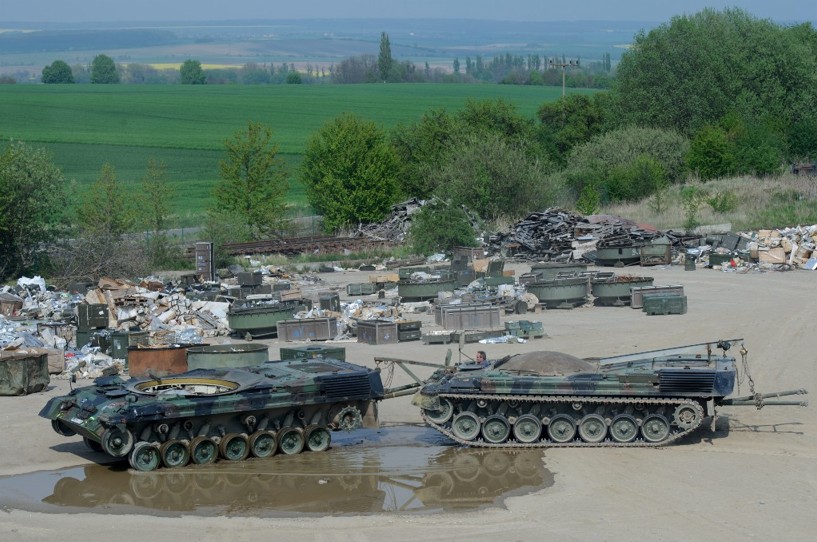
Under the treaty’s unprecedented verification regime, member states were legally required to declare their inventories and allow rival military inspectors onto their sovereign bases to verify compliance. The result was historic: over 50,000 pieces of heavy military equipment were physically destroyed—cut by blowtorches or crushed by hydraulic presses—creating an era of unmatched transparency and trust.
The Collapse of the Architecture
However, the geopolitical landscape shifted drastically. The Warsaw Pact dissolved, and the Soviet Union collapsed. Many former Warsaw Pact nations, and even former Soviet Republics, joined NATO. Moscow began to argue that the original bloc-to-bloc limits of the CFE were now inherently unfair, as NATO’s combined limits had artificially inflated through expansion.
An “Adapted CFE Treaty” was signed in 1999 to establish national, rather than bloc, limits. However, NATO nations refused to ratify it, demanding that Russia first fulfill its commitments to withdraw troops from Georgia and Moldova (Transnistria). A diplomatic stalemate ensued.
The architecture began to crumble in 2007, when Russian President Vladimir Putin formally suspended Russia’s participation in the treaty, citing NATO’s expansion and the deployment of US missile defense systems in Europe.
The Final Nail in the Coffin
The definitive end arrived in 2023. Following its full-scale invasion of Ukraine, Russia formally and legally withdrew from the CFE Treaty. In immediate response, the United States and all NATO allies announced the suspension of their own treaty obligations.
The implications for defense and technology are profound. The guardrails are gone. For the first time since 1990, there are no legal limits, no mandated data exchanges, and no mutual inspections regarding how many tanks, artillery pieces, or attack helicopters a European nation can mass on its borders. The era of arms control has officially been replaced by the era of unrestricted conventional deterrence.
React