
Iran and US Begin War Preparations: Hypersonic Missile Move & Khamenei’s Gulf Declaration

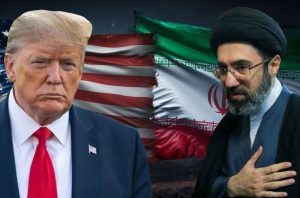
WASHINGTON / TEHRAN — The tactical chessboard in the Middle East is rapidly expanding into a new, highly dangerous theater. As the looming threat of a direct Iran US war intensifies, both Washington and Tehran are executing major strategic realignments, culminating in a U.S. request to deploy hypersonic weaponry to the region for the first time in history.
According to defense intelligence reports, the catalyst for this massive escalation is a calculated defensive maneuver by the Islamic Revolutionary Guard Corps (IRGC). Iran has systematically repositioned its mobile ballistic missile launchers, moving them safely beyond the 483-kilometer (300-mile) strike radius of the U.S. Precision Strike Missile (PrSM) systems currently deployed in the region.

CENTCOM’s Hypersonic Answer: The Dark Eagle
In direct response to Iran moving its high-value assets out of conventional reach, U.S. Central Command (CENTCOM) has officially requested the deployment of the Dark Eagle Long-Range Hypersonic Weapon (LRHW) to the Middle East.
If Washington approves the deployment, it will mark a historic shift in regional deterrence.
Capabilities: The Dark Eagle operates in a completely different paradigm than standard cruise or ballistic missiles. It is capable of reaching speeds exceeding Mach 5 (five times the speed of sound) and can maneuver unpredictably during its glide phase to evade advanced air defense systems.
The Reach: Most critically for the ongoing Iran war calculus, the LRHW has an estimated operational range of roughly 3,000 kilometers (1,860 miles). This effectively nullifies Iran’s attempt to pull its launchers out of range, placing targets deep within the Iranian mainland—including hardened underground silos—back into CENTCOM’s immediate crosshairs.

Khamenei Declares a “New Era” in the Gulf
As military hardware shifts on the ground, the rhetoric emerging from Tehran has grown equally uncompromising. In a message marking National Persian Gulf Day, Iranian Supreme Leader Ayatollah Ali Khamenei declared that a “new chapter” has begun in the highly contested Strait of Hormuz.
Referencing the intense regional conflicts of the past two months, Khamenei framed the current geopolitical landscape as a massive strategic victory for Tehran.
“Today, two months after the largest attack in the region and the shameful failure of the United States in its own design, a new chapter is opening in the Persian Gulf and the Strait of Hormuz,” Khamenei stated, according to the state-run IRNA news agency.
He further noted that the strategic chokepoint has “aroused the greed of many demons in past centuries,” but praised the “determination, vigilance, and courageous struggle” of the Iranian forces.
The Future of the Strait
Khamenei explicitly pointed to the U.S. military presence as the root cause of Middle Eastern instability, predicting a shift in global power dynamics.
“Without the presence of the United States, the Gulf will have a bright future,” the Supreme Leader asserted. Dismissing U.S. regional allies, he added, “The puppet bases of the U.S. do not even have the power and capacity to ensure their own security; there is no hope that the U.S. will provide security to its dependents and those who favor it in the region.”
As the tactical realities of the Iran war continue to evolve, the introduction of hypersonic weapons like the Dark Eagle signals that Washington is preparing for scenarios where traditional standoff distances no longer provide safety for either side.