
French Navy Admits Fourth Suffren-Class Submarine De Grasse to Active Service
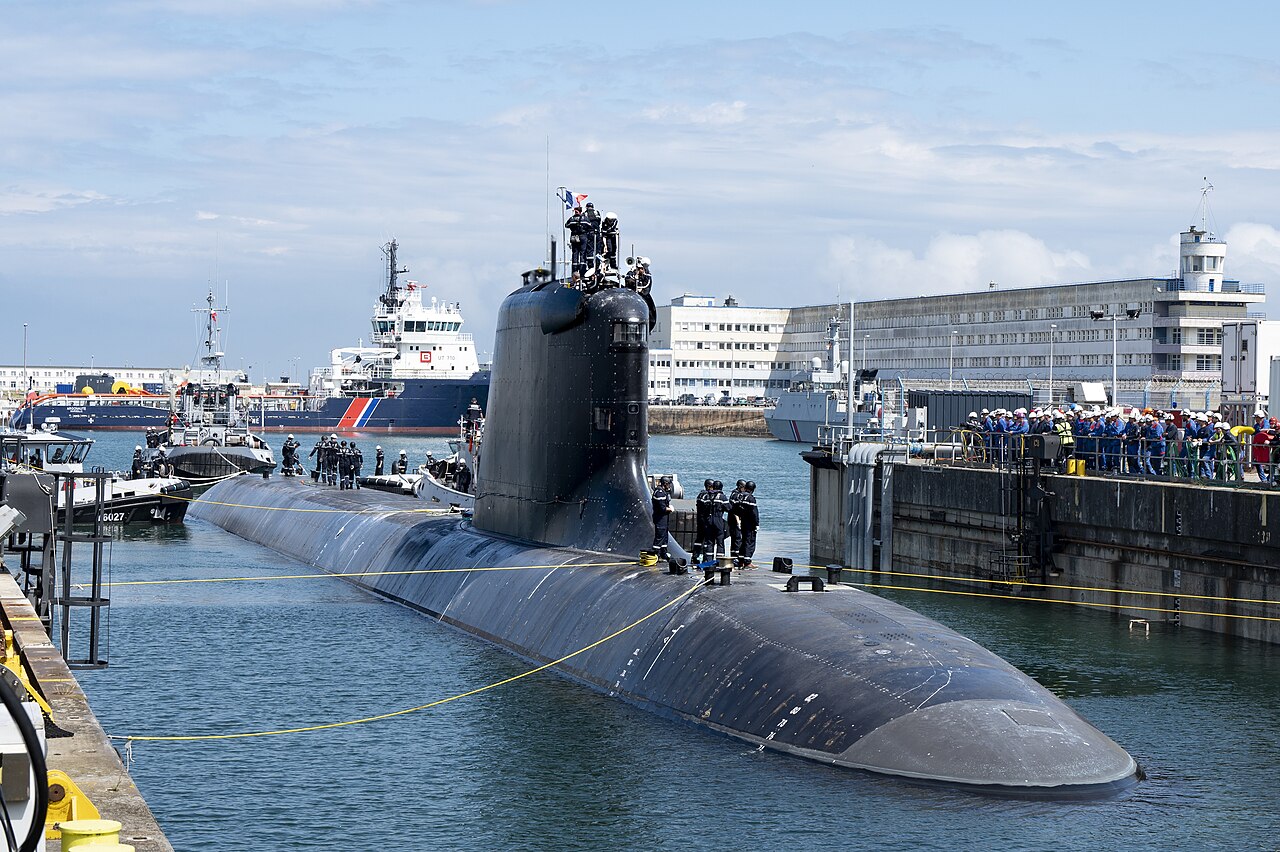

The French Navy has admitted the nuclear attack submarine De Grasse to active service, making it the fourth of six Suffren-class boats cleared for operational deployments. Admiral Christophe Cluzel, the navy’s chief of staff, announced the step on November 20, 2026, according to Naval News and French defence outlet Zone Militaire.
De Grasse (pennant S638) was designed and built by Naval Group in Cherbourg under the Barracuda programme, which is run by the French defence procurement agency DGA. It will join the attack submarine squadron at Toulon.
De Grasse Enters Active Service With the French Navy
| Item | Detail |
|---|---|
| Submarine | De Grasse (S638), fourth Suffren-class nuclear attack submarine |
| Programme | Barracuda, managed by DGA |
| Builder | Naval Group, Cherbourg |
| Operator | French Navy, based at Toulon |
| Announced by | Adm. Christophe Cluzel, chief of the naval staff |
| Admitted to active service | November 20, 2026 |
| Delivered to the navy | Late June 2026 (Naval Group gives June 24) |
| Armament | F21 heavyweight torpedoes, modernised Exocet SM39, naval cruise missiles |
Cluzel said on social media that he was very pleased to have pronounced the admission, Zone Militaire reported. Naval News quoted him as saying the boat, as part of the Barracuda programme, contributes to the renewal of the submarine force. He described a submarine of remarkable stealth, suited to tasks from intelligence gathering to supporting nuclear deterrence, able to deploy special forces and conduct deep strikes with naval cruise missiles.
The announcement follows a period of verification after delivery. De Grasse was handed over in late June, four months after its sea trials began off Cherbourg on February 24, 2026, according to Naval Group. Admission came about five months after delivery. Zone Militaire notes that the first three boats of the class needed roughly seven months.
A Long Deployment From Tromsø to Norfolk
Before admission, the crew completed a long-duration deployment that covered polar and warm waters. Naval News and Zone Militaire both report port calls at Tromsø in Norway and Norfolk in the United States. At Norfolk the crew took part in commemorations of the 1781 Battle of the Chesapeake, which gave the submarine its name: the Comte de Grasse commanded the French fleet in that action.
Zone Militaire adds that the validation phase tests performance, endurance and whether the equipment meets contract specifications. Naval News reports that this boat carries an updated SYCOBS combat management system and a new-generation electronic warfare system compared with the first three submarines.
The Suffren-Class Fleet, Boat by Boat
| Boat | Active service | Status |
|---|---|---|
| Suffren | June 2022 | First of class |
| Duguay-Trouin | April 2024 | In service |
| Tourville | July 2025 | In service |
| De Grasse | November 2026 | Delivered June 2026 |
| Rubis | Not yet | Under construction; the navy expects it in 2028, per Zone Militaire |
| Casabianca | Not yet | Under construction; deliveries run to the end of the decade |
The submarines replace the Rubis class, which entered service in the 1980s. Zone Militaire says the Toulon attack submarine squadron now has four Barracuda-class boats plus Émeraude, the last operational Rubis-class submarine. The fifth boat, Rubis, recently moved out of its construction hall at Cherbourg; our earlier report covers the Rubis rollout and its path to trials.
What De Grasse Brings to the Fleet
| Item | Detail |
|---|---|
| Surface displacement | 4,700 tonnes |
| Submerged displacement | 5,200 tonnes |
| Length / diameter | 99 m / 8.8 m |
| Crew | 65, plus commandos |
| Availability | More than 270 days a year |
| Propulsion | Pressurised water reactor, one turbine, two turbo generators, two electric motors |
Naval Group said the reactor is derived from those fitted to the Triomphant-class ballistic missile submarines and the aircraft carrier Charles de Gaulle. TechnicAtome developed and produced the nuclear boilers with Naval Group, and the CEA works with DGA on the nuclear side.
Armament is the F21 heavyweight torpedo, a modernised Exocet SM39 anti-ship missile and the naval cruise missile, known in French as MdCN. Zone Militaire says the boat can also carry a dry deck shelter and an underwater delivery vehicle for commandos. Its claim that the sensors are 10 to 15 times more capable than on the Rubis class comes from that outlet and was not independently confirmed here.
Timeline From Rollout to Active Service
| Date | Milestone | Source |
|---|---|---|
| May 2025 | Rolled out of the construction hall | Naval Group |
| December 2025 | Nuclear boiler room commissioned | Naval Group |
| February 24, 2026 | Four-month sea trials begin | Naval Group |
| Late June 2026 | Delivered to DGA and the French Navy | Naval Group |
| November 20, 2026 | Admitted to active service | Naval News |
Naval Group Company Profile
| Item | Detail |
|---|---|
| Headquarters | Paris, France |
| Origins | 1631 (French naval dockyards), per Wikipedia |
| Employees | 17,170 (December 31, 2025) |
| Revenue | About €4.7 billion (2025) |
| Chairman and CEO | Pierre Éric Pommellet |
| Key programmes | Barracuda/Suffren SSN, 3G SSBN, FDI frigate, Scorpène |
What Comes Next for the Barracuda Programme
Two boats remain. Naval News reports that Naval Group is delivering slightly ahead of schedule under the 2024-2030 military programming law, with the last deliveries planned through 2029. That reading of the schedule comes from the outlet; Naval Group’s own release says only that deliveries run to the end of the decade.
De Grasse Submarine FAQ
When did De Grasse enter active service?
On November 20, 2026, when Admiral Christophe Cluzel announced its admission.
How many Suffren-class submarines are in service?
Four: Suffren, Duguay-Trouin, Tourville and De Grasse. Rubis and Casabianca are still being built.
Who builds the Suffren-class submarines?
Naval Group builds them in Cherbourg, with TechnicAtome developing the nuclear boilers and DGA managing the Barracuda programme.
What weapons does De Grasse carry?
F21 heavyweight torpedoes, modernised Exocet SM39 anti-ship missiles and naval cruise missiles, according to Naval Group.
Which submarines does the Suffren class replace?
The Rubis-class nuclear attack submarines, which date from the 1980s.
- Naval News – “French Navy’s Fourth Suffren-class SSN ‘De Grasse’ Enters Active Service” (November 21, 2026): navalnews.com
- Zone Militaire (Opex360) – “Le sous-marin nucléaire d’attaque De Grasse a été officiellement admis au service actif” (November 21, 2026): opex360.com
- Naval Group – “Naval Group delivers the fourth Barracuda-class nuclear attack submarine (SSN)” (press release, June 26, 2026): naval-group.com
- Naval Group annual report 2025 and Wikipedia – company data (see our Naval Group company profile)