Who Builds NATO-Standard Tactical Radios?
Europe’s NATO-standard tactical radios are built by a handful of national champions, not one European company: Thales (France) leads with the CONTACT and SYNAPS families, Rohde & Schwarz (Germany) supplies the Bundeswehr’s Soveron sets, Leonardo (UK/Italy) and Poland’s Radmor hold national programmes, and the four-nation ESSOR effort is trying to make these otherwise separate radios talk to each other on a common waveform. No single manufacturer dominates the way Lockheed Martin dominates HIMARS, because every NATO member buys its radios through its own national procurement process, and interoperability is bolted on afterwards through standards rather than a shared production line.
Why this matters
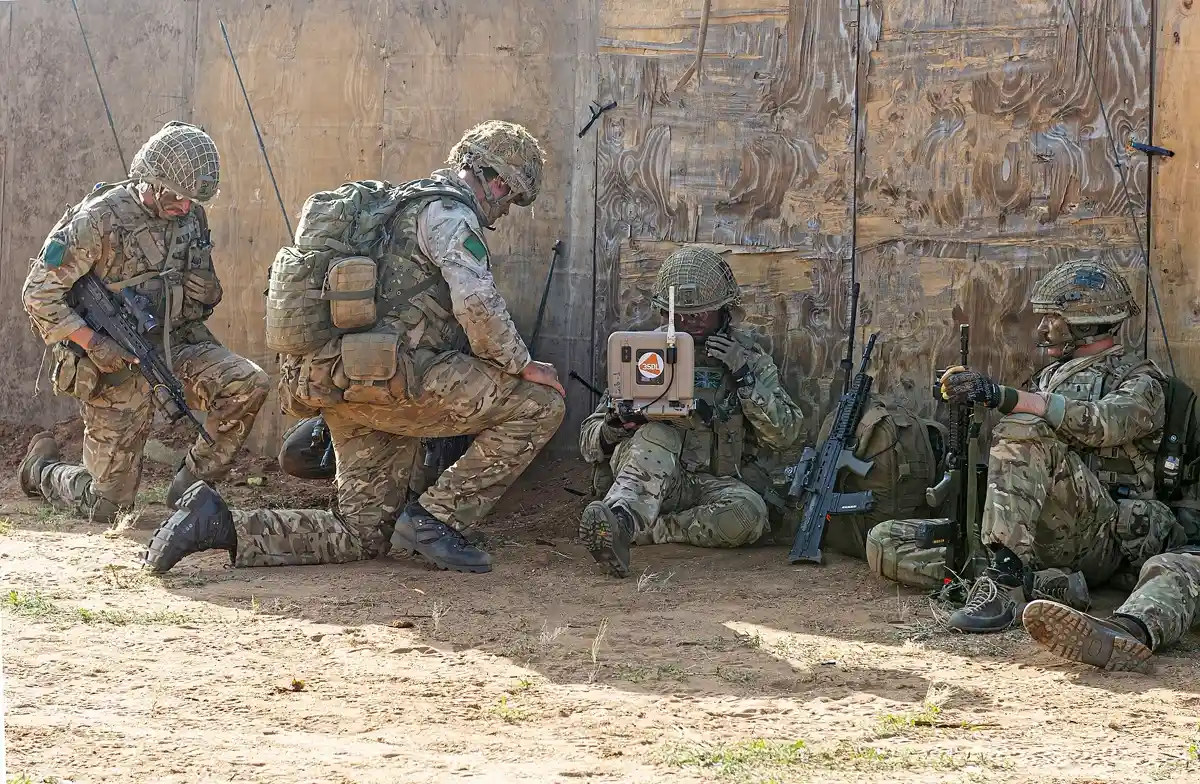
A tactical radio is the thing that actually carries an order from a command post to a soldier kneeling behind a wall, or hands targeting data from one aircraft to another over Link 16. Missiles and radars get the headlines; radios are what makes a coalition of 32 different national armies function as a single force. When Finland, France and Romania all buy different handsets from different manufacturers, the only thing that lets them fight as one NATO is a shared waveform standard and a shared data link, not a shared radio.
That gap has become a procurement priority since 2022. Germany, Poland and the Baltic states are digitising entire divisions for NATO’s eastern flank, Ukraine’s war has shown how fast a battlefield network can be degraded by jamming, and the Alliance’s 2026 budget round has pushed several governments to replace analogue and early-digital sets in a single move rather than piecemeal.
European context
Unlike missiles or air defence, where MBDA or Diehl supply several countries from one assembly line, tactical radios in Europe are still largely a national-sovereignty item: each government wants its own encryption, its own supply chain and its own replacement schedule. That has produced parallel national families, Thales’s CONTACT/SYNAPS in France and for export, Rohde & Schwarz’s Soveron in Germany, Radmor (part of WB Group) in Poland, Leonardo’s radios in Italy and the UK, alongside the separate, NATO-wide effort to standardise how all of these talk to one another, principally through the NATO STANAG waveform and encryption standards and the Link 16 tactical data link that NATO aircraft and air-defence units share.
System and technology
Three technology layers sit underneath the term “tactical radio”:
- Software-defined radios (SDR): modern sets such as Thales SYNAPS, Rohde & Schwarz Soveron and L3Harris Falcon IV run multiple waveforms on the same hardware, so one handset can be reprogrammed for different networks, frequency bands or encryption standards rather than being replaced.
- Tactical data links: Link 16, run over MIDS terminals, carries structured digital tracks (position, identification, targeting cues) between aircraft, ships and ground air-defence units, distinct from the voice and data traffic carried by a soldier’s handheld or vehicle radio. DefenceAndTech covers the standard itself in the Link 16 explainer and the broader military SATCOM bands piece.
- ESSOR waveforms: the European Secure Software defined Radio programme, run through OCCAR for France, Germany, Italy, Spain, Poland and Finland, develops shared waveforms (such as the High Data Rate Waveform and the narrowband waveform) that can be ported onto each nation’s own radio hardware, so a French SYNAPS set and a Polish Radmor set can use the same waveform without either government giving up its own equipment.
| Country | Company | Family | Status | Notes |
|---|---|---|---|---|
| France | Thales | CONTACT, SYNAPS, PR4G | OPERATIONAL/ORDERED | French armed forces plus export to Ireland, Malaysia and others |
| Germany | Rohde & Schwarz | Soveron (SVFuA-derived) | IN PROGRESS | Core of the Bundeswehr’s D-LBO digitisation |
| Italy/UK/Spain | Leonardo (with EuroMIDS partners) | National tactical radios; F-EMIDS terminal | CONTRACTED | Also a subcontractor on the ESSOR-MIDS programme |
| Poland | Radmor (WB Group) | PR4G F@STNET-based sets | IN PROGRESS | National radio supplier to the Polish Armament Agency |
| Türkiye | ASELSAN | 9600 series, SDNR family | OPERATIONAL | Domestic programme for the Turkish Armed Forces; exported sets to Ukraine |
Countries and operators
Ireland placed one of the clearest recent export orders: a framework agreement with Thales, announced in June 2024 and reported at roughly €76m (about $81m), for more than 6,000 software-defined radios across the Irish Defence Forces, over 3,500 handheld SquadNet sets for land forces plus around 2,500 SYNAPS-H, SYNAPS-V and SYNAPS-A radios for vehicles, naval vessels and Air Corps aircraft, with deliveries starting the same year.
Germany is running the largest single re-equipment programme in Europe. The Bundestag’s budget committee approved roughly €2.4bn on 24 June 2026 as the seventh amendment to the Digitalisation of Land-Based Operations (D-LBO) command-radio contract with Rohde & Schwarz, funding around 32,000 additional Soveron software-defined sets to digitise “Division 2025”, the division Germany has committed to NATO, across more than 10,000 vehicles and platforms by the end of 2027. The framework itself has run since 2022, with deliveries under way since 2023. Germany is separately buying US L3Harris Falcon radios: in June 2026 L3Harris confirmed new Foreign Military Sales orders to support D-LBO and special forces requirements, on top of roughly $214m in German orders disclosed in 2025.
Poland continues to field Radmor radios through its Armament Agency, including a 2026 tender for spare parts and sub-assemblies for existing Radmor tactical sets issued by the 3rd Regional Logistics Base in Kraków, alongside earlier framework buys of several hundred software-defined radio stations for army communications.
The United Kingdom awarded a contract worth up to £86m (around £46m firm plus £40m in options) to the British SME BlackTree Technologies in February 2026 for the Dismounted Data System, an AI-capable package of radios, headsets and display tablets trialled by troops deployed in Estonia, with rollout due by 2027. The UK is also procuring L3Harris Falcon IV AN/PRC-163 multi-channel handheld radios for the Army.
A Central European NATO member (undisclosed by name in L3Harris’s own announcement) placed a $170m order for the Falcon IV family in June 2026, while the Dutch Ministry of Defence has a long-term FOXTROT agreement with L3Harris, reported in Dutch and trade press at around €1bn/$1.1bn, for Falcon IV radios.
Industrial players
Thales remains the largest single European supplier by customer count, covering France’s own forces plus export deals in Ireland and beyond. Rohde & Schwarz holds the largest single contract by value through the German D-LBO programme. Leonardo and Indra sit inside the EuroMIDS consortium alongside Thales and Hensoldt, building the shared Link 16-related terminal rather than competing on national handhelds. L3Harris, a US company, has become a significant supplier inside Europe through FMS routes into Germany, the UK, the Netherlands and at least one other NATO member, which is a reminder that “European” procurement does not mean exclusively European industry. Poland’s Radmor, part of the WB Group, is the clearest example of a mid-sized national champion serving its own armed forces rather than exporting at scale.
Procurement status: the ESSOR programme
ESSOR (European Secure Software defined Radio) is managed by OCCAR on behalf of its participating nations and run industrially through the a4ESSOR consortium. Rather than building a single European radio to replace national sets, it builds shared waveforms that can be loaded onto each country’s own hardware:
- In November 2025, a4ESSOR signed a procurement contract with OCCAR for the ESSOR High Data Rate Waveform, which can be ported onto a nation’s existing software-defined radio so that French, German, Italian, Spanish, Polish and Finnish forces can share high-bandwidth tactical data without buying the same radio.
- In April 2026, further development of the ESSOR narrowband waveform was approved, extending the same interoperability principle to lower-bandwidth voice and data traffic.
- A separate but related strand, ESSOR-MIDS (Stage 2, or EMIDS 2), was contracted by OCCAR with the EuroMIDS consortium around 6-20 July 2026 (press reports differ on the exact date) on behalf of Spain, Germany, Italy and France. EuroMIDS is prime contractor, with Indra, Hensoldt, Leonardo and Thales as subcontractors, developing the F-EMIDS terminal to replace current MIDS-LVT units and extend Link 16 interoperability across Eurofighter, Rafale and Tornado fleets. An earlier, separate EuroMIDS contract from 2022 covered MIDS-LVT supply, spares and logistics for the same four nations at a disclosed value of roughly $338.8m over five years; EMIDS 2’s own value has not been disclosed.
NATO’s wider Link 16 ecosystem also runs through non-European channels: the US Navy awarded Data Link Solutions, the BAE Systems/Collins Aerospace (RTX) joint venture, a $248m production contract in January 2026 for MIDS JTRS terminals, a four-channel software-defined radio supporting Link 16 that the company says has already been delivered to more than 50 nations worldwide, several of them NATO allies.
Production capacity
None of the companies above have disclosed unit-output figures comparable to the missile industry’s capacity announcements. What is publicly confirmed is contract scale and schedule: Rohde & Schwarz’s German order alone covers roughly 32,000 radios against a multi-year framework running to 2027; L3Harris describes “broad adoption” of Falcon IV across the US Army, special operations forces and “a growing number of NATO allies” without giving a production-rate figure; Thales’s Irish order of 6,000-plus sets was delivered within roughly a year of signature. The clearest capacity signal is political rather than industrial: the repeated use of options and framework amendments (Germany’s seventh D-LBO amendment, the UK’s £40m of DDS options) shows governments buying in tranches against pre-agreed ceilings rather than placing single fixed orders, which lets manufacturers scale output against confirmed, if staggered, demand.
Competing systems
The main choice European buyers actually face is less “radio versus radio” than “national programme versus US FMS route”. A government can join a domestic programme (Germany’s Soveron, France’s CONTACT/SYNAPS, Poland’s Radmor), which keeps production, encryption control and through-life support at home, or it can buy into the US-built L3Harris Falcon ecosystem, which the Netherlands, Germany and the UK have all done alongside their own national efforts, trading some sovereignty for a wider installed base already used by the US military and other allies. ESSOR is the attempt to get the interoperability benefit of the second option without the sovereignty cost of the first, by standardising the waveform rather than the hardware.
Türkiye, US and allied alternatives
Türkiye answers the same national-sovereignty requirement through ASELSAN, which supplies the Turkish Armed Forces with its own software-defined network radio (SDNR) family, including the 9600-series manpack and vehicular sets that are succeeding the earlier 4600 series, plus handheld models such as the PRC-5333. ASELSAN has also exported VHF/UHF software-defined radios to Ukraine. This is the same pattern seen across NATO, a national manufacturer building sovereign tactical communications rather than relying solely on imports, and DefenceAndTech covers the company in full in its ASELSAN company profile; the firm’s separate, much larger electronic-warfare export business to NATO members is covered in the European electronic warfare companies piece. On the US side, L3Harris’s Falcon family functions as the de facto American benchmark that several European governments now also buy into, detailed further in DefenceAndTech’s L3Harris company profile.
What changes next
Expect three threads to keep moving through 2027: Germany’s D-LBO programme will likely see further contract amendments as more vehicles and platforms are digitised past the 2027 target; the ESSOR-MIDS F-EMIDS terminal will move from contract signature toward testing as it works to replace ageing MIDS-LVT units; and more NATO members are likely to add L3Harris Falcon or Thales SYNAPS orders on top of their national programmes rather than choosing one over the other, reflecting the current pattern of parallel national buys loosely stitched together by shared standards rather than a single continental radio programme.
Frequently asked questions
Is there one company that builds Europe’s tactical radios?
No. Thales (France), Rohde & Schwarz (Germany), Leonardo (Italy/UK) and Poland’s Radmor each supply their own national armed forces, with the ESSOR programme working to make their radios interoperable through shared waveforms rather than shared hardware.
What is the difference between a tactical radio and Link 16?
A tactical radio carries voice and data traffic for soldiers, vehicles and command posts. Link 16 is a structured tactical data link, carried over MIDS terminals, that shares digital tracks such as position and targeting data between aircraft, ships and air-defence units; it is a separate though related layer of military communications, explained in full in DefenceAndTech’s Link 16 explainer.
What is ESSOR?
The European Secure Software defined Radio programme, managed by OCCAR for France, Germany, Italy, Spain, Poland and Finland, develops shared waveforms that can run on each nation’s own radio hardware so that different countries’ sets can communicate without a single common radio being built.
Why is Germany spending so much on radios right now?
Germany is digitising an entire division to meet a NATO commitment, “Division 2025”, replacing older analogue equipment across more than 10,000 vehicles and platforms by the end of 2027 under its Digitalisation of Land-Based Operations (D-LBO) programme, funded through successive amendments to its Rohde & Schwarz contract.
Do European countries buy American radios?
Yes. Germany, the UK and the Netherlands have all placed orders for US-built L3Harris Falcon IV radios alongside their own national programmes, usually through Foreign Military Sales, trading some domestic production for a wider, combat-proven installed base already used by the US military.
Does Türkiye build its own tactical radios?
Yes. ASELSAN supplies the Turkish Armed Forces with its own software-defined radio family, including the 9600-series manpack and vehicular sets, and has exported radios to Ukraine, following the same national-sovereignty model used by Thales in France or Rohde & Schwarz in Germany.
What is the Link 16 terminal programme in Europe called?
ESSOR-MIDS, currently in its second stage (EMIDS 2), contracted by OCCAR with the EuroMIDS consortium (Indra, Hensoldt, Leonardo and Thales) on behalf of France, Germany, Italy and Spain, to build the F-EMIDS terminal replacing current MIDS-LVT units on Eurofighter, Rafale and Tornado aircraft.
How much is the UK spending on new tactical radios?
Up to £86m under the Dismounted Data System contract awarded to BlackTree Technologies in February 2026, covering radios, headsets and display tablets, with full rollout targeted for 2027.
Sources
- Thales: Irish Defence Forces software-defined radio order
- Bundestag €2.4bn D-LBO/Soveron approval, June 2026
- L3Harris: Falcon orders for German forces, June 2026
- L3Harris: $170m Central European Falcon IV order
- L3Harris: $214m German D-LBO orders, 2025
- UK MoD: Dismounted Data System, £86m, Feb 2026
- OCCAR: ESSOR-MIDS 2 (EMIDS 2) contract signature
- Indra: EuroMIDS/F-EMIDS consortium details
- EuroMIDS $338.8m MIDS-LVT contract, 2022
- a4ESSOR/OCCAR: High Data Rate Waveform contract, Nov 2025
- ESUT: ESSOR narrowband waveform development approved, April 2026
- Data Link Solutions: $248m MIDS JTRS contract, Jan 2026
- Defence24: Radmor backpack radios for the Polish military
- Radmor radio parts tender, Kraków logistics base, 2026
- ASELSAN: software-defined network radios (SDNR)
- ASELSAN 9600-series tactical radios overview
- Shephard Media: Ukraine buys Turkish radios
Last updated: 11 November 2026.