MIZRAK Loitering Munition: Baykar’s 1,000 km Strike Drone Explained
MIZRAK (Turkish for “spear”) is Baykar’s intelligent loitering munition: a 200 kg, runway- or rocket-launched aircraft that the company says carries a 40 kg payload, flies more than 1,000 km for over seven hours and can navigate without GPS. Baykar announced a live-fire test at the end of April 2026, showed MIZRAK publicly at SAHA 2026 in Istanbul in May, and on 30 September 2026 the head of Türkiye’s Presidency of Defence Industries (SSB) announced a supply contract with Azerbaijan, the first known customer. The specifications below are Baykar’s published figures, checked on its product page on 10 November 2026 (Baykar); they have not been independently verified.
- Maker: Baykar, Türkiye; intelligent loitering munition (manufacturer class)
- Baykar figures: 200 kg MTOW, 40 kg payload, 1,000+ km range, 7+ h endurance, 80/100 KIAS, 4 m wingspan
- Configurations: two warheads totalling 40 kg, or one 20 kg warhead plus an RF seeker; runway or rocket-assisted (RATO) take-off
- Milestones: live-fire test announced late April 2026; public debut at SAHA 2026 (5–9 May); Azerbaijan supply contract announced 30 Sep 2026 at ADEX
- Azerbaijan: quantity, value and delivery dates not disclosed; the >US$500m ADEX figure covers the whole package
- No unit price, engine maker or Turkish order published; performance claims are not independently verified
What is MIZRAK?
Baykar describes MIZRAK as a next-generation loitering munition designed “to deliver high impact at medium altitude”, with a customisable structure and long range. A loitering munition is an expendable unmanned aircraft that can fly to an area, stay there while its sensors search, and then attack by diving onto the target; it is not recovered after a strike. Baykar’s 30 April press release says the system was “indigenously and originally developed” and frames it as a surface-to-surface, long-range strike tool that combines surveillance and attack in one airframe (Baykar press release).
MIZRAK is one of three expendable strike types Baykar presented in spring 2026, alongside the much larger K2 Kamikaze UAV and the lighter Sivrisinek. For the company background, see our Baykar company profile.
MIZRAK specifications
The table follows Baykar’s English product page; the Turkish page gives the same values.
| Parameter | MIZRAK (Baykar figures) |
|---|---|
| Maximum take-off weight | 200 kg |
| Payload capacity | 40 kg |
| Warhead options | 40 kg (two warheads), or 20 kg plus an RF seeker |
| Operational range | 1,000+ km |
| Endurance | 7+ hours |
| Cruise / maximum speed | 80 KIAS / 100 KIAS (about 148 / 185 km/h) |
| Service ceiling / operational altitude | 10,000 ft / 4,000 ft |
| Wingspan / length / height | 4 m / 3.6 m / 1.2 m |
| Power plant | Internal combustion engine (maker and model not named) |
| Launch and recovery | Runway (landing gear) or rocket-assisted take-off (RATO) |
| Communications | Line of sight; beyond line of sight and SATCOM optional; 70+ km range on the product page, “exceeding 80 km” in the 30 April press release |
| Relay | Digital data and video link via Bayraktar TB2, TB3 or AKINCI |
| Sensors / payload | AI-assisted interchangeable EO or IR camera; RF seeker or second warhead |
| Terminal guidance | EO or GNSS |
| Versions listed | MIZRAK-C (no further details published) |
The two communication-range figures come from Baykar itself and we report both rather than choose one. Baykar does not publish a unit price, production rate, engine supplier or any Turkish Armed Forces order on the product page, and it gives no detail on what distinguishes the “MIZRAK-C” version. Those points are left open rather than estimated.
Configurations: two warheads or warhead plus RF seeker
Baykar offers MIZRAK in two main configurations. The dual-warhead version carries 40 kg of explosives in total. The single-warhead version carries 20 kg and adds a radio-frequency (RF) seeker, which Baykar says provides “precise target detection”. The Turkish defence site TURDEF describes the RF-seeker version as intended for missions against radar emitters; that is TURDEF’s reading, not a Baykar statement (TURDEF). Because these are configurations of one aircraft rather than separately specified models, Defense and Tech covers them in this article instead of on separate pages.
Autonomy and navigation claims
Baykar lists an AI-assisted autopilot and optical guidance set, sensor fusion, visual positioning and an anti-jamming system, and says MIZRAK can locate its target even where electronic warfare is heavy or GPS signals are denied (Baykar). These are manufacturer descriptions. No independent assessment of MIZRAK’s accuracy, resistance to jamming or survivability was found in the sources reviewed, and this article does not describe targeting or employment procedures.
The link with Baykar’s armed UAVs matters for how the system would be used in practice: Baykar says MIZRAK can pass data and video through a Bayraktar TB2, TB3 or AKINCI, which would let an operator stay in contact beyond the munition’s own line-of-sight range.
Development timeline
Late April 2026: live-fire test. Baykar announced a firing test of MIZRAK with a live warhead; TURDEF reported on 30 April that the test included an autonomous dive with a 40 kg warhead after a runway take-off (TURDEF). The SSB’s weekly industry summary dated 4 May 2026 recorded that the MIZRAK firing test had been completed successfully (SSB). Baykar has not published the exact test date.
30 April 2026: announcement. Baykar said MIZRAK would be unveiled for the first time at SAHA 2026 (Baykar).
5–9 May 2026: SAHA 2026, Istanbul. MIZRAK made its public debut at the exhibition, according to Airforce Technology’s project page (Airforce Technology).
30 September 2026: Azerbaijan contract at ADEX 2026. SSB President Prof. Dr. Haluk Görgün listed the agreements signed with Azerbaijan in Baku, including a “MIZRAK smart loitering munition supply contract” and a separate ANTIDOT supply contract with Baykar (MilDefIn; Central Asia Wire). Janes described it as the first MIZRAK contract and noted that no further details were released (Janes). Our news report on the full package is here: Türkiye and Azerbaijan sign $500m+ defence deals at ADEX 2026.
Azerbaijan order: what is and is not known
Known: a supply contract for MIZRAK was signed with Azerbaijan on 30 September 2026, announced by the SSB president, and Azerbaijan is the first publicly known buyer. Not known: the number of munitions, the contract value, the configuration ordered and the delivery schedule. Görgün put the total value of all the agreements signed at ADEX at more than US$500 million, but that figure covers the whole package, including TUSAŞ HÜRKUŞ trainers and the ROKETSAN BARBAROS coastal defence system. It is not a MIZRAK price, and it should not be divided to estimate one. A signed contract is also not a delivery; we found no report of MIZRAK deliveries.
How MIZRAK fits Baykar’s range
The figures below are each taken from Baykar’s own product pages; they describe different classes of system and are not a ranking.
| Baykar figures | Sivrisinek (UM / UMX) | MIZRAK | K2 Kamikaze |
|---|---|---|---|
| Maximum take-off weight | 76 / 78 kg | 200 kg | 800 kg |
| Payload / warhead | 20 kg | 40 kg | 200 kg |
| Range | 1,000 / 900 km | 1,000+ km | 2,000+ km |
| Endurance | 9+ / 8+ h | 7+ h | 13+ h |
| Launch | Catapult | Runway or RATO | Runway, short/unimproved strips |
Sources: Baykar Sivrisinek page, Baykar MIZRAK page, Baykar K2 page (all accessed 10 November 2026). MIZRAK sits in the middle: its listed payload is a fifth of the K2’s and twice Sivrisinek’s, and it adds the option of rocket launch that Baykar also offers on its KEMANKEŞ 2 mini cruise missile.
Frequently asked questions
Who makes MIZRAK?
Baykar of Türkiye, which says it developed the munition indigenously.
What is MIZRAK’s range?
Baykar lists an operational range of more than 1,000 km and endurance of more than seven hours. Its communication range is given as 70+ km on the product page and more than 80 km in the April 2026 press release, with satellite communication as an option.
How heavy is MIZRAK’s warhead?
Baykar lists a 40 kg payload: either two warheads totalling 40 kg, or a single 20 kg warhead with an RF seeker.
Has MIZRAK been exported?
Yes, a contract has been signed. Azerbaijan signed a MIZRAK supply contract with Baykar at ADEX 2026 on 30 September 2026, as announced by SSB President Haluk Görgün. Quantity, value and delivery dates have not been disclosed.
Is MIZRAK the same as Sivrisinek or K2?
No. They are separate Baykar products. Sivrisinek is lighter and catapult-launched; K2 is about four times heavier than MIZRAK.
Can MIZRAK be launched without a runway?
Baykar says yes: besides conventional take-off on landing gear, it offers a rocket-assisted take-off (RATO) option for unprepared areas.
Sources
- Baykar – MIZRAK product page (EN) (accessed 10 November 2026)
- Baykar – MIZRAK product page (TR) (accessed 10 November 2026)
- Baykar – “MIZRAK Intelligent Loitering Munition to debut at SAHA 2026”, 30 April 2026
- SSB – weekly Turkish defence industry summary, 4 May 2026
- Janes – ADEX 2026: Azerbaijani contract for Baykar’s Mizrak announced
- MilDefIn – list of ADEX contracts announced by Haluk Görgün, 30 September 2026
- Central Asia Wire – Türkiye and Azerbaijan sign defence contracts at ADEX, 1 October 2026
- TURDEF – Baykar tests MIZRAK with warhead, 30 April 2026
- Airforce Technology – MIZRAK project page
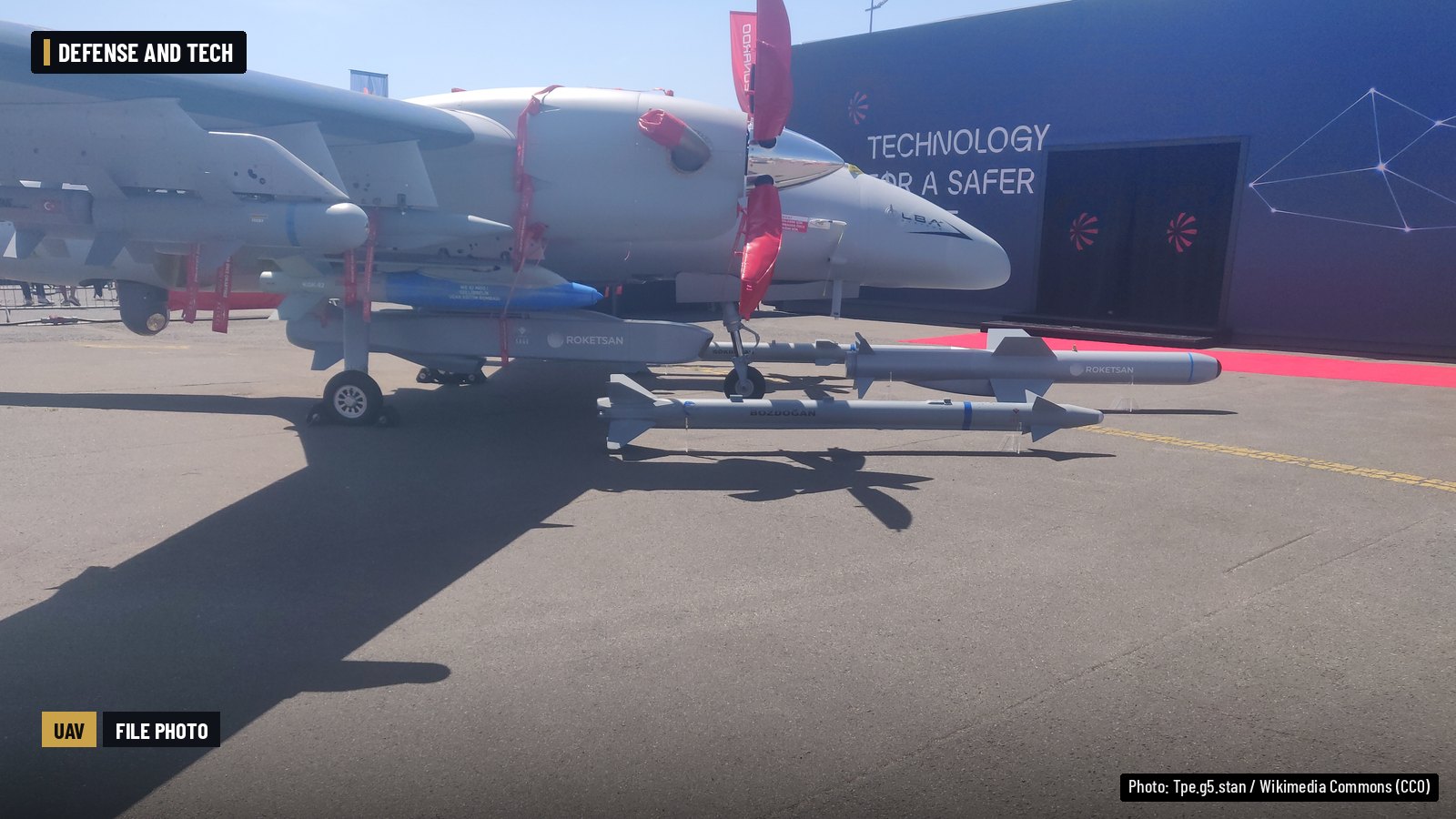
- Wikimedia Commons – cover photograph, a Bayraktar AKINCI (Tpe.g5.stan, CC0)
Last updated: 10 November 2026. The cover photograph is a file photo of a Baykar Bayraktar AKINCI at the Paris Air Show 2025, not of MIZRAK.