India’s Indigenous Submarine AIP Enters Setting to Work Phase-2, Kalvari Fit Planned for Early 2027
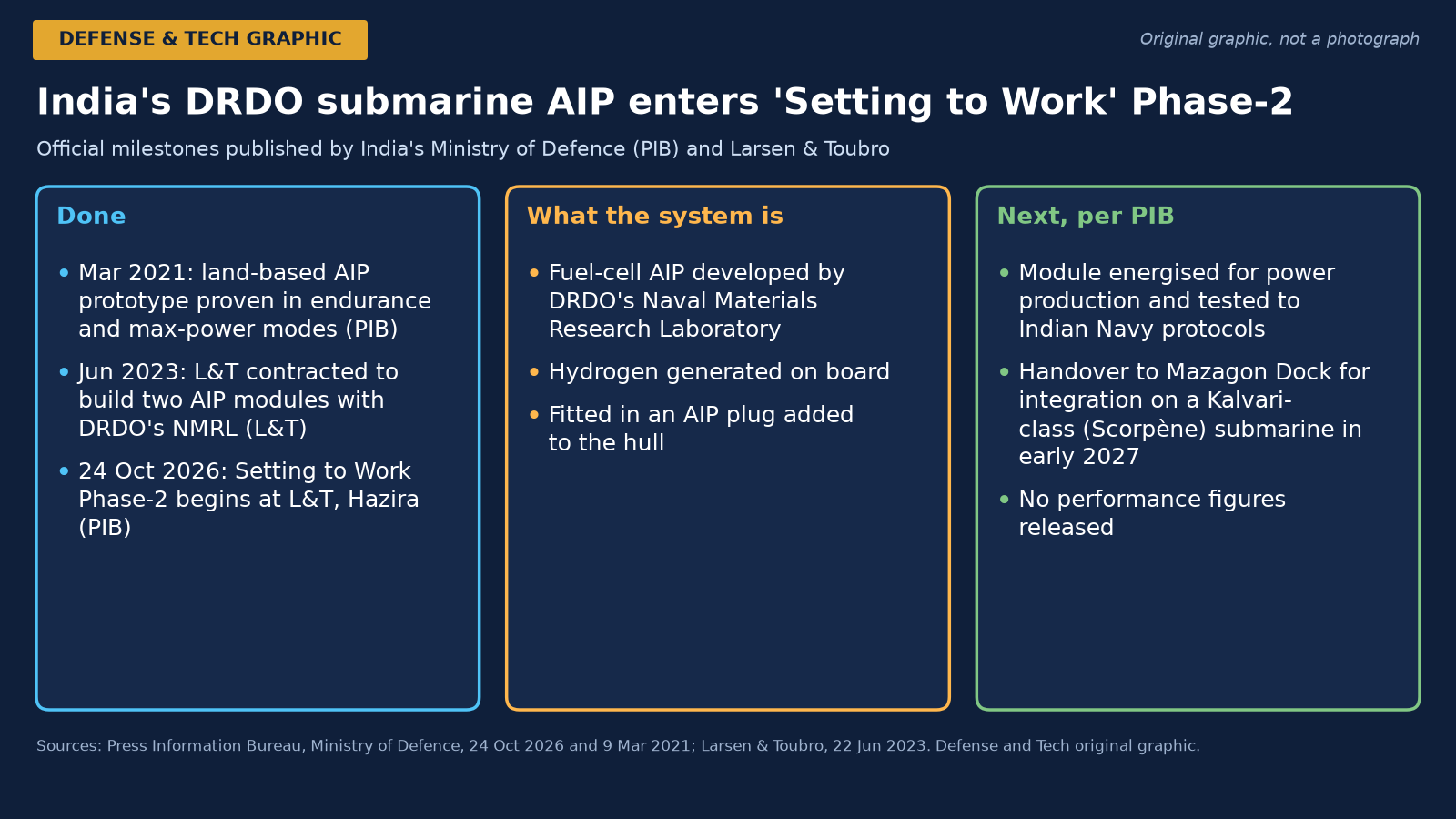
India’s home-grown submarine AIP (air-independent propulsion) system for diesel-electric boats has entered “Setting to Work Phase-2”, the Ministry of Defence said on 24 October 2026. The energy module, developed by the Defence Research and Development Organisation’s Naval Materials Research Laboratory (NMRL), will now be powered up and tested before going to Mazagon Dock Shipbuilders for fitting on a Kalvari-class submarine in early 2027 (PIB).
- What: ‘Setting to Work Phase-2’ of the AIP system energy module developed by DRDO’s Naval Materials Research Laboratory
- Where and when: L&T’s AM Naik Heavy Engineering Complex, Hazira, Gujarat, 24 October 2026
- Next step: the module will be energised to produce power and tested to Indian Navy protocols
- Then: handover to Mazagon Dock Shipbuilders for integration on a Kalvari-class submarine in early 2027
- Technology: fuel-cell AIP that generates its hydrogen on board
What happened at Hazira
The ceremony took place at Larsen & Toubro’s AM Naik Heavy Engineering Complex in Hazira, Gujarat. Defence Secretary Rajesh Kumar Singh, who is also Secretary of the Department of Defence R&D and Chairman of DRDO, joined virtually as chief guest. The Indian Navy’s Chief of Materiel, Vice Admiral B Sivakumar, and DRDO’s Director General (Naval Systems & Materials), Dr R Balamuralikrishnan, attended in person (Ministry of Defence).
According to the ministry, Singh said the programme had “culminated into productive reality on the shop floor” and credited the Navy for testing and validating the system at every stage. He asked the teams to keep to the Navy’s induction timelines “while maintaining the exacting safety culture that hydrogen and fuel cell systems require without compromise”.
What comes next
In the next phase the energy module will be energised to produce power and put through tests set by the Indian Navy. After that it is to be handed to Mazagon Dock Shipbuilders Limited (MDL) for integration on a Kalvari-class submarine in early 2027, the ministry said. It did not say which of the boats will receive the system first, and it gave no figures for power output or added submerged endurance, so we do not publish any.
How India’s AIP works
A conventional submarine has to come up to snorkel depth to run its diesel engines and recharge its batteries, which is when it is easiest to detect. AIP lets it generate power underwater without outside air, so it can stay submerged far longer. NMRL’s design uses fuel cells. Unlike systems that store hydrogen in tanks, it produces hydrogen on board, which DRDO has described as unique among the AIP types pursued internationally (PIB, 2021).
L&T says the energy modules, made up of the fuel cells and the on-board hydrogen generator, are built and factory-tested at its Hazira complex and then supplied for an AIP “plug”, a new hull section retrofitted into the submarine (L&T).
Previous milestones
DRDO proved a land-based prototype on 8 March 2021, running it in endurance and maximum-power modes to the Navy’s requirements; L&T and Thermax were the industry partners (PIB). On 22 June 2023 DRDO and L&T signed a contract for two AIP modules for the Kalvari class. L&T said at the time that the project could lead to orders for the remaining five boats of the class and to possible exports to other Scorpène operators; that is the company’s expectation, not a placed order (L&T).
Industry context
The six Kalvari-class boats are Scorpène-design submarines built by MDL in Mumbai. Adding a domestically built AIP plug during a refit is a way to extend their submerged endurance without buying new hulls. The milestone also matters for India’s wider push to build key naval technology at home, alongside programmes covered in our guide to the drones India operates. Fuel-cell AIP is already in service on some foreign submarine classes; we have not drawn a performance comparison because no official Indian performance data has been released.
Sources: Ministry of Defence, India (PIB, 24 October 2026); PIB, 9 March 2021; Larsen & Toubro press release, 22 June 2023. This article will be updated when the energy module completes its power trials.