Admiral Nakhimov: Russia’s Nuclear Battlecruiser and Its Zircon Missiles
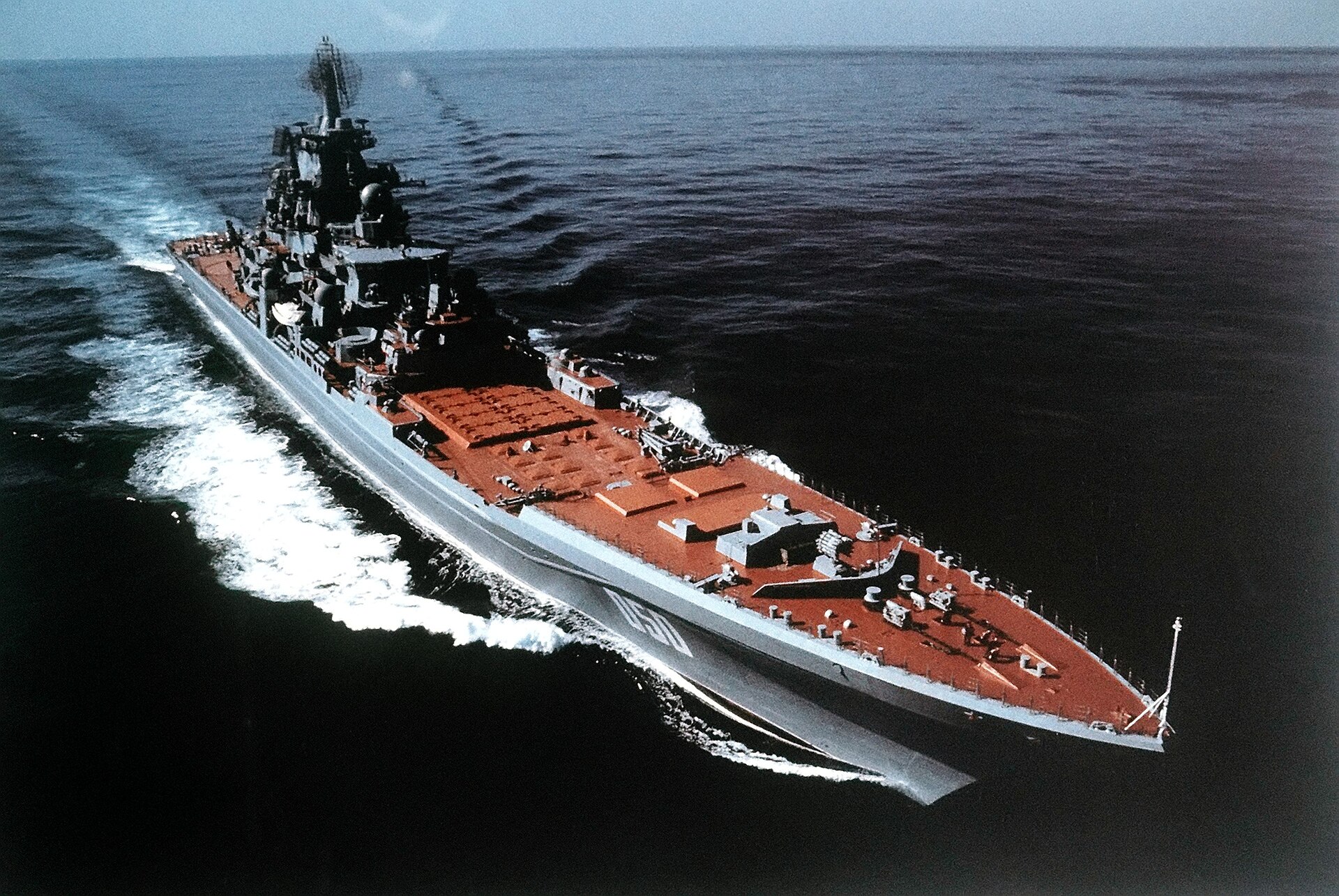
Few warships carry as much symbolism for the Russian Navy as Admiral Nakhimov. A Cold War Kirov-class nuclear-powered battlecruiser, it has spent more than two decades in a shipyard being rebuilt into what Russian officials describe as the most heavily armed surface warship in the world. Here is what the ship is, what it carries and why its return matters.
- Kirov-class nuclear-powered battlecruiser, about 252 m long
- Roughly 25,000 tonnes full load, the largest non-carrier surface warship
- About 80 universal launch cells for Kalibr, Oniks and Zircon
- Laid up since 1999, under modernisation at Sevmash
- Return to service has been delayed many times
What is Admiral Nakhimov?
Admiral Nakhimov was laid down in 1983 as Kalinin and commissioned in 1988, one of four Kirov-class battlecruisers built for the Soviet Navy. At about 252 metres long and around 25,000 tonnes full load, the class remains the largest non-aircraft-carrier surface combatant afloat. Two nuclear reactors give it virtually unlimited range. The ship was renamed in 1992 and laid up in 1999 as Russia’s navy shrank after the Soviet collapse.
A modernisation measured in decades
Serious work at the Sevmash shipyard in Severodvinsk began in the 2010s. The programme has replaced the old P-700 Granit anti-ship missiles with modern vertical launchers, renewed the electronics and overhauled the propulsion plant. Costs and delays have grown repeatedly, and Russian officials have moved the planned return date many times. Its final entry into service remains one of the most closely watched questions in Russian shipbuilding.
Weapons: Kalibr, Oniks and Zircon
The key upgrade is around 80 universal 3S14 vertical launch cells. These can fire Kalibr land-attack and anti-ship cruise missiles, P-800 Oniks supersonic anti-ship missiles and the 3M22 Zircon hypersonic missile, which Russia claims can fly at around Mach 8 or more. For air defence the ship is being fitted with the naval Fort-M system, a relative of the S-300, plus Pantsir-M close-in weapon systems. Anti-submarine weapons and helicopters complete the fit.
What role will it play?
In wartime, Admiral Nakhimov would act as the centrepiece of a surface action group in the Northern Fleet, able to threaten carrier groups and land targets thousands of kilometres away. In peacetime its value is just as much political: Russia’s only aircraft carrier, Admiral Kuznetsov, has been out of action for years, and its sister ship Pyotr Velikiy is ageing. A modernised Nakhimov would be the most visible symbol of Russian naval power.
Strengths and weaknesses
Its strengths are firepower, range and endurance. Its weaknesses are age, a huge crew, high running costs and vulnerability to modern anti-ship missiles and submarines, lessons underlined when Ukraine sank the cruiser Moskva in 2022. Critics argue the money could have bought several modern frigates. Supporters say no other Russian ship can carry so many long-range missiles.
The bottom line
Admiral Nakhimov is a Cold War giant rebuilt for the hypersonic age. If it finally returns to sea, it will be the most heavily armed ship in Russia’s fleet. Whether it can survive in modern naval warfare is another question.
Featured image: Camera Operator: MITSUO SHIBATA / Public domain, via Wikimedia Commons