Iraq’s $2.8B South Korean Air Defense Deal Stalls as Coalition Exits

Lead
Iraq’s $2.8 billion contract to buy eight batteries of South Korea’s Cheongung-II (KM-SAM II) medium-range air defense system has stalled over unpaid installments, according to regional and Korean trade press, just as the United States-led international coalition completed its withdrawal from Iraq and drone attacks continue to strike the Kurdistan Region, including the private office of Kurdistan Regional Government (KRG) Prime Minister Masrour Barzani. The convergence leaves Baghdad and Erbil increasingly dependent on air defenses that have not yet arrived, at the exact moment the foreign systems that filled the gap are leaving.
What Happened
Iraq’s Ministry of Defense signed a contract with South Korea’s LIG Nex1 in September 2024 for eight Cheongung-II batteries, valued by Korean outlets including the Korea Times and Korea JoongAng Daily at roughly 3.7 trillion won, or about $2.78 billion. Baghdad reportedly made an initial payment of $500 million but has not completed subsequent installments, according to reporting by Amwaj Media and Shafaq News, which cited the stalled payments as the reason deliveries originally expected in early 2026 are now in doubt.
Iraqi and South Korean officials have since held repeated talks on financing. Iraq’s finance ministry met South Korea’s ambassador to Baghdad in late August 2026 specifically to discuss the contract’s funding file, and Prime Minister Ali al-Zaidi ordered a dedicated air-defense fund and chaired a meeting on foreign defense contracts in mid-August. South Korean officials have reportedly signaled that LIG Nex1 could offer the batteries to another buyer if Iraq does not resume payment, though no South Korean government statement making that threat directly has been published.
The financing trouble has surfaced as Iraq’s broader fiscal picture has tightened. Iraq watcher Joel Wing, writing on the stall, said paying government salaries has become Baghdad’s priority and that the state “probably does not have the money” for the full contract at present, linking the squeeze in part to disruption around the Strait of Hormuz.
The Product/System
The Cheongung-II, also marketed as KM-SAM II or Cheolmae-2 (“Iron Hawk”), is a medium-range, mobile surface-to-air missile system developed by South Korea’s Agency for Defense Development with technical assistance from Russia’s Almaz-Antey and Fakel design bureaus. Its missile draws on technology from the 9M96 interceptor used in Russia’s S-350E and S-400 systems. A standard battery consists of an engagement control center, a multifunction radar, a power generator and four to six vertical launchers, each carrying eight missiles, giving a single battery roughly 32 ready rounds. Reported performance figures put the Block-II missile’s range at about 50 km and its top speed near Mach 5, placing it in the same tier as the US Patriot PAC-2/3 and Russian S-350/S-400 families.
LIG Nex1, the prime contractor and South Korea’s leading guided-weapons manufacturer, has used the Cheongung-II’s export success as a showcase for the country’s broader defense-export push, which has also delivered the K9 Thunder howitzer, FA-50 light fighter and Chunmoo rocket system to multiple foreign buyers over the past five years.
Who Uses It
The Cheongung-II is operational with South Korea’s own armed forces, which have fielded the system since 2015 as part of a layered defense built around US Patriot batteries and Seoul’s indigenous Korea Air and Missile Defense architecture. Outside South Korea, the system — in Cheongung-II or related M-SAM II/L-SAM configurations — has been sold to the United Arab Emirates (roughly $3.5 billion, agreed in 2022) and Saudi Arabia (roughly $3.2 billion, agreed in 2023), according to Korean and Gulf defense trade reporting. Iraq’s 2024 contract was described by Korean outlets at the time as the system’s third Middle East export success within two years. Iraq is listed as a contracted buyer whose batteries have not yet been delivered, rather than as a confirmed operator.
Export/Procurement History
South Korea’s missile-defense exports to the Gulf and Middle East have followed a consistent pattern: an initial contract announcement, financing or delivery delays, and eventual fulfillment over several years. The UAE deal, Seoul’s largest single arms-export contract at the time it was signed, proceeded largely on schedule and the Cheongung-II reportedly intercepted an Iranian ballistic missile over the UAE for the first time in 2026, according to Militarnyi and Korean reporting — a combat result Seoul has cited to market the system further. Iraq’s contract, by contrast, has run into financing trouble before any batteries were delivered, a risk flagged by a government source speaking to Shafaq News as early as November 2025, who warned the deal could collapse without completed payment.
Global Competitors
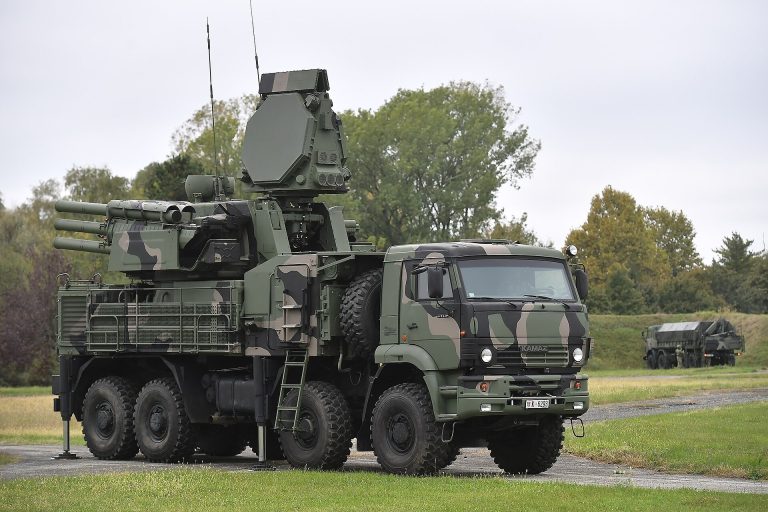
The Cheongung-II competes in the medium-range tier against Russia’s Buk-M3 and Pantsir-S1, China’s HQ-16 and FK-3, and Western systems such as the US-made NASAMS and the French-Italian SAMP/T. Within Iraq specifically, the government’s existing air-defense inventory is thin and aging, built around a mix of older Russian-origin systems and the ineffective — according to analysts cited by Amwaj Media — Pantsir-S1, which Iraq operates but which has struggled against drone swarms. Iraq has also discussed, without confirming, a parallel interest in South Korea’s KAI T-50 Golden Eagle light combat aircraft as part of a wider defense relationship with Seoul.
Why It Matters
The timing compounds the stakes. The US-led coalition against the Islamic State group formally ended its military mission in Iraq by Iraq’s own September 30, 2026 deadline, with wire reports describing the departure of the last American and British troops from the country around that date. Much of the US-provided air-defense equipment that had protected the Kurdistan Region, including Patriot batteries, is being withdrawn alongside the troops. KRG Prime Minister Masrour Barzani warned in July and again on October 6 that Kurdistan lacks adequate air defenses of its own and has urged Baghdad to supply replacement systems, explicitly citing the loss of American coverage.
The threat Barzani is warning about is active. On August 17, 2026, two Hadid-110 drones struck Barzani’s private office and the nearby residence of the Parastin intelligence chief in Erbil; the KRG said the drones were launched from across the Iranian border, and no group claimed responsibility. The KRG says the region has absorbed more than 1,000 drone, rocket and missile attacks since late February 2026, which Barzani has attributed variously to Iran and to Iran-aligned armed factions operating inside Iraq, sometimes described collectively as the “Islamic Resistance in Iraq.” A separate interception in late September, in which Kurdish counter-terrorism forces reportedly shot down ten drones approaching Erbil over roughly two hours, illustrates both the frequency of the threat and current reliance on ad hoc, partial defenses rather than a layered missile shield.
Set against that backdrop, the stalled Cheongung-II contract is not simply a commercial dispute. It is the centerpiece of Iraq’s plan to replace departing American air-defense coverage with an indigenous, paid-for capability, and its stall leaves an exposed window between the coalition’s exit and the system’s eventual, uncertain arrival.
What Happens Next
Officials and analysts have described three broad paths forward, as reported by Amwaj Media. Baghdad could unlock the remaining payments and restart deliveries under the existing contract; a residual US or allied presence could be negotiated past the September 30 deadline to cover the gap, something Iraqi officials have resisted politically; or Kurdistan could be left to manage the drone threat largely on its own, relying on counter-drone point defenses at energy infrastructure and ad hoc interception rather than a full medium-range shield. Baghdad has in the meantime told foreign energy companies operating in Kurdistan that they may deploy their own air-defense systems, an acknowledgment that state coverage currently falls short. None of the three paths has been confirmed as settled policy, and Iraqi and South Korean officials have not announced a resolution to the payment dispute as of this writing.
FAQ
What is the Cheongung-II (KM-SAM II)?
It is a South Korean medium-range, mobile surface-to-air missile system built by the Agency for Defense Development and exported by LIG Nex1, with a reported range of about 50 km and an interceptor speed near Mach 5.
Why has Iraq’s air-defense deal with South Korea stalled?
Iraq paid an initial $500 million toward the $2.8 billion, 2024 contract for eight batteries but has not completed further installments, which Iraq watchers link to strained state finances; South Korea has reportedly signaled it could sell the batteries elsewhere if payment is not resumed.
Has the US-led coalition actually left Iraq?
Wire reports from around September 30, 2026 describe the departure of the last US and British troops under the coalition’s anti-Islamic State mission, meeting the deadline Prime Minister Ali al-Zaidi had set as final.
Who is behind the drone attacks on Iraqi Kurdistan?
The KRG has blamed Iran and Iran-aligned armed factions inside Iraq for the bulk of the drone, rocket and missile attacks on the region since February 2026, including the August 17 strike on Prime Minister Barzani’s office; no attack has been independently attributed beyond these official Kurdish statements.
What happens if Iraq cannot pay for the South Korean system?
Analysts cited by Amwaj Media say South Korea could redirect the batteries to another buyer, leaving Iraq and Kurdistan reliant on weaker interim measures, such as point air defenses around energy sites, rather than a layered medium-range shield.
Sources
- Paul Iddon, “Iraq’s Air Defense Future in Disarray Amid Stalled South Korean Deal,” Amwaj Media, August 21, 2026 — primary account of the payment stall, coalition withdrawal timeline and Kurdistan drone threat.
- Shafaq News, “Baghdad risks losing $2.7B Korean air-defense deal” — reporting on the payment-default risk flagged by a government source.
- Korea Times / Korea JoongAng Daily, September 2024 coverage of LIG Nex1’s original 3.7 trillion won ($2.78 billion) Cheongung-II contract with Iraq.
- Rudaw, “Iraq, South Korea enhance defense diplomacy with new arms deals” — on continuing bilateral contacts over the contract.
- Defence Security Asia, “Middle East Proves a Lucrative Market for South Korea’s KM-SAM II, Iraq Newest Buyer” — regional export context, including UAE and Saudi deals.
- Kurdistan24 and Shafaq News, August–October 2026 reporting on the Hadid-110 drone strike on PM Barzani’s office and his October 6 call for Baghdad to supply air defenses.
- Wire reporting (Ahram Online, UNI, regional outlets), late September 2026, on the completion of the US-led coalition’s troop withdrawal from Iraq by the September 30 deadline.