Russia’s Glide Bombs: How UMPK Kits Turned Old FABs into Precision Weapons
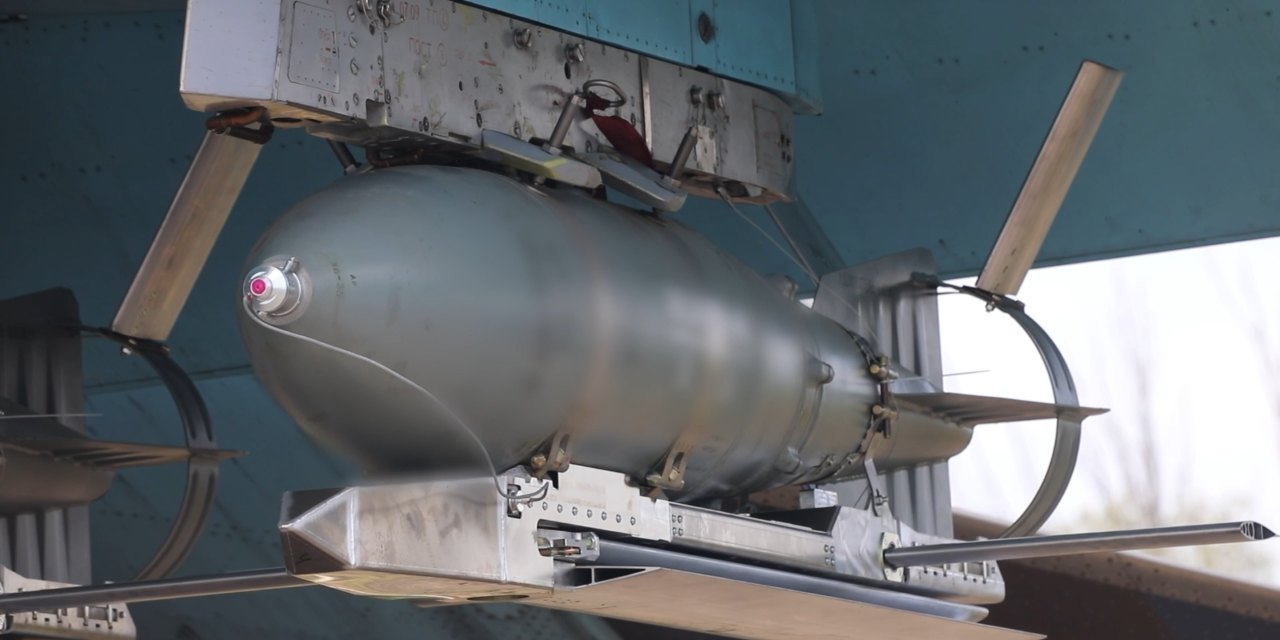
Russia’s most destructive weapon on the front line in Ukraine is not a missile but a Soviet-era iron bomb fitted with a cheap wing kit. The kit, known as the UMPK, lets a Su-34 release a 500 kg or 1,500 kg bomb from tens of kilometres away, beyond the reach of most Ukrainian air defenses, and Russian aircraft dropped a record 8,766 of them in August 2026.
This guide explains how the kit works, which bombs it carries, how far they fly, how many are being used and why they have proved so hard to stop.
What is a UMPK glide bomb?
FAB is the Russian abbreviation for a general-purpose high-explosive aircraft bomb, a family designed for free-fall delivery and stockpiled in enormous numbers since Soviet times. The UMPK, or unified gliding and correction module, is a strap-on kit that turns one into a guided weapon. It adds a pair of folding wings, tail control surfaces, a battery, and a guidance unit that combines inertial navigation with satellite signals received through a Kometa-M jam-resistant antenna.
The idea mirrors the American JDAM-ER, but the Russian kit is cruder and cheaper: Russian military bloggers put the cost at about 2 million rubles, roughly $25,000, and it can be fitted at a front-line airfield. First used in early 2023, the bombs are usually called KABs in Ukrainian reports. Accuracy is modest by Western standards, but a miss of 10–20 metres matters little when the warhead weighs hundreds of kilograms.
FAB-500, FAB-1500, FAB-3000: the bombs and their ranges
The same kit design has been scaled to four sizes of bomb, and to thermobaric ODAB and cluster RBK-500 munitions. The FAB-500 is by far the most common. The FAB-1500 appeared in late 2023 and the three-tonne FAB-3000 in June 2024, both used to collapse multi-storey buildings and deep fortifications. Russia also builds a smaller purpose-designed glide bomb, the UMPB D-30SN.
| Bomb | Weight | Typical use | Range with standard kit |
|---|---|---|---|
| FAB-250 | 250 kg | Field positions, vehicles | 40–70 km |
| FAB-500 | 500 kg | Strongpoints, buildings; most common | 40–70 km |
| FAB-1500 | 1,500 kg | Large buildings, bunkers | 40–70 km |
| FAB-3000 | 3,000 kg | Major fortified sites | 50–60 km |
Range comes from the aircraft as much as from the kit. A Su-34 climbs to about 10–12 km, accelerates and releases the bomb, which then glides to pre-set coordinates. The launch aircraft never needs to cross the front line.
How many glide bombs does Russia use?
Use has risen almost without interruption. Figures from Ukraine’s General Staff, compiled by independent monitors, show 5,717 guided bombs in January 2026, then a record, followed by 8,266 in June, about 8,300 in July and 8,766 in August, an average of some 283 a day.
| Month | Bombs dropped |
|---|---|
| October 2025 | 5,328 |
| January 2026 | 5,717 |
| June 2026 | 8,266 |
| July 2026 | About 8,300 |
| August 2026 | 8,766 |
The bombs are concentrated on whichever sector Russia is attacking. Ukrainian officers reported 860 on the Pokrovsk area alone in a single month of 2025. The method is simple: erase the defended buildings, then send in infantry.
The Su-34 and how the bombs are delivered
The Su-34 strike fighter carries almost all of these weapons, with Su-35S and Su-30SM fighters used occasionally; the fleet is described in our guide to Russia’s fighter jets. Because the aircraft release their bombs from inside Russian-controlled airspace, they are exposed only to the longest-range Ukrainian systems. Ukraine shot down several Su-34s in early 2024 by moving Patriot launchers close to the front, but it cannot risk those launchers often.
The other countermeasures are indirect. Ukraine strikes the airfields from which the bombers fly, and jams satellite navigation to push bombs off target, a contest described in our guide to Russian electronic warfare. Russia has answered with larger Kometa antenna arrays. Reliability is still imperfect: the independent Russian outlet Astra has documented well over a hundred bombs that fell on Russian or Russian-held territory by accident.
Longer-range and jet-powered versions
Since late 2025 Russia has extended the reach of these weapons. The UMPK-PD kit, with longer wings, carries a FAB-500 about 100 km. A jet-powered model, the UMPB-5R, adds a small commercial turbojet of Chinese origin; it was first reported on 18 October 2025 in a strike on Lozova in the Kharkiv region, released from about 130 km away.
Major General Vadym Skibitskyi of Ukraine’s military intelligence said the new weapons had a range of 150–200 km, with one test reaching 193 km, and that serial production would follow in smaller numbers than the standard kit. That puts cities well behind the front, previously reachable only by missiles and by the drones covered in our guide to Russia’s military drones, within range of tactical aircraft.
Why glide bombs matter
The economics are lopsided. A UMPK bomb costs a small fraction of a cruise missile and delivers several times the explosive, while the interceptor needed to stop it costs far more than the bomb. A glide bomb has no engine, a small radar signature and a flight time of only a few minutes, so shooting it down is possible but rarely efficient. Ukrainian commanders consistently say the only real answer is to destroy the aircraft or keep it at a distance.
That is why the long-range air defenses described in our guide to Russian air defense systems matter in reverse: they keep Ukrainian fighters far enough back that the bombers can work. As long as that holds, glide bombs remain the cheapest way for Russia to convert its Soviet stockpiles into firepower.
Frequently asked questions
What is a UMPK?
UMPK stands for unified gliding and correction module. It is a strap-on kit with folding wings and satellite-aided guidance that converts a Soviet-era FAB free-fall bomb into a guided glide bomb. It reportedly costs about $25,000.
How far can Russian glide bombs fly?
The standard kit gives a range of about 40–70 km. The extended UMPK-PD reaches around 100 km, and Ukrainian intelligence says jet-powered versions have reached 150–200 km in tests and combat use.
How many glide bombs does Russia drop on Ukraine?
According to Ukrainian General Staff data, Russia dropped a record 8,766 guided bombs in August 2026, about 283 a day, up from 5,717 in January 2026.
Can glide bombs be shot down?
Yes, but it is difficult and expensive. The bombs are small, fast-falling targets with no engine, and the missiles able to hit them cost far more. Ukraine focuses instead on the launch aircraft, their airfields and jamming.
What is the FAB-3000?
It is a three-tonne high-explosive bomb, the largest used with the UMPK kit. It was first employed in Ukraine in June 2024 and is used against large fortified buildings.
- Kyiv Independent – Russia drops record number of deadly glide bombs on Ukraine: kyivindependent.com
- The Defense Post – Russia’s highest monthly air bomb total, February 2026: thedefensepost.com
- FDD’s Long War Journal – Russia deploys new, longer-range bombs in war against Ukraine: longwarjournal.org
- The Aviationist – Russia’s new jet-powered glide bomb: theaviationist.com
- Al Jazeera – Russia drops record number of glide bombs on Ukraine, August 2026: aljazeera.com