Russia’s Military Drones: Geran, Lancet, Orlan and the FPV Swarm
Russia now builds and launches military drones on a scale few armies imagined before 2022: thousands of Geran strike drones a month, millions of FPV quadcopters a year and a dedicated Unmanned Systems Forces branch to fly them. A country that entered the war short of modern unmanned aircraft has made them its main tool for both long-range strikes on Ukrainian cities and close combat along the front.
This guide sorts the fleet into its main types, explains what each one does and sets out the latest production and attack figures available in October 2026.
The main types of Russian drones
Russian unmanned aircraft fall into four working layers. At the top are long-range one-way attack drones of the Geran family, which fly hundreds of kilometres to hit cities, power stations and factories. Below them are loitering munitions such as the Lancet, which hunt individual vehicles and guns 40–70 km behind the line. A third layer of reconnaissance drones, led by the Orlan-10, finds targets and corrects fire. The fourth and largest is the mass of FPV drones that dominates the last 20 km of the battlefield.
Larger armed drones in the class of the Bayraktar TB2 exist, but play only a small role. The table lists the principal types.
| Type | Class | Maker | Key data |
|---|---|---|---|
| Geran-2 | One-way attack drone | Alabuga plant (Iranian Shahed-136 design) | 50–90 kg warhead, 1,000+ km |
| Lancet | Loitering munition | Zala Aero (Kalashnikov group) | 3–5 kg warhead, 40–70 km |
| Orlan-10 | Reconnaissance | Special Technology Center | About 15 kg, up to 16 hours aloft |
| Orion (Inokhodets) | Armed medium-altitude drone | Kronshtadt | About 1 tonne, up to 200 kg payload |
| Forpost-R | Armed medium-altitude drone | Ural Civil Aviation Plant | About 500 kg, around 18 hours aloft |
| S-70 Okhotnik | Stealth combat drone | Sukhoi | About 20 tonnes, still in testing |
Geran: the long-range strike drone
The Geran-2 is the Russian-built version of Iran’s Shahed-136: a propeller-driven delta wing about 3.5 metres long that cruises at roughly 185 km/h and carries a warhead of 50 kg, or 90 kg in later versions. Production is centred on the Alabuga special economic zone in Tatarstan, with a second line in Izhevsk building the similar Garpiya. Ukraine’s military intelligence agency (HUR) said on 12 August 2026 that Russia held about 6,200 Gerans in stock; earlier Ukrainian estimates put output at around 5,500 a month.
Tactics rely on mass. A typical night brings 150–200 drones, mixed with cheap Gerbera decoys made of foam and plywood to soak up interceptors; the largest raid so far, on 13–14 May 2026, involved 1,560 drones. Jet-powered versions are the newest problem for defenders. Ukrainian researchers counted about 1,400 jet-powered Gerans in the first half of 2026, against 180 in all of 2025. The Geran-5 is reported to carry a 90 kg warhead about 950 km at up to 600 km/h, fast enough to outrun the interceptor drones and truck-mounted machine guns that deal with the Geran-2. These drones fly alongside the weapons described in our guide to Russia’s cruise missiles.
| Type | Engine | Speed | Warhead | Range |
|---|---|---|---|---|
| Geran-1 (Shahed-131) | Piston | Up to 185 km/h | Up to 20 kg | About 900 km |
| Geran-2 (Shahed-136) | Piston | About 185 km/h | 50–90 kg | 1,000+ km |
| Geran-3 | Jet | About 370 km/h or more | Not stated | Up to 1,000 km |
| Geran-4 | Jet | Up to 500 km/h | 50 kg | About 450 km |
| Geran-5 | Jet | Up to 600 km/h | 90 kg | About 950 km |
Lancet and the hunt for artillery
The Lancet, made by Zala Aero, a Kalashnikov group company, is a loitering munition with X-shaped wings, an electric motor and a warhead of 3–5 kg. It is launched from a catapult, flies 40–70 km and is steered onto its target by an operator, usually after a reconnaissance drone has found it. Since 2022 it has been Russia’s main weapon against Ukrainian howitzers, air-defense launchers and armored vehicles behind the front line, and pro-Russian trackers have catalogued several thousand filmed strikes.
The Lancet’s limits are its small warhead, which often damages a target without destroying it, and a price in the tens of thousands of dollars, far above that of an FPV drone. Newer versions add automatic target lock for the final seconds of flight, a response to Ukrainian jamming. The category as a whole is explained in our guide to loitering munitions.
Orlan-10: the eyes of the artillery
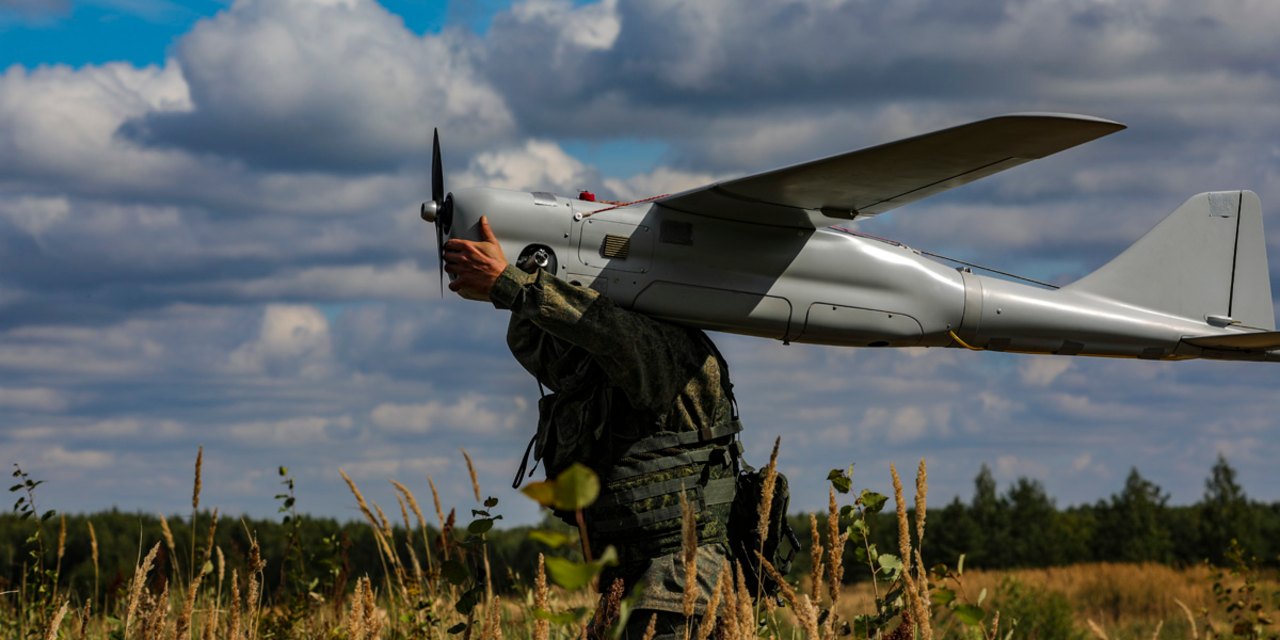
The Orlan-10 is the most numerous Russian reconnaissance drone. Built by the Special Technology Center in St Petersburg, it weighs about 15 kg, is launched from a folding catapult, stays up for as long as 16 hours and works up to about 120 km from its control station. Its job is to find targets and correct fire for the guns and rocket launchers described in our guide to Russian artillery, and it also carries the Leer-3 electronic-warfare payload that jams mobile phone networks. The larger Orlan-30 adds a laser designator for Krasnopol guided shells.
Alongside it fly the Zala 421-16 and the Supercam S350, which do the same job with better cameras. Their constant presence over the battlefield is the reason both sides struggle to concentrate forces unseen, and the reason Ukraine has built interceptor drones specifically to ram them.
FPV drones, fiber optics and Rubikon
The weapon that causes most casualties on the front is the first-person-view (FPV) drone: a racing-style quadcopter with a grenade or shaped charge strapped to it, flown through goggles into its target. Ukraine’s commander-in-chief Oleksandr Syrskyi said in March 2026 that Russian industry was producing more than 19,000 a day, a pace of roughly 7 million a year. Russia also fields the Molniya, a cheap fixed-wing FPV drone that carries a heavier charge further.
Russia’s most important innovation here is the fiber-optic FPV drone, which trails a spool of cable instead of using a radio link and so cannot be jammed. First used at scale in the Kursk region in 2024–25, such drones now reach 20 km or more and have made supply roads behind the front as dangerous as the trenches. The Rubikon center, set up in 2024, combines these tools in specialist units that hunt Ukrainian drone crews and logistics. Radio-controlled drones remain exposed to the techniques explained in our guide to GPS jamming and spoofing.
Unmanned Systems Forces and what Russia still lacks
Russia formalized all of this on 12 November 2025, when it announced the creation of the Unmanned Systems Forces as a separate branch. According to Syrskyi, Moscow planned to bring the branch to 101,000 personnel by April 2026. Drone units now exist at every level from platoon to military district, as outlined in our guide to the size of Russia’s army.
The weak spot is at the top end. The Orion and Forpost-R are medium-altitude armed drones in the class of the Bayraktar TB2, but dense air defenses keep them away from the front. The S-70 Okhotnik stealth combat drone remains in testing; one was shot down by its own Su-57 escort over Ukraine in October 2024 after control was lost. Russian drones of every size also depend on imported engines, cameras and chips, most of them from China, which makes the supply chain as much a target of sanctions as the factories themselves.
Frequently asked questions
What drones does Russia use in Ukraine?
The main types are the Geran family of long-range attack drones, the Lancet loitering munition, Orlan-10, Zala and Supercam reconnaissance drones, and very large numbers of FPV quadcopters, including fiber-optic versions that cannot be jammed.
What is the Geran-2?
It is the Russian-built version of Iran’s Shahed-136 one-way attack drone. It flies at about 185 km/h, carries a 50–90 kg warhead more than 1,000 km and is produced mainly at the Alabuga plant in Tatarstan.
How many drones does Russia produce?
Ukrainian intelligence has estimated Geran output at around 5,500 a month and a stockpile of 6,200 in August 2026. Ukraine’s commander-in-chief put Russian FPV production at more than 19,000 a day in March 2026. Russia does not publish figures.
What is a fiber-optic FPV drone?
It is an FPV drone controlled through a thin optical cable that unspools behind it in flight. Because there is no radio link, electronic jamming does not work against it. Range is limited by the length of the cable, now 20 km or more.
Does Russia have a drone like the Bayraktar TB2 or MQ-9 Reaper?
The closest equivalents are the Orion and the Forpost-R, both armed medium-altitude drones. They are much smaller than the MQ-9 and are rarely used near the front because of Ukrainian air defenses.
- Kyiv Independent – Ukraine’s HUR reveals size of Russia’s Geran attack drone stockpile, August 2026: kyivindependent.com
- Defence Blog – Ukraine faces 8x more jet-powered Russian drones than last year: defence-blog.com
- Institute for Science and International Security – Analysis of Russian Shahed-type UAV deployment against Ukraine, May 2026: isis-online.org
- Euromaidan Press – Russia aims for 101,000 drone troops by April, March 2026: euromaidanpress.com
- Inside Unmanned Systems – What Russia’s Rubicon drone units reveal about the future of massed effects: insideunmannedsystems.com