Russia’s Strategic Bombers: Tu-160, Tu-95MS and Tu-22M3
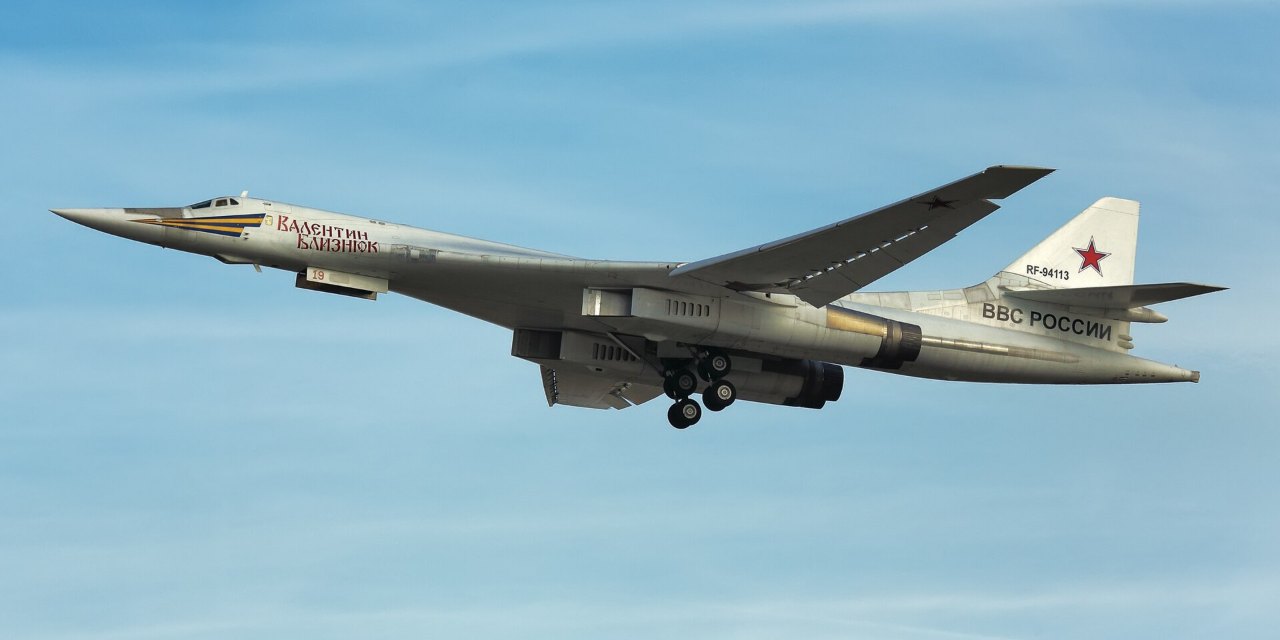
Russia’s bomber force rests on three Soviet-designed aircraft: the supersonic Tu-160, the propeller-driven Tu-95MS and the shorter-range Tu-22M3. The Federation of American Scientists counts about 60 of the first two in the active inventory, the only Russian aircraft able to deliver nuclear cruise missiles at intercontinental range.
In Ukraine these bombers do a conventional job, launching cruise missiles from deep inside Russia. They have also become targets. This guide explains each aircraft, what it carries and how Ukrainian drones changed the way the fleet operates.
What strategic bombers does Russia have?
The bombers belong to Long-Range Aviation, a command of the Aerospace Forces. Its main bases are Engels in the Saratov region, Ukrainka in the Far East and Belaya in Siberia, with forward airfields in the Arctic.
| Aircraft | NATO name | Type | Top speed | Range without refueling | In service |
|---|---|---|---|---|---|
| Tu-160 / Tu-160M | Blackjack | Supersonic strategic bomber | Mach 2 | About 12,000 km | About 17 |
| Tu-95MS | Bear-H | Turboprop strategic bomber | About 830 km/h | About 10,500 km | About 40 |
| Tu-22M3 | Backfire-C | Supersonic long-range bomber | Mach 1.9 | About 7,000 km | About 50 |
Only the Tu-160 and Tu-95MS were counted as strategic bombers under the New START treaty, which expired in February 2026. Their nuclear role is covered in how many nuclear weapons Russia has.
Tu-160, the largest combat aircraft ever built
The Tu-160 is a swing-wing supersonic bomber that first flew in 1981. With a maximum takeoff weight of about 275 tonnes it is the heaviest combat aircraft in the world, and its four engines are the most powerful ever fitted to one. Russian crews call it the White Swan.
It carries up to 12 cruise missiles on two rotary launchers inside the fuselage: the Kh-101 with a conventional warhead or the Kh-102 with a nuclear one. Russia restarted production at Kazan in the late 2010s. The modernized Tu-160M has new engines and avionics, and the first newly built aircraft flew in January 2022. Deliveries have been slow, a few aircraft at a time.
Tu-95MS, the turboprop that keeps flying
The Tu-95 first flew in 1952 and is the only propeller-driven strategic bomber still in service anywhere. The current aircraft are not that old: the Tu-95MS airframes were built in the 1980s to carry cruise missiles. Four turboprop engines turning contra-rotating propellers give it great range and a distinctive noise that submarine crews can reportedly hear underwater.
Upgraded aircraft carry eight Kh-101 missiles on pylons under the wings. Because the missiles fly more than 2,500 km, the bomber never has to approach defended airspace, which is why a 1950s design is still useful. The missiles are described in Russia’s cruise missiles.
Tu-22M3, the Backfire
The Tu-22M3 is a smaller supersonic bomber designed to attack American aircraft carrier groups with heavy anti-ship missiles. It has no intercontinental role. In Ukraine it launches Kh-22 and Kh-32 missiles, which are fast and inaccurate against land targets, and it was used to drop unguided bombs on Mariupol in 2022.
It has been the most exposed of the three. One was destroyed by a drone at Soltsy air base in August 2023, and another crashed in the Stavropol region in April 2024 after what Ukraine said was a long-range missile hit and Russia called a technical failure.
What was Operation Spiderweb?
On 1 June 2025 Ukraine’s security service attacked four Russian air bases with small first-person-view drones launched from trucks that had been driven close to the airfields. The targets included Belaya in Siberia and Olenya near Murmansk, thousands of kilometers from Ukraine.
Ukraine said it hit 41 aircraft. Analysts working from satellite images confirmed at least a dozen bombers destroyed, mostly Tu-95MS and Tu-22M3. Neither type is in production, so the losses are permanent. Since then Russia has dispersed its bombers to remote airfields in the Far East and Arctic, built shelters and flown longer missions to reach launch points.
What comes next for Russia’s bombers?
The only new airframes are Tu-160Ms from Kazan. A contract signed in 2018 covers ten aircraft, and the rate of delivery suggests it will take well into the 2030s to rebuild the fleet. Existing Tu-160s and Tu-95MS are being upgraded in parallel.
A stealth flying-wing bomber known as PAK DA has been in development for more than a decade. No prototype has been shown, and its first flight has been postponed repeatedly. For the rest of Russia’s combat aircraft, see what fighter jets Russia has.
Frequently asked questions
How many strategic bombers does Russia have?
About 60 nuclear-capable Tu-160 and Tu-95MS bombers in the active inventory, according to the Federation of American Scientists, plus about 50 Tu-22M3.
What is Russia’s biggest bomber?
The Tu-160, the largest and heaviest combat aircraft ever built.
Can Russian bombers reach the United States?
Yes. The Tu-160 and Tu-95MS have intercontinental range, and their cruise missiles add more than 2,500 km.
Why does Russia still use the Tu-95?
Because it launches long-range cruise missiles from a safe distance. It does not need speed or stealth for that role.
Does Russia have a stealth bomber?
No. The PAK DA stealth bomber is in development and has not flown.
- Bulletin of the Atomic Scientists – Russian nuclear weapons, 2026: thebulletin.org
- Wikipedia – Tupolev Tu-160: en.wikipedia.org
- Wikipedia – Tupolev Tu-95: en.wikipedia.org
- Wikipedia – Operation Spider’s Web: en.wikipedia.org
- Wikipedia – List of active Russian military aircraft: en.wikipedia.org