Russia’s Hypersonic Missiles: Kinzhal, Zircon, Avangard, Oreshnik
Russia fields four weapons it calls hypersonic: the air-launched Kinzhal, the ship-launched Zircon, the nuclear Avangard glide vehicle and the Oreshnik intermediate-range missile. Three of them have been fired at Ukraine, which makes Russia the first country to use hypersonic weapons in war.
The label covers very different machines. Two are ballistic missiles that reach hypersonic speed the way all such missiles do. Two are the newer kind that can maneuver inside the atmosphere. This guide explains each one, what Russia claims for it and what the combat record shows.
What hypersonic missiles does Russia have?
Hypersonic means faster than Mach 5, five times the speed of sound. Speed alone is not new: long-range ballistic missiles have exceeded it since the 1950s. What defines the modern category is sustained hypersonic flight inside the atmosphere combined with maneuver, which makes the weapon hard to track and intercept. The physics is set out in how hypersonic missiles work.
| System | Type | Claimed speed | Claimed range | Launched from |
|---|---|---|---|---|
| Kinzhal (Kh-47M2) | Air-launched ballistic missile | Mach 10 | 2,000 km | MiG-31K |
| Zircon (3M22) | Scramjet cruise missile | Mach 8 to 9 | 1,000 km | Frigates, submarines, coastal launchers |
| Avangard | Boost-glide vehicle, nuclear | Above Mach 20 | Intercontinental | UR-100N ballistic missile |
| Oreshnik | Intermediate-range ballistic missile | Above Mach 10 | About 5,000 km | Road-mobile launcher |
By the stricter definition only the Zircon and the Avangard are hypersonic weapons in the new sense. The Kinzhal and Oreshnik are ballistic missiles with some ability to maneuver. All four are part of the wider arsenal described in what missiles Russia has.
Kinzhal, the air-launched Iskander
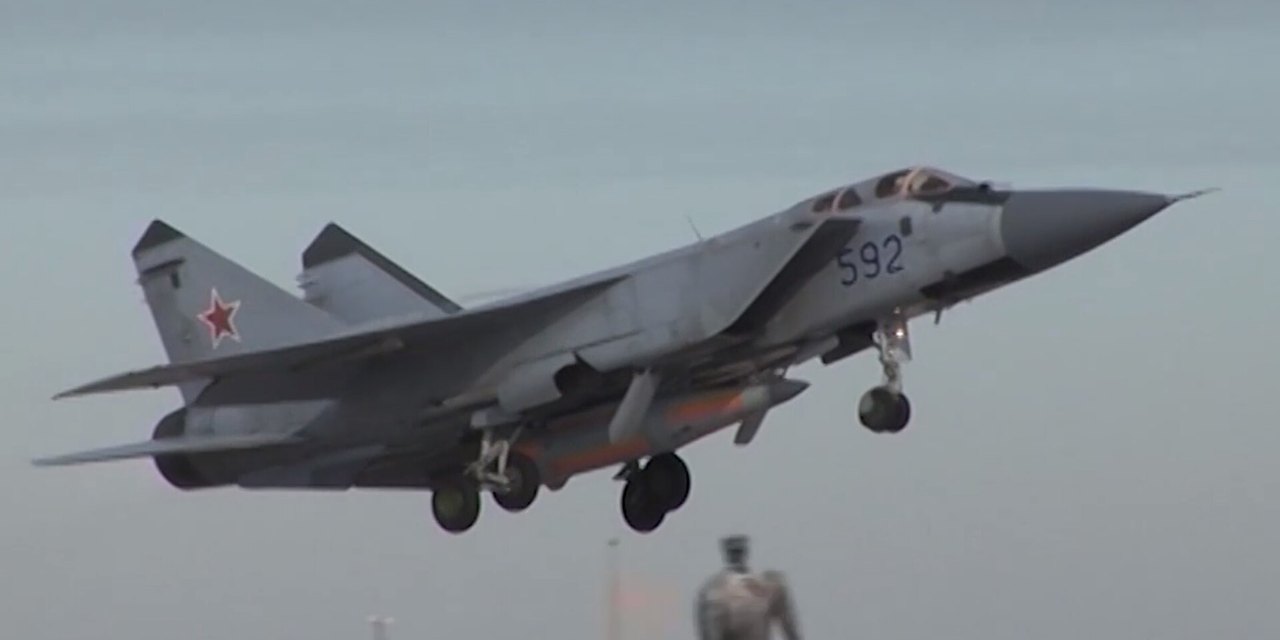
The Kinzhal, meaning dagger, is an adapted version of the Iskander-M ground-launched missile. A MiG-31K carries it to high altitude and supersonic speed before release, which adds range and energy. Russia claims a top speed of Mach 10 and a reach of 2,000 km including the aircraft’s flight. It entered service in 2017 and was first used in Ukraine in March 2022.
Its reputation for invulnerability ended in May 2023, when a Ukrainian Patriot battery shot one down over Kyiv, an interception later confirmed by the Pentagon. Ukrainian military intelligence estimated in mid-2026 that Russia held about 50 Kinzhals and was building about five a month. The full profile is in our Kinzhal guide.
Zircon, the scramjet cruise missile
The Zircon is the most technically ambitious of the four. A rocket booster accelerates it until an air-breathing scramjet engine can take over, and it then cruises at a claimed Mach 8 to 9 at high altitude. It was designed to sink ships and is carried by Admiral Gorshkov-class frigates and Yasen-M submarines in the same launch cells as the Kalibr.
Since early 2024 Russia has fired Zircons at land targets in Ukraine, apparently from coastal launchers in Crimea. Ukraine says it has intercepted some. Stocks were put at about 120 in mid-2026, with output of about three a month. See our Zircon guide for details.
Avangard, the nuclear glide vehicle
The Avangard is a strategic weapon and has never been used. An old UR-100N intercontinental missile lifts the glide vehicle to the edge of space. It then skims back through the upper atmosphere at more than 20 times the speed of sound, changing course to avoid missile defenses, before striking with a nuclear warhead.
Russia declared the first regiment operational in December 2019 at Dombarovsky in the Orenburg region. The Federation of American Scientists counts two regiments. The Avangard is intended to move to the Sarmat missile once that enters service. Its place in the strategic forces is covered in how many nuclear weapons Russia has.
Oreshnik, the newest and most publicized
The Oreshnik is an intermediate-range ballistic missile derived from the RS-26 Rubezh. It carries six warheads, each releasing several submunitions, which arrive at more than Mach 10. Russia first fired it at an industrial site in Dnipro in November 2024, struck an aircraft repair plant in the Lviv region in January 2026 and launched two more in May 2026.
Russia calls it hypersonic, which is accurate for the speed of its warheads and true of every missile of that range. Western and Ukrainian analysts see it mainly as a signal: a weapon that can reach any European capital in minutes and that was placed on combat duty in Belarus in December 2025.
Can Russia’s hypersonic missiles be stopped?
Some can. Patriot batteries firing PAC-3 interceptors have destroyed Kinzhals repeatedly since 2023, though success depends on the battery being close to the target and having enough missiles. Ukraine also claims Zircon interceptions, which are harder to verify.
Oreshnik is a different problem. Its warheads separate outside the atmosphere, and Ukraine has no system built to engage targets there. Interceptors of that kind exist, including the American SM-3 and THAAD and the Israeli Arrow 3, but they are few and expensive. The Avangard has never been tested against a real defense.
Frequently asked questions
How many hypersonic missiles does Russia have?
Ukrainian military intelligence estimated about 50 Kinzhals and 120 Zircons in mid-2026. Avangard and Oreshnik numbers are not public but are small.
What is Russia’s fastest hypersonic missile?
The Avangard glide vehicle, for which Russia claims speeds above Mach 20.
Has Ukraine shot down a hypersonic missile?
Yes. A Patriot battery shot down a Kinzhal in May 2023, and more have been intercepted since.
Is the Oreshnik a hypersonic missile?
Its warheads travel at hypersonic speed, but it is a ballistic missile, not a maneuvering glide or cruise weapon.
Does the United States have hypersonic missiles?
The US Army began fielding its Dark Eagle long-range hypersonic weapon in 2025. Russia and China deployed comparable systems earlier.
- CSIS Missile Threat – Missiles of Russia: missilethreat.csis.org
- Bulletin of the Atomic Scientists – Russian nuclear weapons, 2026: thebulletin.org
- The New Voice of Ukraine – Ukrainian intelligence data on Russian missile output (July 2026): english.nv.ua
- Wikipedia – Oreshnik (missile): en.wikipedia.org
- Wikipedia – Avangard (hypersonic glide vehicle): en.wikipedia.org