
What Fighter Jets Does Russia Have? Every Type and Numbers
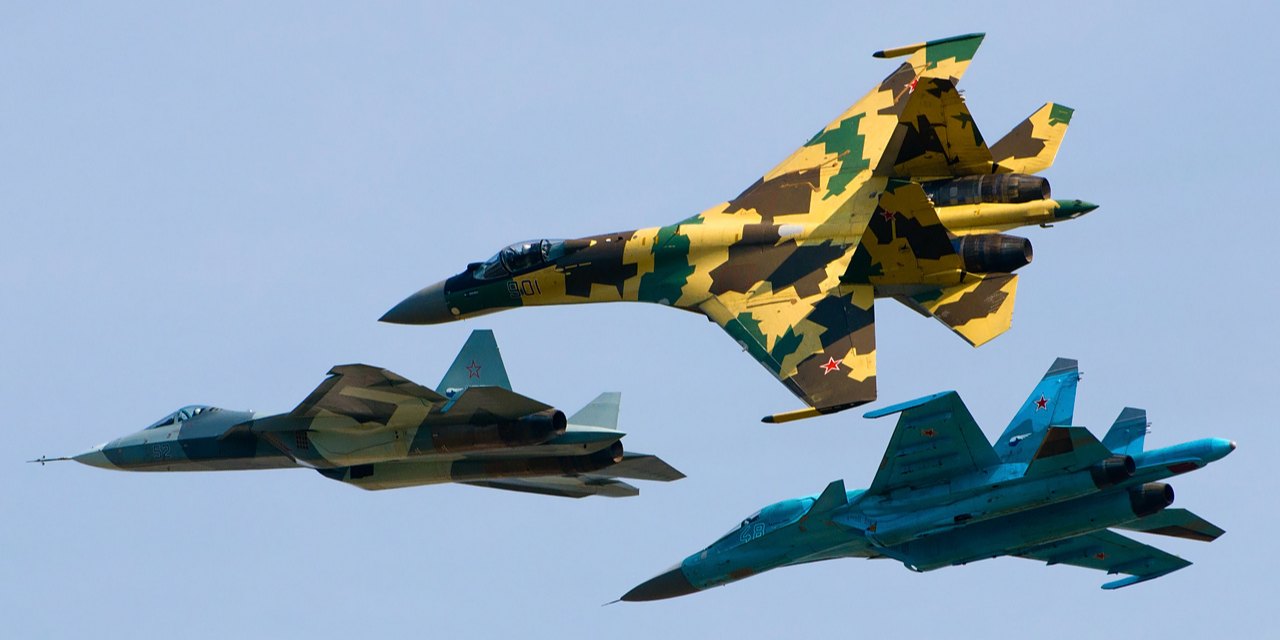
Russia flies about 1,200 combat aircraft, and most of its fighter jets come from one family: the Sukhoi Flanker and its descendants, the Su-27, Su-30, Su-34 and Su-35. Alongside them are the MiG-31 interceptor, a small but growing number of Su-57 stealth fighters and aging MiG-29, Su-24 and Su-25 jets.
This guide lists every fighter and strike jet in Russian service in 2026, what each one does, roughly how many there are and how the fleet has held up after more than four years of war.
What fighter jets does Russia have?
The Russian Aerospace Forces and Naval Aviation together operate about 1,200 combat aircraft, according to figures from the IISS Military Balance 2026. That is about half the US total and well below China’s, but it is still by far the largest air arm in Europe.
The fleet is a mix of new-build aircraft delivered since 2010 and modernized Soviet airframes. The table shows the main types. For how the best of them rank globally, see our list of the top 10 fighter jets.
| Aircraft | NATO name | Role | In service |
|---|---|---|---|
| Su-57 | Felon | Stealth multirole fighter | About 30 |
| Su-35S | Flanker-E | Air superiority fighter | About 120 |
| Su-30SM / SM2 | Flanker-H | Two-seat multirole fighter | About 110, plus naval aircraft |
| Su-34 | Fullback | Strike fighter | About 140 to 160 |
| Su-27 family | Flanker | Air defense fighter | About 100 |
| MiG-31BM / MiG-31K | Foxhound | Interceptor and Kinzhal carrier | About 120 to 130 |
| MiG-29 family | Fulcrum | Light fighter | Fewer than 100 active |
| Su-25SM / SM3 | Frogfoot | Ground attack | About 160 to 175 |
| Su-24M | Fencer | Strike bomber | About 120, being retired |
Su-57 Felon, Russia’s stealth fighter
The Su-57, which NATO calls Felon, is Russia’s only fifth-generation fighter. It combines a reduced radar signature with internal weapon bays and thrust-vectoring engines. A 2019 contract covers 76 aircraft for delivery by 2028, and open sources counted about 30 in service by 2025.
Russia uses the Su-57 cautiously, mostly to launch long-range missiles from inside its own airspace. Algeria became the first export customer and received its first two aircraft in late 2025. A two-seat version, the Su-57D, made its first flight in May 2026, and a new engine began flight tests in December 2025. Our F-35 vs Su-57 comparison looks at how it measures up.
Su-35S and Su-30SM, the Flanker fleet
The Su-35S is the most capable Russian fighter available in numbers. It is a single-seat, twin-engine air superiority aircraft with thrust vectoring, the powerful Irbis-E radar and the R-37M missile, which Russia credits with a range of up to 300 km. Over Ukraine it flies combat air patrols that force Ukrainian jets to stay low.
The two-seat Su-30SM does similar work for the air force and the navy. The upgraded Su-30SM2 takes the engine and radar of the Su-35S, which simplifies maintenance across the Flanker fleet.
Su-34, the strike fighter doing most of the bombing
The Su-34 is a two-seat strike aircraft with a side-by-side cockpit, and it is the busiest jet in the Russian fleet. It is the main carrier of the UMPK glide bombs that Russia drops on Ukrainian front-line positions and cities, at a rate that reached a reported 8,766 in August 2026.
Releasing bombs 40 km or more from the target keeps the Su-34 outside the reach of most air defenses. Even so, it has suffered the heaviest losses of any Russian fast jet.
MiG-31, MiG-29 and Su-25
The MiG-31 is a large interceptor built to defend Russia’s northern approaches at speeds of up to Mach 2.8. The MiG-31BM carries long-range air-to-air missiles, and the MiG-31K variant carries the Kinzhal ballistic missile. The rest of the missile inventory is covered in what missiles Russia has.
Older types are thinning out. The MiG-29 has largely left front-line service, the Su-24 bomber is being replaced by the Su-34, and the Su-25 attack jet, used for low-level rocket attacks, has taken steady losses. No replacement for the Su-25 is in production.
How many fighter jets has Russia lost?
Oryx, which counts only losses confirmed by photo or video, has documented well over 150 Russian fixed-wing aircraft destroyed or damaged since February 2022. The Su-34 and Su-25 account for the largest shares. Ukrainian drone strikes on air bases have added to the total, including the June 2025 operation that hit strategic bombers deep inside Russia.
For fighters, production has roughly kept pace. Open-source tallies of announced deliveries suggest Russia has received two to three dozen new combat aircraft a year since 2022, mostly Su-34, Su-35S and Su-57. Trained aircrew are harder to replace than airframes, and the remaining flying hours on older jets are being used up quickly.
Frequently asked questions
How many fighter jets does Russia have?
About 1,200 combat aircraft of all types, according to the IISS Military Balance 2026. Around 400 are modern Su-57, Su-35S, Su-30SM and Su-34 jets.
What is Russia’s best fighter jet?
The Su-57 is the most advanced. The Su-35S is the most capable fighter Russia has in large numbers.
Does Russia have a fifth-generation fighter?
Yes, the Su-57 Felon. About 30 were in service by 2025, and 76 are on order.
What is Russia’s fastest fighter?
The MiG-31, with a top speed of about Mach 2.8.
Which Russian jet drops glide bombs?
Mainly the Su-34. The Su-35S and Su-30SM are also used.
- IISS – The Military Balance 2026: iiss.org
- Wikipedia – List of active Russian military aircraft: en.wikipedia.org
- Wikipedia – Sukhoi Su-57: en.wikipedia.org
- Oryx – Documenting Russian equipment losses during the invasion of Ukraine: oryxspioenkop.com
- MiGFlug – UMPK glide bombs, August 2026 figures from the Ukrainian General Staff: migflug.com