
The Hidden Arms Race of Satellite Warfare



 React
React
While invisible to the naked eye, the satellites orbiting our planet are the silent backbone of modern civilization. From ATM transactions to global television broadcasts, daily life is tethered to space. However, as highlighted in a recent trend analysis by STM ThinkTech, the stars have become a strategic battlefield. Satellites are no longer just tools for communication; they are the primary eyes, ears, and guidance systems of the world’s most powerful militaries.
The Architecture of Space Power
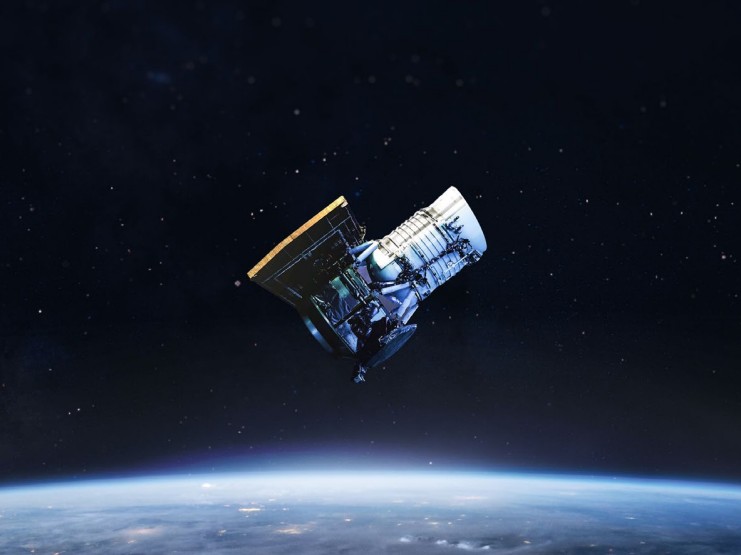
The militarization of space began as a quest for intelligence but has evolved into a race for kinetic and electronic dominance. According to data from UNOOSA and the Union of Concerned Scientists, the number of objects in orbit continues to climb, with nearly 400 active military satellites currently in operation.
The United States: Leading the field with approximately 159 military satellites, including the advanced Wideband Global SATCOM (WGS) and the doomsday-hardened Advanced Extremely High Frequency (AEHF) systems.
Russia: Operating 74 military satellites, Moscow has recently drawn international concern with “stalker” satellites that perform suspicious proximity maneuvers and impact tests.
China: With 68 military satellites, Beijing shocked the world in 2007 by successfully destroying its own weather satellite with a missile, signaling the start of a new era in anti-satellite (ASAT) capabilities.
Weapons of the High Ground: From Lasers to Robotic Claws
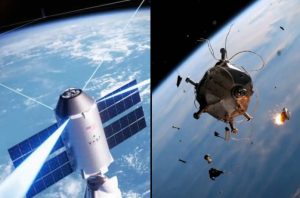
The weaponry being developed for satellite warfare ranges from the primitive to the futuristic. Reports indicate that China has deployed satellites equipped with robotic arms capable of snatching or dismantling adversary satellites in mid-orbit. Simultaneously, both Russia and China are advancing directed-energy weapons (lasers) designed to “blind” the sensitive optical sensors of spy satellites, rendering them useless without physical destruction.
The U.S. response involves massive investment, reaching nearly $22 billion annually for space defense. This includes the classified X-37B autonomous space plane, which experts believe serves as a versatile platform for orbital surveillance and experimental weaponry. Additionally, DARPA’s Phoenix Project aims to develop robotic systems to repair—or potentially sabotage—orbital assets.
The Kessler Syndrome: The Doomsday Scenario
The greatest risk of satellite warfare is not just the loss of communication, but the potential for a permanent orbital blockade known as the Kessler Syndrome. When a satellite is destroyed in a kinetic strike—as demonstrated by China’s 2007 test—it creates thousands of fragments traveling at 25,000 kilometers per hour.
Each fragment becomes a projectile that can trigger a chain reaction of collisions, creating a cloud of debris that could render Earth’s orbit inaccessible for decades. The International Space Station already performs frequent maneuvers to dodge such “space junk,” but a full-scale orbital war could lock humanity out of space forever.
Conclusion
Satellite warfare is no longer a science fiction scenario; it is a permanent reality of 21st-century defense. As the “Big Three” continue to arm the high ground, the stability of our global communication and defense infrastructure depends on maintaining the delicate balance of power in the silence of the void.
React