John Cockerill Defense, the Belgian Turret Specialist Explained
John Cockerill Defense is the turret-and-weapon-systems arm of a Belgian industrial group founded in 1817, and its 105 mm and 120 mm gun turrets put heavy firepower on vehicles of 20 tonnes or less. The business is small beside the group’s steel, energy and rail activities, but it has become one of Europe’s more visible niche suppliers as armies look for affordable ways to upgrade wheeled and light tracked fleets.
What is John Cockerill Defense
The Cockerill name goes back to William Cockerill, an English mechanic who moved to the Low Countries, and to his son John, who founded an ironworks and machine-building complex at Seraing near Liège in 1817. The site grew into one of continental Europe’s first integrated steel and engineering enterprises. The modern group, headquartered in Seraing, still makes industrial equipment, energy and hydrogen technology, rail products and services.
The defense business grew out of Cockerill Maintenance and Ingénierie, which became known as CMI Defence before adopting the group name. Its specialty is the turret and the gun system, not the hull. That model lets the company sell the same weapon station to many vehicle builders, which is why its products appear on platforms from several countries.
| Item | Detail |
|---|---|
| Parent group | John Cockerill, headquartered in Seraing, Belgium |
| Defense focus | Turrets, medium and large caliber guns, remote weapon stations and combat vehicle systems |
| Founding of group | 1817, by John Cockerill |
| Core offer | Weapon systems integrated on third-party hulls such as 8×8 and tracked vehicles |
| Related work | Training, maintenance and upgrade of combat vehicles, plus naval and ammunition-related activity |
Who owns John Cockerill Defense
John Cockerill is a privately held Belgian group. Chairman and chief executive François Michel has led it since the early 2000s and is widely reported to be its controlling shareholder. There is no stock listing, which means detailed financial disclosure is limited compared with publicly traded rivals such as KNDS.
Private ownership has allowed the group to make bets that listed companies often avoid. The defense arm, for example, pushed a 105 mm turret concept at a time when many analysts considered the big-gun light vehicle a dead end. It has also expanded by acquisition; the group’s purchase of French vehicle maker Arquus from Volvo, reported in recent years, gave it a hull builder to pair with its turrets.
John Cockerill Defense products
| Product | Armament | Typical role |
|---|---|---|
| Cockerill 3105 | 105 mm high-pressure gun | Fire support on 8×8 and tracked hulls |
| CT-CV 105HP | 105 mm cannon with low recoil force | Lightweight vehicles, marketed for hulls from roughly 15 tonnes |
| XC-8 | 120 mm gun, low-profile turret | Heavier mobile protected firepower |
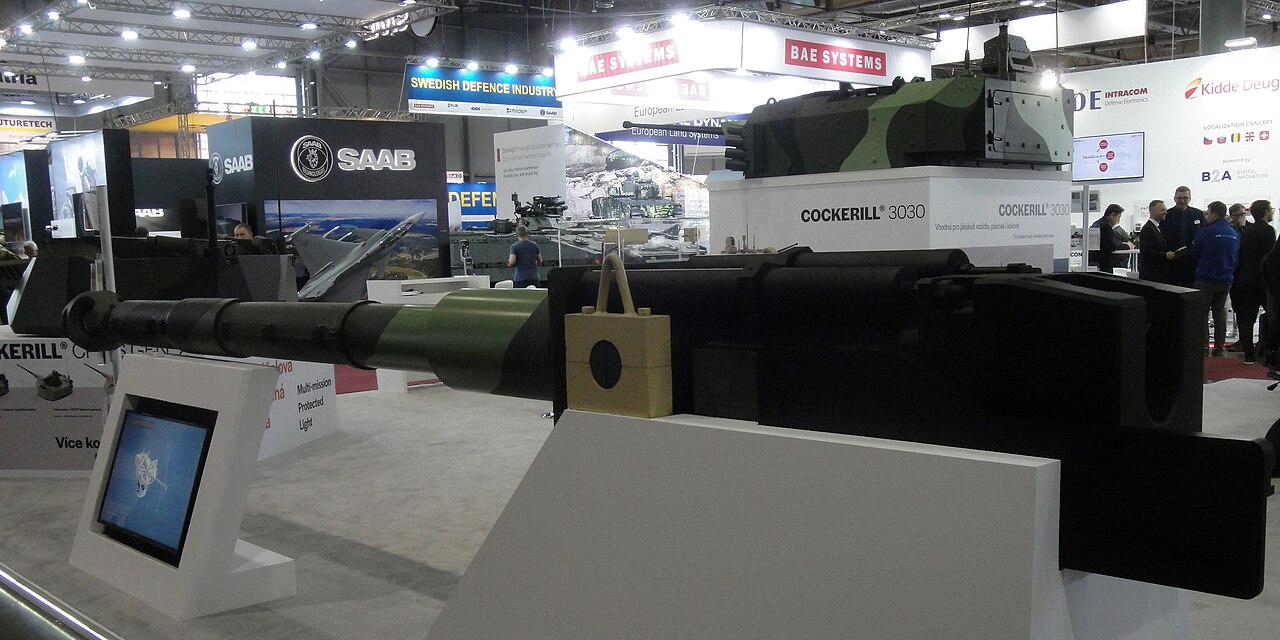
| Cockerill 3030 | 30 mm cannon | Infantry fighting vehicles and armored carriers |
| CPWS | Remote weapon station, 7.62 to 30 mm options | Self-defense and support on many platforms |
The 105 HP gun is the signature product. Its pitch is to deliver tank-gun effects without the weight of a tank, using a muzzle brake and recoil system designed to fit on wheeled vehicles. That approach is often marketed as mobile protected firepower, the same niche that the US Army’s cancelled M10 Booker once targeted with a much heavier package.
Where is the Cockerill turret used
The company sells to many small and mid-sized forces. Its turrets are offered on Piranha, Stryker-class, ASCOD and other families, and several NATO and partner countries have bought 30 mm or 90 mm weapons for upgrade programs. Customers have included European, Middle Eastern, Asian and Latin American armies, though not every program has reached full series production. Independent confirmation of exact fleet numbers is scarce, and readers should treat unit counts quoted in marketing with caution.
A second pillar is upgrades. Many armies hold older tracked and wheeled vehicles with obsolete guns; replacing a turret can be cheaper than buying a new vehicle. Rivals include FN Herstal on the remote-weapon side, and Patria-type integrators who bring complete vehicles.
John Cockerill Defense revenue and outlook
The group has reported annual revenue in the region of two billion euros in recent years, with defense making up a minority of that total. Growth has come from European rearmament since 2022, and from the Arquus acquisition that widened the product range from turrets to complete vehicles and logistic trucks. Management has also said it wants to build more production capacity in Belgium and abroad.
The main risks are concentration and competition. Niche turret makers depend on a limited number of big prime-vehicle programs, and larger groups like KNDS, Rheinmetall and Hanwha are also moving into lighter firepower. Success will depend on winning series contracts rather than demonstrator orders.
John Cockerill Defense frequently asked questions
What does John Cockerill Defense make?
Mainly gun turrets, medium and large caliber cannons, remote weapon stations and integrated combat vehicle systems, plus upgrade and support services.
Who owns John Cockerill?
It is a private Belgian group led by chairman and CEO François Michel, who is reported to be the controlling shareholder.
Where is John Cockerill based?
The group is headquartered in Seraing near Liège, Belgium, with operations in several other countries.
What is the Cockerill 3105 turret?
A turret built around a 105 mm gun, intended to give 8×8 and tracked vehicles main-battle-tank-class firepower at lower weight.
Did John Cockerill buy Arquus?
Yes, the group acquired the French vehicle maker Arquus from Volvo Group, according to reports, combining turrets and hulls.
- John Cockerill Group and Cockerill Defense public company information
- Manufacturer product literature for the 105 HP, XC-8 and 3030 turrets
- Wikipedia – John Cockerill (company) (accessed October 2026)
- Defence & Tech reporting